OUTSIDE York Minster on a sunny Monday morning in March, visitors from around the UK and as far away as the United States mill around, gazing up at the windows and stonework. They look blank, and often apologetic, at the mention of William of York. “I know the name,” says a day-tripping Leeds resident, “but I’ve never met him.” “Is he from the olden days?” asks a man from north Wales. “Was he a king?” says a woman from Stoke-on-Trent. Even residents of the city struggle to identify their patron saint: “I used to sing in the choir here,” one says, “but I’ve never heard of him.”
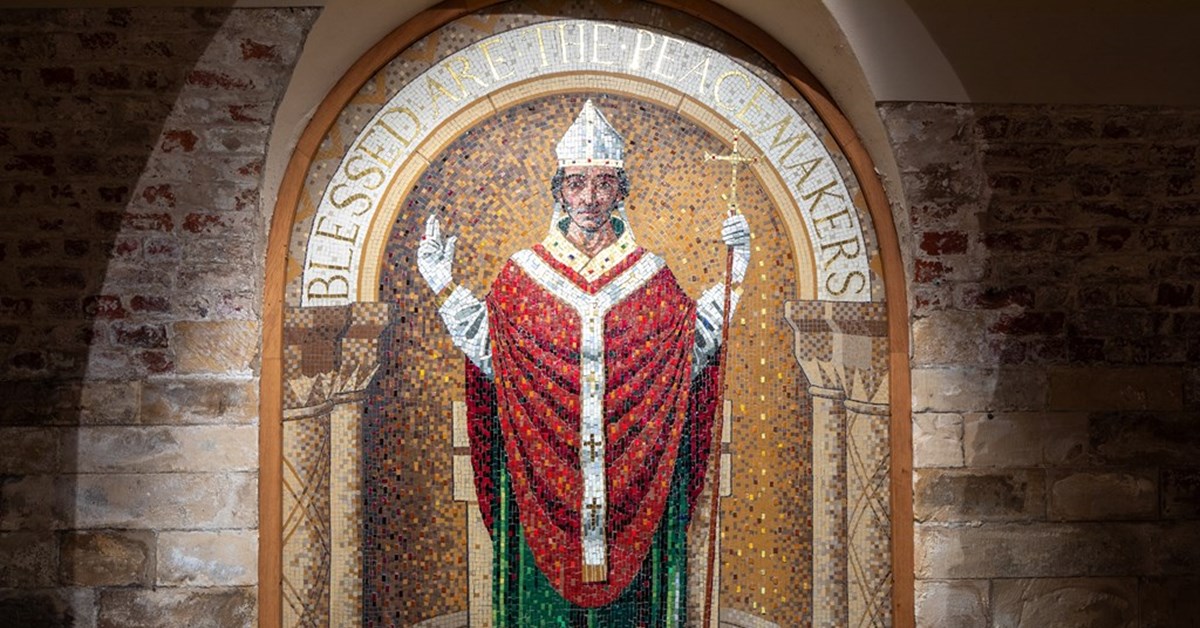
The staff team at the Minster are hoping to change perceptions of William of York, described as “York’s forgotten saint” on the Minster website. On the 800th anniversary of his canonisation, a new exhibition (News, 4 February 2026) invites visitors to learn more about the man and his times. Included in the price of visitor entry, it brings together artefacts for the first time since they were scattered during the Reformation. A short film tells William’s story, and includes a digital recreation of his shrine.
Dr Jennie England, research co-ordinator at the Minster, says that William “isn’t widely known, but he was so important to the city and so important in shaping the Minster that we see today”. The Minster was, “in many ways, built around the people who came to see his shrines, and we live with the echoes of St William”.
Although none of his own writings survive, William is believed to have been much loved in his lifetime, and the subject of enthusiastic local devotion. A long-serving Treasurer of York, William, whose surname was fitzHerbert — he was the son of a wealthy landowner and a cousin of the king — was twice made Archbishop of York, for the first time in 1141.
It was a contentious appointment at a time of church reform against the backdrop of civil war. He was deposed and reinstated, finally returning in triumph from Italy to York in May 1154. Three weeks later, he was dead. A persistent legend points to a poisoned communion chalice at the request of Osbert of Bayeux, the Archdeacon of York.
There were “immediate rumours that he’d been poisoned”, Dr England says. “But it’s important to say nothing was proved at the time, nothing was proved in the 12th century. So it’s a mystery that continues after St William’s lifetime, all the way back to us.”
The first miracle that William is associated with was said to have occurred during his triumphant return to York after being made Archbishop for the second time. A bridge bearing crowds rushing to welcome him collapsed, plunging them into the river below. William prayed and made the sign of the cross over them, and no lives were lost.
Despite his untimely end, his death coincided with a broader peace, Dr England says. “The civil war that had raged since 1139 finished in 1154; so elements of that broader political spectrum changed.” His resting place in the Minster became a destination for pilgrims who travelled for miles to pray at his shrine.
A 95-PANE window, more than 21 metres high, was finished in about 1414, and is sited opposite the entrance to the crypt where William’s tomb lies. It recounts his life story in stained glass. Among the incidents depicted are post-mortem miracles attributed to his intercession, including a falling stone that was diverted by God’s hand from the head of “Roger of Ripon” (the engraved “miracle” stone also features in the exhibition) and a woman suffering indigestion from having eaten a frog baked into a loaf of bread, who vomited it up after visiting William’s shrine. Nothing was too obscure for his intervention.
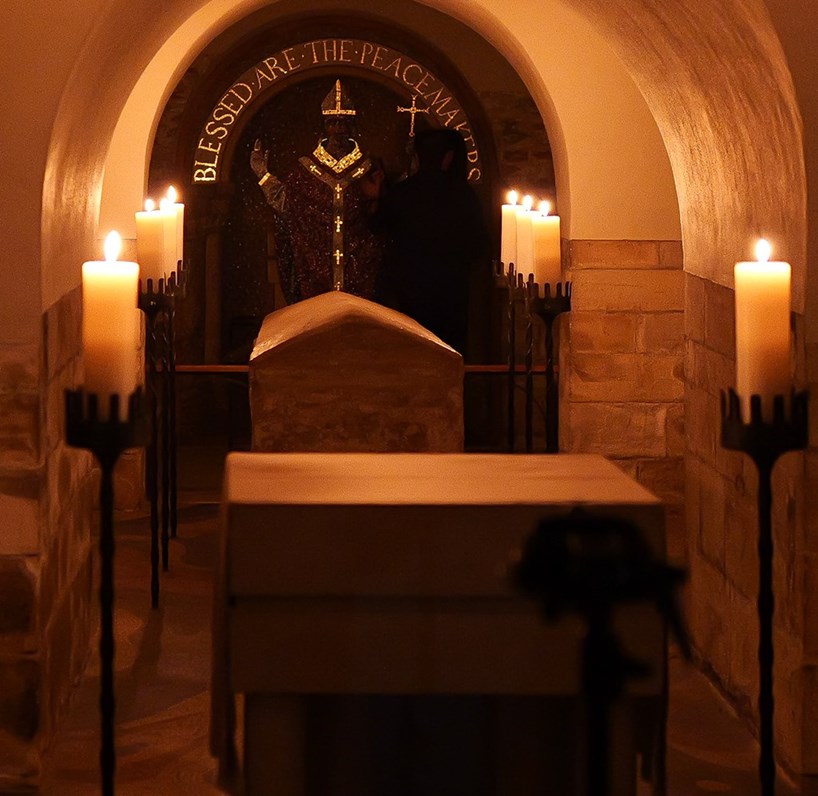 Chapter of YorkSt William’s tomb, in the crypt of York Minster
William is a “good-for-everything” saint, the Minster’s Canon Missioner, the Revd Maggie McLean, says. She sees similarities in the reasons that people are drawn to the Minster then and now. “There is a sense — looking at why people went on pilgrimage in the past, and why they might come in the present — it feels very natural to bring William into that story, because that’s how people would have come to York in the first place.”
Part of the attraction of William, she says, “is the stories of people, ordinary people, going to him in his lifetime for help. . . They still came after he died, with the same kind of frustrations, the same kind of hopes. They would come with their health issues. They would come with their aspirations . . . with their concerns, their family and friends.
“It’s nice that people see that continuity. There’s a past event for a present purpose for a future hope. It’s a nice kind of ‘bringing together’. We have the tomb. We have the legacy. We have the stories and the intrigue of all that. . . When I spend time on the floor of the Minster, the very, very similar reasons people come here today are also the reasons that they would have come: they would have wanted to come and talk to somebody.”
IT WAS the Reformation, 300 years after William’s death, that literally drove his story underground. In the chaos after the Privy Council edict in 1541 demanding the removal of all shrines, it is believed that William’s supporters dismantled his shrine and hid it in parts around the city. Some parts have been unearthed; others remain lost.
“It seems that there’s evidence that the pieces of the shrine were carefully buried,” Dr England says. “Reports in the 1930s, when pieces were found, said that they were face down.” The decorative elements were “on a bed of sand. We could suppose that that was done to try and protect them. Perhaps there was a hope that they would return. I don’t know the motivations of those who buried it, but it does speak to — even at that moment when things were changing — a care and perhaps an ongoing hope.”
The new exhibition marks the first time that the recovered parts have been under the same roof since the shrine was hidden. A “generous loan” of pieces from York Museum Trust, Dr England says, has “allowed us to bring pieces of the 14th-century nave shrine back into the building for the first time in close to 500 years. . . I can’t imagine those people who took apart the shrine and buried them would ever imagine that we’d recreate it in the way we have, with digital technologies.”
The technology used in recreating the shrine was provided in a partnership with two York-based studios: Hewitt & Walker, and Viridian FX.
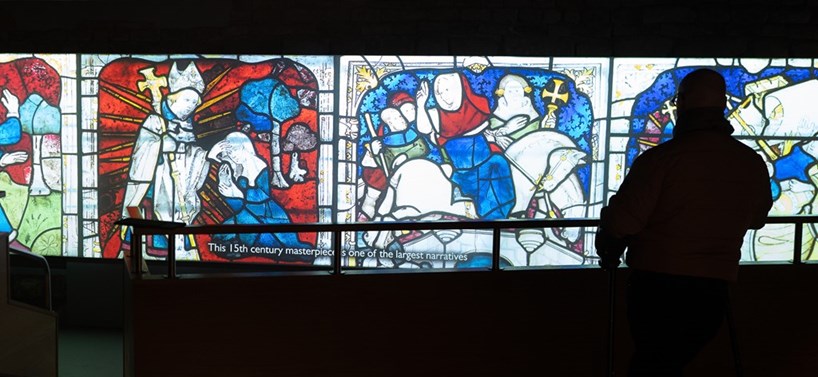 Chapter of YorkThe “cinematic experience” at the exhibition
The shrine was almost four metres tall, and contained William’s tomb. Visitors hundreds of years ago offered prayers by laying hands on the sarcophagus. Still visible are finger marks, where it was worn by the touch of countless hopeful hands. Visitors today can light a candle next to the tomb, now behind railings.
Canon McLean says that the atmosphere around William’s tomb is key. It is “why we have the music, why we have the candles lit”, she says, “so that people sense that there is a change from the film to the exhibition to [being in] the place where you can say a prayer for your Auntie Beth, your Uncle Fred. . . Your opportunity to light a candle where people have come in for generations in the past, in order to encounter holiness, to have an experience of God.”
YORK’s history and heritage sector are vital to the city’s economy and to the Minster’s. In 2025, 375,000 tourists (paying visitors rather than worshippers) visited York Minster. It is hoped that the William exhibition will encourage more.
Among events planned for the year are a commemorative evensong, a book launch, and a Lego experience, for Minster visitors to drop into over a week in April and work with an artist to help to make sections of the shrine. The Lego bricks will be used to recreate a life-sized replica of William’s shrine, and the finished creation will then go on display in the Minster.
“What’s really nice about that is it’ll be multicoloured, because the shrine was,” Canon McLean says. “There was a lot of colour in York Minster up until the Reformation, before it was all painted over. I’m excited to see how it’s built. It’s playful; it’s fun and educational all at once.”
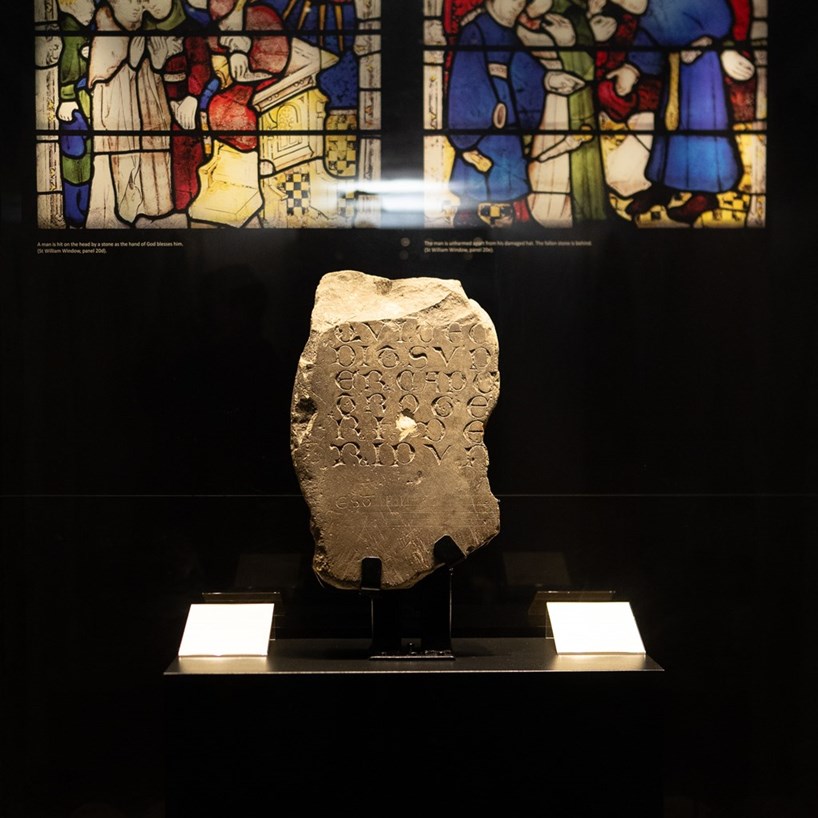 Chapter of YorkThe Roger of Ripon “miracle” stone, which features in the exhibition
It also nods towards the shrine’s history. Dr England says that “evidence of medieval polychrome survives on bits of the shrine. . . We can tell from what does survive that it would have been painted. We can assume that it would have been brightly painted. It’s sometimes hard to imagine it, but that would have been part of how the shrine was experienced as well.”
Inside the Minster, a new generation is becoming acquainted with York’s patron saint. A teenage visitor from Canada — taking in the exhibits, including a rare ivory casket believed to have travelled with William from Sicily, and a Book of Hours, where William is placed next to the better-known northern saint Cuthbert — says that he thinks that William is “really cool.”
As the year of commemoration gets under way, the team has every reason to hope that William’s legacy will reach many, from within the city and beyond, as the legacy of pilgrimage associated with his name is given new life.
For more information about the exhibition and events commemorating William of York, visit: yorkminster.org