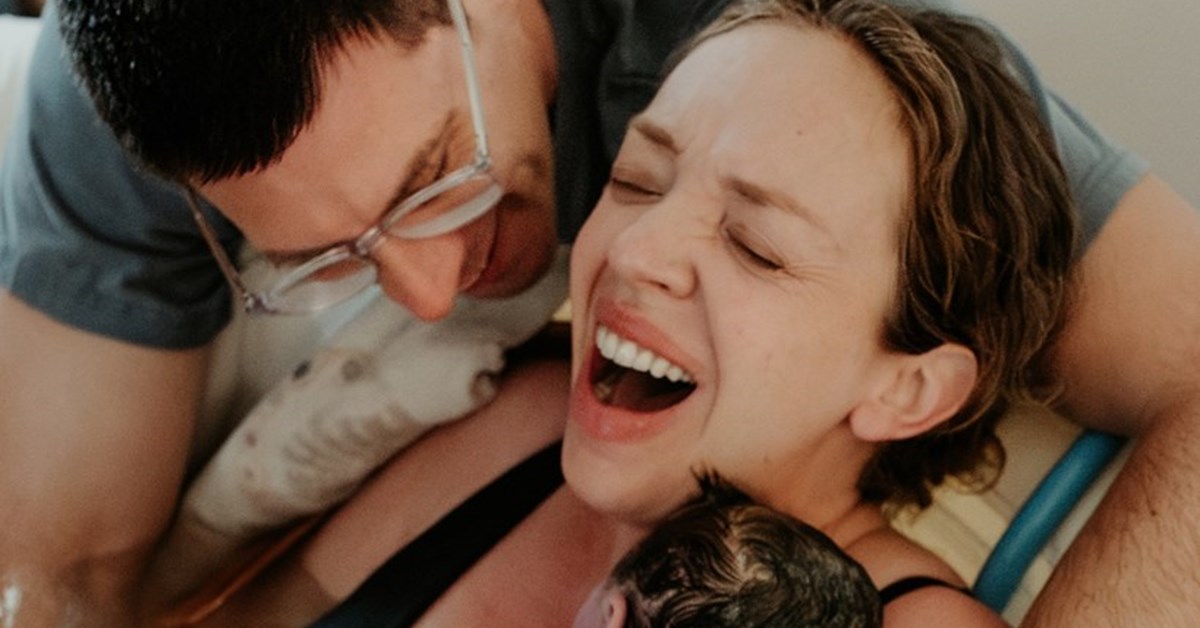
OVER the past decade, alongside a broader cultural shift toward health and “wellness”, there has been a marked rise in the demand for holistic birth support. This growing interest is fuelled by parents’ desire for more empowered — and fewer interventionist — births.
Research indicates that four to five per cent of women in England and Wales experience post-traumatic stress disorder after birth. As a result, many expectant parents are seeking to reclaim childbirth as a positive, controlled, and very personal event.
Support on offer often comes in the form of hypnobirthing and doula care. The demand for doula services, in particular, is rising rapidly, according to the organisation Doula UK.
Historically, birth support within church communities has been patchy, typically limited to mother-and-baby or toddler groups, or, occasionally, the presence of a woman in the congregation with a calling to support pregnant or new mothers. The increasing emergence of Christian birth workers suggests that this is beginning to change.
Tara Menzies, a mother of three, who attends an Anglican church in Perth, Australia, developed the Christian Hypnobirthing app in 2018, and the Faith-Filled Childbirth Course, and says that, since then, interest in Christian birth support has mushroomed.
“Because of the way we live today, becoming a mother can be one of the loneliest times for many women,” she says. “Thankfully, there’s a definite stirring and increasing interest in birth and post-partum support, particularly through faith, which is exciting.
“It’s also desperately needed, and should be a standard part of care for churches. Many will run the Alpha course, or a marriage course, but no one’s running birth courses.”
THE Revd Helena Whitwell, Assistant Curate at St Francis’s, Ashton Gate, in Bristol, and St Michael and All Angels, Bedminster, trained as a doula in 2019, and, two years later, began ordination training at Sarum College. She was ordained deacon in 2024, and belongs to the Church of England’s Distinctive Deacons Network.
Her Christian Birth Support website offers Calm Birth training courses for hypnobirthing practitioners, who typically work alongside a midwife, as well as group and private Calm Birth courses for new parents. She also runs pregnancy retreats and birth debriefs, which allow women to talk and pray through traumatic labours.
“Looking back, the callings to be ordained and to support women on birth journeys actually coincided in timing,” she says. “At the time, it was confusing, as they felt like two very different things, and I had no idea that they would one day be so intertwined with each other.
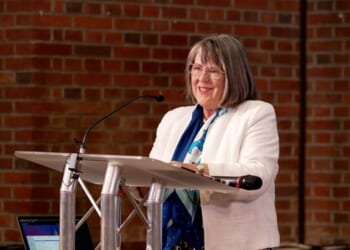
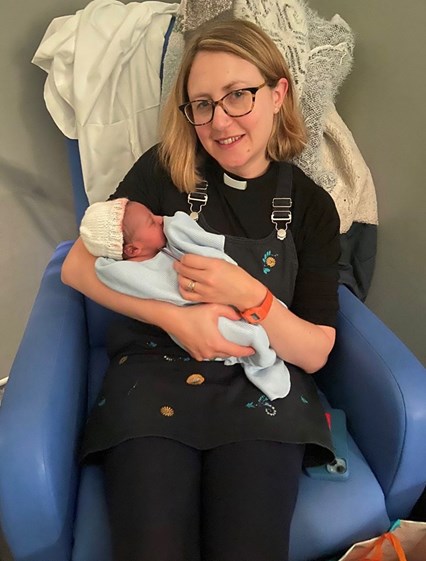 The Revd Helena Whitwell
“Both ‘deacon’ and ‘doula’ come from original root words meaning ‘to serve’. Doulas accompany women on pregnancy journeys, through loss, birth, and into early motherhood. As both a doula and a deacon, I love to hold and facilitate safe spaces for people to process their journeys, and to connect with God, too.”
Mrs Whitwell says that a network of Christian birth workers has been developing in the UK over the past few years.
“In 2022, a WhatsApp group was formed for Christian doulas and midwives to support each other online. . . At first, there were only five of us, but, over the past year, it’s flourished, and there are now 50 of us, from a diverse range of backgrounds and Christian traditions.
“The aim is to be a support and encouragement to each other, particularly when there’s not always the spiritual support around that’s needed, especially in this work.
“We have ongoing conversations sharing stories, experiences, and practical things, from sole-trader business tips, to comfort measures for our clients in labour. We will also regularly pray for each other’s clients — anonymously, no names shared — when we hear they are in labour.
“We also hold Zoom working hubs, as well as prayer and connection points. We really hope to hold an in-person Christian birth-worker retreat day later this year.”
Out of the WhatsApp group, a new community, Mums Nourished, has emerged. Meeting on Wednesday lunchtimes, it welcomes any pregnant women, and mothers with babies or young children, across the UK, to free online “drop-in” sessions.
“There is a prayer and Bible-based framework to the sessions, but the main aim is for mums at home to have a free and accessible connection point,” Mrs Whitwell says. There is no requirement to have a Christian faith to attend.
ROS GINN is an active member of the birth workers’ WhatsApp group, and works as a Christian doula, providing Christian hypnobirthing and antenatal education. Mrs Ginn is also a first year ordinand at St Mellitus, London (her placement church is St Mark’s, Coventry). After training with a secular hypnobirthing company, she has since incorporated her own faith-based elements into her practice.
“I have three children, and my first was born in 2017. The first time I heard about hypnobirthing was during an NCT antenatal group. At that time, all I knew about hypnosis was from watching Derren Brown. . . My scepticism really stemmed from wondering why I would hand over power of my mind, or subconscious, to someone else. . . I reconsidered after my second baby, because things didn’t go according to plan.
“I realised that hypnobirthing was about . . . recognising that we have thought patterns, and there is an element in which we can control those. At that point, I also found the Christian Hypnobirthing app, and it had all these beautiful relaxation scripts that were founded on Biblical truth, like: ‘God has made you for a purpose’ or ‘God’s plan for Jesus involved birth. Why would he make it unsafe?’ This instilled in me a sense of confidence that I could do this — that I was able to give birth.
“It made me feel more confident and just deepened my sense of recognising that, mostly, what I needed to do during my next labour was to give over the control to God, and trust him, and trust the way he’s created me, trust the team that he’s put around me, the midwives, trust that it would go to plan.”
Mrs Ginn’s third baby was born at home, and she says that, thanks to the techniques she had learned, she felt calm and supported, despite the fact that everything did still not go to plan. She describes the experience as deeply spiritual: she sang a worship song as she held her newborn, feeling a profound sense of peace, love, and connection as a parent with God.
She subsequently completed a hypnobirthing training course to become an instructor.
“BIRTH preparation is not about planning a particular type of birth, and then ensuring at all costs you stick to it,” Mrs Whitwell says. “It also doesn’t need to all ‘go out the window’ when you don’t see it panning out as you hoped. Very often, there are twists and turns, and we are extremely grateful for medical intervention when it is needed for us, or our baby.
 Ros Ginn
“Being prepared is, firstly, learning about what happens in your mind and body during birth, so that you can give yourself the best chance . . . to have a fear-free and peace-filled experience.
“It’s also about being informed and clear of your options in different scenarios, having time and space to think through your next steps, and ultimately feeling heard and supported, so you can feel confident and equipped.
“And if you come through it feeling let down, disappointed, or that your prayers weren’t answered, take some time to process that in a safe and well-held space with an experienced spiritual accompanier, or minister.”
christianhypnobirthing.mykajabi.com/
christianbirthsupport.co.uk/about
bookwhen.com/rosginnbirthsupport
Sign up for Mum’s Nourished via christianbirthsupport.co.uk, or follow on Instagram @mums_nourished