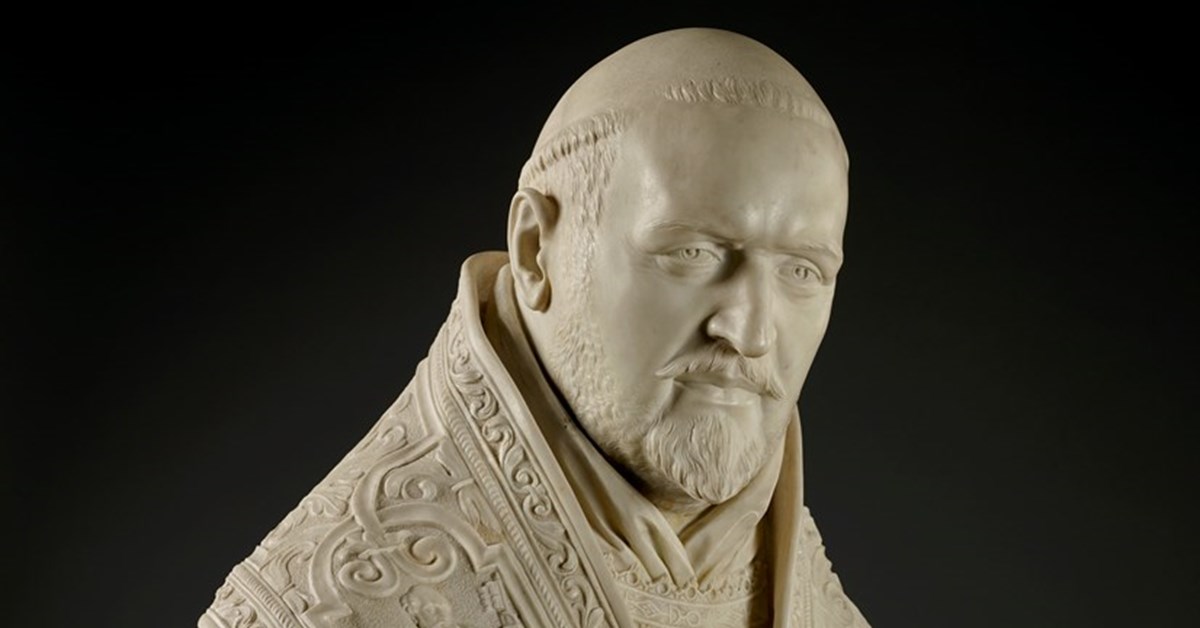
THE present exhibition at the National Gallery in Rome sets out to celebrate the 400th anniversary of the dedication of the New St Peter’s (18 November 1626). As it is a joint enterprise of the National Gallery and the Fabbrica of St Peter’s, it struck me as somewhat injudicious that the press conference and private view clashed with the weekly papal audience across the Tiber.
The exhibition explores the close working relationship of Gian Lorenzo Bernini, a painter, sculptor, and architect, born in Naples (in 1598), and his patron, Maffeo Barberini, Urban VIII, who was Pope from 1623 to 1644, and was thirty years his senior.
It offers a treasure house of some of Bernini’s greatest early works, showing how he rapidly moved away from the style of his celebrated father, Pietro Bernini, seen here in the first room with the Four Seasons (private collection), somewhat heavy and dull late Mannerist works. They are dated to 1620 and were recorded in 1632 in the collection of the Strozzi Palazzo on the Viminal Hill.
What emerges — even at a second viewing on the first day that the exhibition opened to an indifferent public — is the audacity of youth and the prodigious vibrancy of the young sculptor casting off his paternal shackles.
Step forward the 18- or 19-year-old son; the outrageous St Laurence (1616-17) reclines on a chaise longue of flame above a gridiron bed like a male odalisque, a work that, the artist’s own son and biographer, Domenico, suggested, was in part to celebrate his namesake. Beside him, St Sebastian (1617) swoons in the pose of the Farnese faun (private loan, Museo Thyssen-Bornemisza, Madrid). The passionate young artist portrays his own near contemporaries. He was already light years ahead of his father.
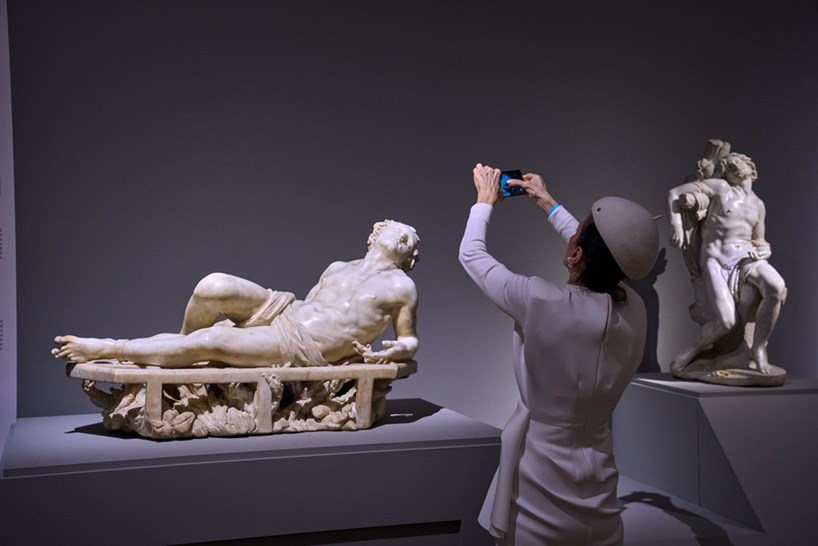 AlamyA journalist photographs the St Laurence (left) and the St Sebastian (right) by Gian Lorenzo Bernini, during last month’s press preview of the exhibition
A metaphor for this transition might well be found in the statue group of Aeneas rescuing his father Anchises from the flames of Troy, a group (1618-19) in the heart of the Galleria Borghese and not on loan here. In the Classical account of the siege of Troy, the young Aeneas shoulders his father, who in turn carries the household gods, the penates, to safety.
This surely is the young Gian Lorenzo carrying his father, who carries symbols of the protecting deities of the skill that he once had. Pietro was 36 years older than his son (and did not die until 1629): a vigorous mature man, much as Anchises was.
Pope Barberini was not always a popular figure, despite his good intentions in encouraging Bernini to reorder the interior of the new basilica. Pope Julius II had, a century before, demolished the Constantinian basilica of Old St Peter’s, commissioning Michelangelo, among others, to build a new patriarchal church. A pasquinade at the time suggested that what the barbarians had failed to destroy the Barberini undertook, notably in stripping the remaining bronze from the roof and portico of the Pantheon for the great baldacchino in St Peter’s.
I was reminded of this each day when I was in Rome recently, as my front door, tucked in behind the Senate Library, gave out on to a view of the bald pate of the Pantheon’s dome at the end of the alleyway. Around the corner stood Bernini’s famous elephant, shouldering its obelisk in front of the Church of Santa Maria sopra Minerva in its rather bleak side square (Books, 18/25 December 2020).
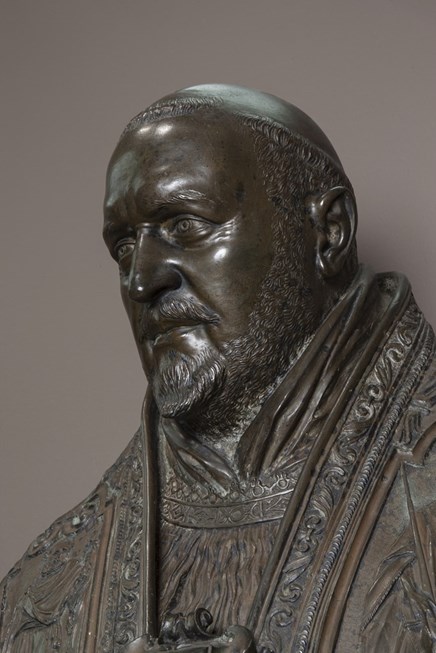 open.smk.dk, public domainGian Lorenzo Bernini, Bust of Pope Paul V Borghese (1621-2), on loan from the National Gallery of Denmark
The exhibition and catalogue make no mention of the dispute (it is now suggested that the bronze was used for cannon on the Castel Sant’Angelo and not in the Vatican), but Pope Barberini was not always so unpopular. Crowds turned out to acclaim him when, also in 1626, he laid the foundation stone for the Capuchin church, just behind his palace in its grounds and now cut off on the Via Veneto.
The pope had wanted a grand church, no doubt having Bernini and marble in mind, but the piety of his brother Antonio, who was head of the Franciscan house, left him to accept simpler furnishings of wood. To this day, visitors to that church, the first in the city to be dedicated to the Immaculate Conception, see the great chancel and side-chapel gates and screens with their beautifully polished wood.
The second room of the exhibition shows just how rapidly Bernini’s fortunes rose. He had been knighted at the age of 23 by Urban’s predecessor, Pope Gregory XIII, for undertaking five portrait busts for the then pope. Now he would propagate the image of his new papal patron by reordering the central crossing of the basilica above the confessio where, it is said, St Peter is buried.
The richly illuminated ceremoniale for the papal benediction for the new altar (Toledo) is shown alongside a marble incised slab that was placed over the gathered remains of the earth, ashes, and bone that had been removed to install the massive Solomonic columns of the baldachin. These relics were reinterred to mark the 1300th anniversary of the first Constantinian basilica after Urban VIII wrote a record in the dust in both Greek and Latin.
In the third room, we are confronted by the power that comes with bronze and marble, with busts of the Barberini family. Among the seven of the pope himself is one from the collection of the Duke of Marlborough which was only recently, in 1997, authenticated as being by the master.
Here, the most intriguing bust is one with a bronze head set on a rich porphyry torso (private collection) that had once belonged to Taddeo Barberini. Bernini captures the steely gaze and confidence of the 63-year-old pontiff. The mammoth bust that the pope commissioned for Spoleto Cathedral in 1640-41 stands sombrely alongside.
The marble bust that Bernini sculpted of Charles I, working from Van Dyck’s famed triple portrait of him (Royal Collection), was destroyed in the 1698 Whitehall Palace fire, but from the same years (1637-38) comes the life-size bust of the 32-year-old Sir Thomas Baker, of Whittingham Hall (V&A), who was Charles’s envoy in Rome for the intended royal commission. All too evidently, this was a work completed by a pupil, whereas, no doubt, the lost Charles would have been an autograph piece.
Travellers arriving by train for this exhibition pass directly beside the little church of Santa Bibiana, which Bernini began to restore in August 1624, and for which he was paid for a life-size statue of the virgin martyr in June 1626. It is well worth visiting, as is the later church of Sant’Andrea al Quirinale, four hundred yards around the corner from the exhibition and built for Cardinal Camillo Pamphilj in 1658. The elliptical ground plan and the sacristy in the neighbouring convent show how Bernini’s ardour remained in a cityscape that he did so much to enhance.
“Bernini and the Barberini” is at the Gallerie Nazionali di Arte Antica, Palazzo Barberini, Via delle Quattro Fontane, 13 Rome, until 14 June. barberinicorsini.org