The Federal Reserve got it wrong again.
By refusing to cut rates yesterday, the Fed showed that it is still fighting yesterday’s inflation while ignoring today’s economy. The Federal Open Market Committee left its target range unchanged at 3.5% to 3.75%. It also didn’t change the rate it pays on nearly $3 trillion of bank reserves, a disincentive for bank lending. Moreover, the difference between short-term interest rates on Treasury securities and long-term ones is ridiculously narrow. The one-month Treasury bill rate is about 3.7%. Given that the ten-year Treasury bond is yielding around 4.25%, that Treasury bill rate should be little more than 2 1/2%.
The Fed mistakenly believes prosperity causes inflation. By those misguided lights, our central bank should be cutting rates.
The labor market is plainly softer: February payrolls fell by 92,000. Fourth-quarter 2025 GDP was just revised down to a weak 0.7% annual rate. Those are not numbers that justify monetary paralysis. They are numbers that argue for relief.
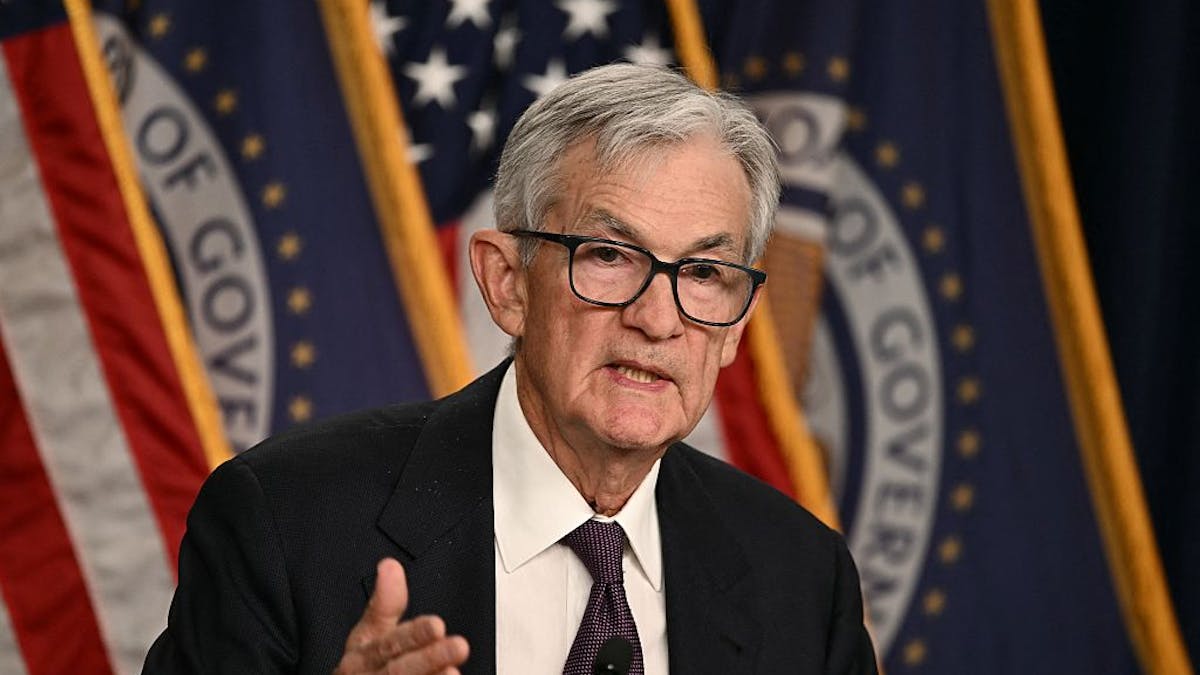
Yet Jerome Powell persists in presenting this stance as prudence. It is not prudence. It is institutional vanity masquerading as caution. Powell said that the current stance of policy is “appropriate,” and he again leaned on vague uncertainty tied to developments in the Middle East. Central banking is supposed to be about weighing actual monetary conditions, not using every geopolitical tremor as an excuse for inaction. Monetary policy cannot prevent wars, but it can certainly make an already slowing economy weaker by keeping the price credit too high for too long.
Worse, Powell’s comments about remaining in office as “chair pro tem” if no successor is confirmed were the most revealing part of the day. By saying he would stay on beyond the end of his current term if necessary, Powell projected exactly the wrong message: that the office belongs to him until the political system catches up. It does not. The Federal Reserve chairmanship is not a hereditary title, not a lifetime appointment, and certainly not a perch from which one signals permanence during a period of policy failure. Reuters reported yesterday that Powell said he would remain as Fed leader until a successor is confirmed. That may be legally arguable. It is politically tone-deaf and economically reckless.
The real issue is not just style. It is substance. High rates are not costless. They punish homebuyers, freeze housing activity, discourage business expansion, and increase the financing burden across the economy. Powell himself acknowledged yesterday that housing remains weak and that job gains have remained low. January retail sales were down 0.2%, hires in the JOLTS report were stuck at 5.3 million, and quits remained subdued at 3.1 million. The Fed has an institutional bias against vigorous economic growth. But even by its perverted lights, those numbers don’t convey a booming economy screaming for restraint. That is a country telling the Fed, in plain English, that the price of borrowing money is too high.
This is the chronic disease of modern central banking: officials are always late. They were late to recognize inflation when easy money was flooding the system, and now they are late to recognize disinflation as growth fades. Instead of admitting that policy works with long lags, the Fed clings to a backward-looking obsession with proving its anti-inflation credentials. It is as though Powell is determined to be remembered as “tough,” even if that means being wrong.
America does not need theatrical sternness from the Eccles Building. It needs sound money and common sense. Inflation has come down. Growth has slowed sharply. Employment has weakened. Credit-sensitive sectors are under strain. The right move was not another pose of caution. It was a rate cut.
The Fed missed the moment. Again.
And Powell’s insinuation that he may simply remain in place until Washington resolves his succession only adds arrogance to error. The central bank needs humility, not self-importance; discipline, not drift; and above all, leadership that understands that keeping rates too high for too long is every bit as damaging as holding them too low for too long.
* * *
Steve Forbes is Chairman and Editor-in-Chief of Forbes Media.
The views expressed in this piece are those of the author and do not necessarily represent those of The Daily Wire.