IT WAS a conversation with the choral director Sarah Tenant-Flowers, four years ago, that sparked the first draft of a new work focusing on women in the Passion story. Sarah Meyrick (now the editor of the Church Times) went on retreat soon afterwards, and emerged, days later, having written a full libretto, narrating the stories of Mary the Mother of God, Mary Magdalene, Mary and Martha, the sisters of Lazarus, and Veronica, as they experience the events of Holy Week. The project has evolved since then, with new collaborators, but, this Easter, Passia will be heard for the first time.
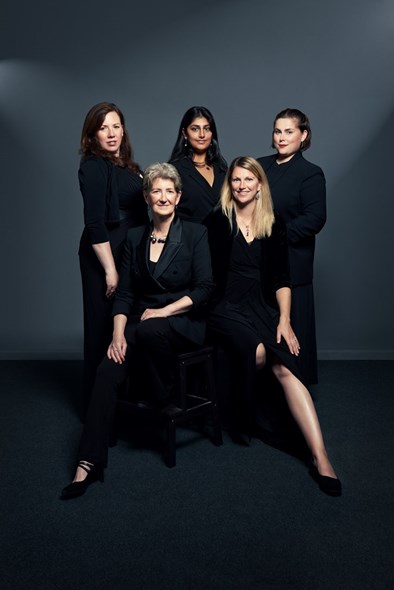
Passia will be performed by Papagena, a small choir of professional singers founded by Ms Tenant-Flowers to specialise in music for adult female upper voices. “Papagena is a group of five women. We range in age from mid-twenties to, in my case, mid-sixties; so we’re quite a diverse group,” Ms Tenant-Flowers explains. “We formed because there weren’t many opportunities for professional female singers to sing in small consorts.”
The group formed ten years ago, when the consort-singing scene, “certainly in classical music, was very dominated by male groups, such as the King’s Singers. They are fantastic groups, but there wasn’t much opportunity for women who wanted to sing at that level,” Ms Tenant-Flowers says.
“We very much champion music written for adult female voices, with an all-adult extended vocal range, and an adult life experience. So often, when people think about music for female voices, they automatically think of music for children’s voices. And that is absolutely what we don’t sing. We want to sing as real, full-blooded women.”
 PapagenaPapagena
For some time, Ms Tenant-Flowers had been mulling over a piece that would encapsulate the experience of women, particularly the watching and waiting dimension of motherhood. An invitation to conduct Arvo Pårt’s Passio, the composer’s 1982 setting of the St John Passion, narrated by the voices of Jesus and Pilate, shone a spotlight on the absence of a female viewpoint in traditional musical responses to the Passion.
“It [was] written, at the time, for the male voices of the Hilliard Ensemble,” who, she says, “inspire me a huge amount. That was a male quartet singing at a fantastic standard, and singing passionately.”
The creation of Passia occurred to her “as a way of bringing my original ideas to life, and establishing the Marys around the crucifixion, perhaps creating a work around Mary’s ideas, but broadening it out to universal themes of motherhood, love, and loss”.
After Ms Meyrick’s initial work, collaboration began with the composer Liz Dilnot Johnson and the British-Ukrainian poet Neta Shlain, and the form of Passia with Papegena’s five performers — Imogen Ram-Prasad, Margaret Lingas, Suzzie Vango, Shivani Rattan and Sarah Tenant-Flowers — and an upper-voice choir of angels took shape.
Ms Dilnot Johnson was approached to compose the piece in summer 2024, after Papagena members witnessed her work for upper voices in a composition Nimrod Reimagined. “I jumped at the chance to be able to do this, because it was a big part of their motivation to put Papagena on the map as a serious group who make big commissions happen,” she says.
“They are able to cover the whole range of music, from beautiful pop arrangements and covers to very serious and intense music, right across the ages. They go from medieval to the very modern repertoire. They’re quite exceptional and unique. And it’s a massive privilege to be able to work with singers of this calibre on such a big project.”
MUSIC for Easter comes with a rich lineage, which Passia acknowledges in innovative ways. Kassia, a ninth-century Byzantine female composer, whose work predates the better known Hildegard von Bingen, is referred to in the piece, as is Thomas Aquinas.
Passia’s Mary, the mother of Jesus, is not the stoically suffering, sorrowing Mary of Stabat Mater, but a woman angered by having to be a bystander in her son’s violent fate. The words of the Magnificat are reworked from “My soul doth magnify the Lord”, to an anguished decrying of “my hoodwinked soul”, as she is forced to witness her child’s suffering and agony.
Veronica, sung by Ms Tenant-Flowers, is, at first, the outsider of the group, treated as an interloper, until her story of being healed from pain, and the outcast status imposed by her condition, bonds her with the other women.
Ms Dilnot Johnson continues: “My working practice as a composer is to bring different cultures together, side by side. I’m imagining the actual five women. Who were they? What languages were they speaking? Where did they come from? And what might they have been saying to each other? That set me on a path to do some research into Hebrew, and I found the Hebrew phrase ‘Min haShamayim Tenuhamu.’ I was aware that Hebrew has a lot of phrases that are what you would say if somebody’s child had died. So, what might they have said to Mary when her son dies?”
Ms Shlain, a poet who speaks Hebrew as a first language, expounded on the metaphorical meaning behind the phrase. These wider meanings were translated into English, and became a text for the upper voices choir. “Water, tears From above Descend to comfort you.”
Songs of contemporary Palestinian women are also now included in the text. “I researched what Palestinian women are singing right now in the circumstances they find themselves in,” she says. In translation, a beautiful folk song becomes Martha’s song “To the Gazelle”: “To you who climb in li-ti-lit the mountain li-li-lit we light a flame To, li-li-lil to wish you safe from li-li-lil night to dawn.”
The song then becomes a duet between Martha and her sister, Mary: “To the gazelle who li-li-til is captive li-i-lil Wish you safe. Know li-li-lil The strong gazelles come li-li-lil to free you.”
“To the Gazelle” is an emotional turning point in the piece, as it marks the transition from the youthful hopefulness of the sisters, who have seen Jesus perform the miracle bringing their brother back to life, to a more sombre comprehension of the events of the Passion.
The description of the crucifixion is taken from Julian of Norwich, as Ms Dilnot Johnson explains: “Suddenly, stuff starts to happen. Then, Jesus gets nailed to the cross. I found this amazing description from Julian of Norwich, where she describes in graphic detail what happens as he is dying. She describes the crown of thorns, creating this flood of blood from his head, and describes these beads of blood as round, like herring scales, and like a heavy flood.
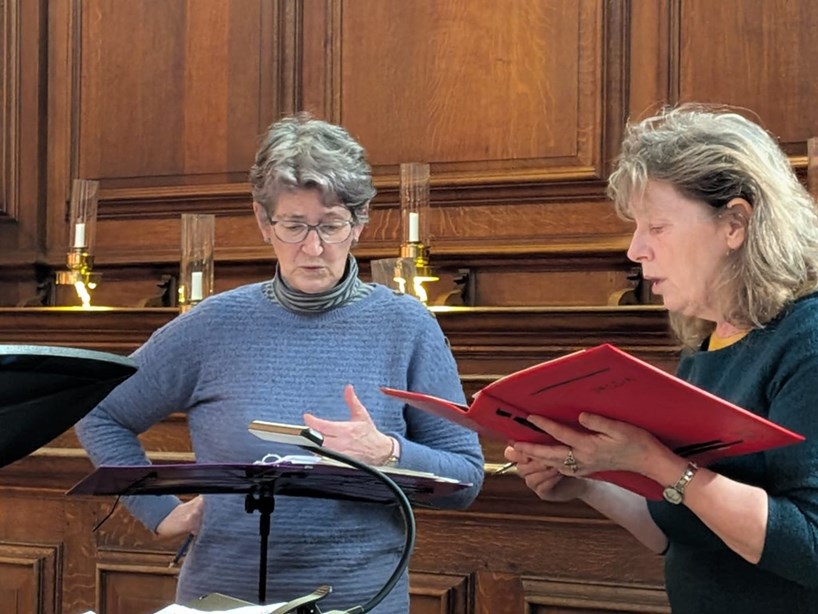 PapagenaSarah Tenant-Flowers and Liz Dilnot Johnson at a rehearsal for Passia
“I created a poetic version of that text to be able to sing it. The tension builds, and eventually he dies, and then there’s this massive outpouring. The moment he dies, that’s when the angels, the upper-voice choir, starts to sing immediately. It’s like the angels know that we’re along the next step of the path. So, we’ve got this massive contrast from the kind of deep grief of the women and the very bright light of these young voices.”
Papagena will work with different upper-voice choirs of angels in each of the venues Passia is performed. There has already been outreach to many young people through rehearsals and workshops. It is hoped, for future tours, that the production will appeal to cathedrals with girls’ choirs, as the piece offers such potential for the female voice. “We will have different angels in different locations. For every performance, we’ve got a different choir of angels,” Ms Dilnot Johnson says. “We’re working with a large number of young people, which is really exciting — and also quite challenging, because each group have got to nail it on the day.”
At a rehearsal at the Arts Centre in Warwick University, where the soprano Suzzie Vango is an Associate Artist, the undergraduate angel singers were keen participants, staying to work with Papagena for the maximum time possible. Also clear was the beneficial contrast that the pure focus of choral singing provides, to the attention-scattering demands of the digital world.
While Ms Tenant-Flowers guided singers towards “brighter Es”, Papagena’s performers worked with the composer on timings, adjusting the score accordingly. Papagena, are an a cappella choir, but Passia contains passages of percussion, and music from hand bells and bowl bells, performed by the singers.
Witnessing a creative idea, incubated over many years, come to life through such a spirit of collaboration, is amazing. “An act of faith” is Ms Tenant-Flowers’s description of producing and touring Passia, and there is still scope for individuals and organisations to support the production financially.
Passia begins and ends with the singers dispersed across the stage. “The last thing that the audience will hear is the women walking away again from the central space, just singing, ‘Hallelujah, Amen. Hear my voice,’” Ms Dilnot Johnson says. “And it’s left open. It’s not a positive ending. It’s not a negative ending. It’s just very open. It gives space for the audience to have a moment to reflect on what they’ve dealt with, just witnessed, and maybe what that means to them. I’m hoping it will appeal to people of Christian faith, but also other faiths and people of no faith.”
Asked to sum up Passia, Ms Tenant-Flowers concludes: “It’s five women, almost holding hands around the cross, comparing notes about their experience of Christ, and their reflection on what’s actually happening.”