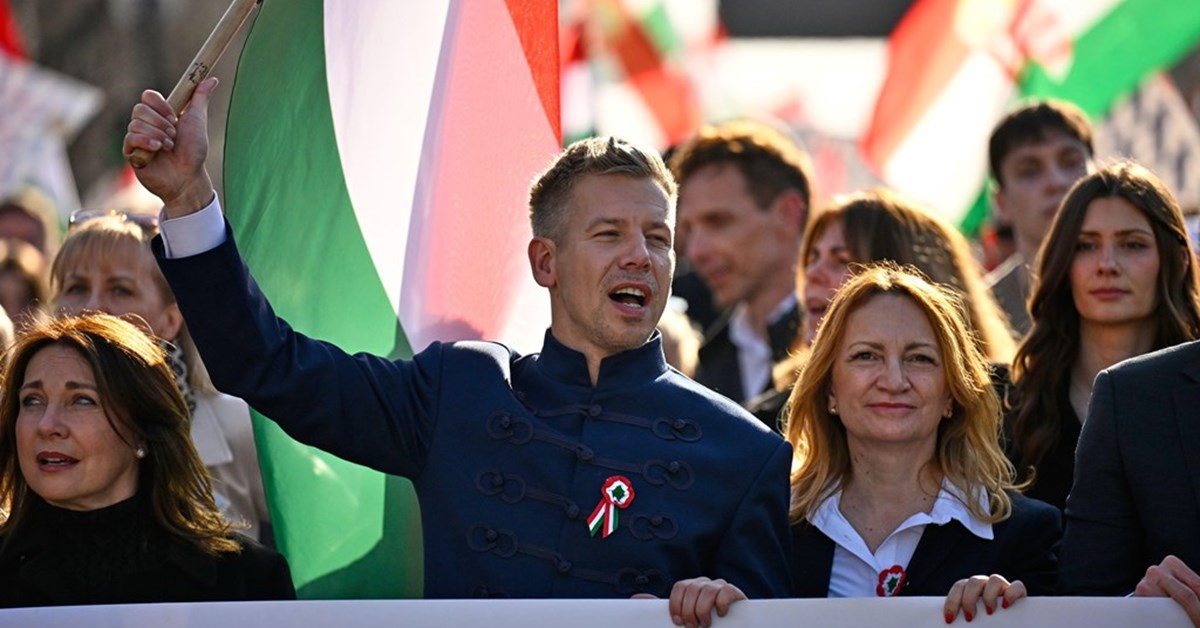
HUNGARY’s experiment in “illiberal democracy”, which has caused the country to be hailed as a beacon of hope by many Christian conservatives internationally, might be coming to an end. On Low Sunday (12 April), Hungarian citizens go to the polls. At the time of writing, the ruling party, Fidesz, led by the Prime Minister, Viktor Orbán, is trailing the insurgent challenger, Tisza, led by Péter Magyar, by nine points, on Politico Europe’s aggregated “Poll of Polls”.
Appeals to Christianity, plus an alliance with Hungarian historic Churches, are traditional cornerstones of Fidesz’s communication. In the current election campaign, however, the relationship between faith and politics is more complicated.
Fidesz’s grip on power was long thought unassailable, thanks to a slanted electoral system, the party’s domination of the mass media, and the inefficacy of a weak and divided opposition. Since February 2024, however, Hungarian politics has been transformed by the rise of Mr Magyar, a Fidesz insider turned critic, and his Tisza (“Respect and Freedom”) Party.
His political career took off in the wake of a controversy concerning the pardoning of a paedophile accomplice by the President at the time, Katalin Novák. The pardon was granted after the intervention of the Presiding Bishop of the Hungarian Reformed Church, Pastor Zoltán (Comment 19 April 2024). The scandal forced President Novák’s resignation, which prompted a debate about the relationship between religion and politics in Hungary. Mr Magyar’s ex-wife, Judit Varga, who co-signed the pardon while serving as Justice Minister, also retired from public life.
Subsequently, a deteriorating economic context, characterised by stagnant growth and high inflation, has caused Fidesz’s support to plummet, as Hungarians grapple with a cost-of-living crisis. Grinding dysfunctionality in public services, thanks to underfunding and endemic corruption, has alienated even voters who are sympathetic to Fidesz’s cultural conservatism.
TISZA, which brands itself as centre-Right, shows significant rhetorical continuity with Fidesz (for example, on migration and sovereignty), while promising to tackle corruption, restore the rule of law, and return Hungary to a Western path in foreign and security policy — one that is outside Moscow’s orbit.
Mr Magyar does not appeal to Christianity in his speeches as much as Mr Orbán does, and yet Mr Magyar’s Roman Catholicism remains an important part of his public image.
Echoing Pope John Paul II, Mr Magyar has made the phrase “Do not be afraid” his motto. On 10 February 2024, he used it to conclude the Facebook post that launched his political career. Shortly afterwards, he incorporated it into the title of his social-media pages. After his election as an MEP, he also used it in a significant speech on Hungary in the European Parliament, in October 2024.
Mr Magyar’s much-publicised ten-day walk in May 2025 over the 190 miles from Budapest to Oradea, in Romania — home to a large Hungarian minority — had echoes of pilgrimage — especially since he started from the steps of the basilica in Budapest, dedicated in honour of one Hungarian royal saint, Stephen I (975-1038), and finished in Oradea beneath the statue of another, Ladislas I (1040-1095).
While supporting Christianity, Tisza has also signalled that it intends to approach Church-State relations very differently from Fidesz.
Tisza’s manifesto notes critically that, “in recent years, political and economic interdependence has replaced partnership between the State and Churches”. Furthermore, the granting of special legal status (and financial benefits) to a small number of “Established” Churches seems to “depend on the loyalty of the community in question to the government”. Tisza promises to maintain public funding for Churches, while not “playing favourites” among them, by creating a fair and transparent registration system.
MEANWHILE, the run-up to next month’s election has presented a mixed picture when it comes to political engagement by church leaders.
A Lent pastoral letter by the Hungarian Catholic Bishops’ Conference, focusing on the horrors of the war in Ukraine, was criticised by some lay RCs. The letter’s use of graphic imagery, they argued, seemed to echo Fidesz’s campaign messaging, which emphasises the danger posed by war in a neighbour country. Others believe that the letter was well-meant but poorly executed — an attempt to evoke sympathy for Ukrainians and to raise funds for Caritas’s relief work in Ukraine.
Scepticism about the Bishops’ letter is understandable, given that the Conference has taken no corporate stand against the vicious tone of Fidesz’s election campaign.
AI deepfake smears against Opposition leaders have been circulating for months. In February, a short AI-generated Fidesz campaign video took matters further. It used exceptionally violent images to show the (alleged) likely consequences of a Tisza victory: a Hungarian father being shot in the head by a Nazi-style figure while kneeling in the mud of a Ukrainian battlefield.
Lately, however, three RC bishops and one senior rabbi have spoken out about Fidesz’s campaign in letters published by the independent religious-affairs portal Szemlélek. Bishop Asztrik Várszegi, a retired Abbot of Pannonhalma Abbey, was particularly terse: “This senseless (pathological) struggle has nothing to do with Jesus Christ, our Church, or even what remains of common sense.” One can only hope that, where Bishop Várszegi has led, others will follow.
The Revd Alexander Faludy is a freelance journalist based in Budapest.