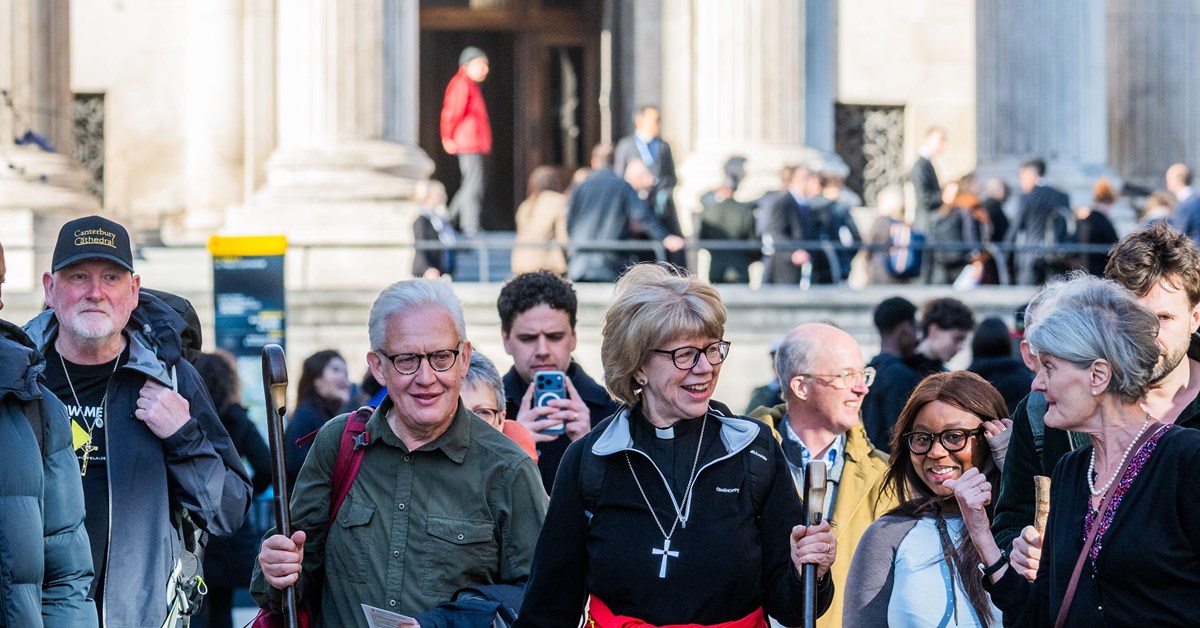
AS THE Most Revd Sarah Mullally walks the Pilgrims’ Way towards Canterbury for her installation as Archbishop on Wednesday, the Revd Professor Andrew Atherstone has published an intriguing biography of her, along with an article in The Sunday Times. He emphasises her roots in conservative Evangelicalism, after a conversion experience at the age of 16 in the context of a lively church in suburban Surrey.
This sustained her during her years of training as a nurse. She was President of the Christian Union at Southbank Polytechnic and attended an Evangelical church in south London for more than two decades. Yet, the Mullally who emerged from theological training and a decade of parish ministry came to speak the rather different language of inclusion and social justice. She espouses the view that the Church of England has always been a “broad” Church. It was not an exposure to any alternative theology which changed her: she has been fairly frank about her lack of interest in formal theology.
And yet she is typical of what often happens to those who were zealous Evangelicals in their teenage and early adult years. Doubts creep in about some of the cherished Evangelical certainties. The high-pressure enthusiasm can be hard to sustain, while other approaches to faith begin to appear more plausible. Eventually, the magic of being one of the chosen few wears off, and what was once a firm faith is either abandoned or reconfigured.
Some Evangelicals become social activists with a progressive agenda. There is a certain continuity in this trajectory: it remains possible to enjoy the moral superiority of being contra mundum while abandoning some of the difficult aspects of the Evangelical agenda. There is a redirection of Evangelical activism into political activism.
Archbishop Mullally certainly regards herself as a Martha rather than a Mary, and her interventions in the House of Lords have usually followed a Left-liberal trajectory, the notable exception being her consistent opposition to assisted dying. She appears to favour a consensual, collaborative style of leadership, making good use of the gifts that conservative Evangelicals tend to look for and prefer in women.
While she recognises the breadth of the Church of England, it is not clear how much sympathy she will have for genuine social conservatism. There is an increasing mismatch between the assumptions of the Church’s leadership and much lay conviction, between, typically, those who attempt to convert congregations to progressive “Kingdom” views while many in the pews worry more about keeping the church roof on and paying the parish share.
This is a divide that really matters. If the Archbishop is to improve the health of the C of E during her Primacy, it would be good if she at least attempted to address it.
Archbishop Sarah Mullally by Andrew Atherstone is published by Hodder & Stoughton at £22 (Church Times Bookshop £17.60); 978-1-3998-2878-9.