ONE of the religious success stories in my lifetime has been interfaith dialogue. What is more, it is about to enter a radical new stage. After centuries of ignoring each other, castigating each other, or even persecuting one another, there has been a remarkable blossoming of religious relationships.
The process took time, and has gone through different stages. While formal engagement was cautious, local groups or individuals — Christian and Jewish, clergy and laity — became interested in exploring one another’s tenets and practices. The braver priests and rabbis took their congregations with them, and started local dialogue groups, which then received affirmation from the hierarchy. Interfaith cups of tea and looking together at common issues gradually became the norm.
Another step was to extend Jewish-Christian dialogue to the third strand of the Abrahamic tradition: Islam. This was at first considered very daring, but, once done, led more easily to the next stage: widening the circle to other faiths, such as Hinduism, Sikhism, Buddhism, and Jainism. They may not share the similar sacred history of the Abrahamic threesome, but all offer paths to heaven in their own way.
In all these developments, however, the structure was always the same: visiting each other’s places of worship, and learning about their traditions. Now, a very different model of dialogue has emerged that may become the next template — or, if too controversial, may prove a step too far.
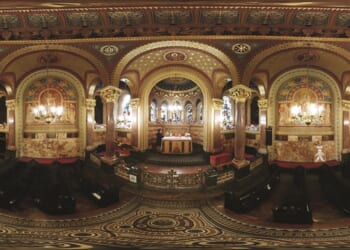
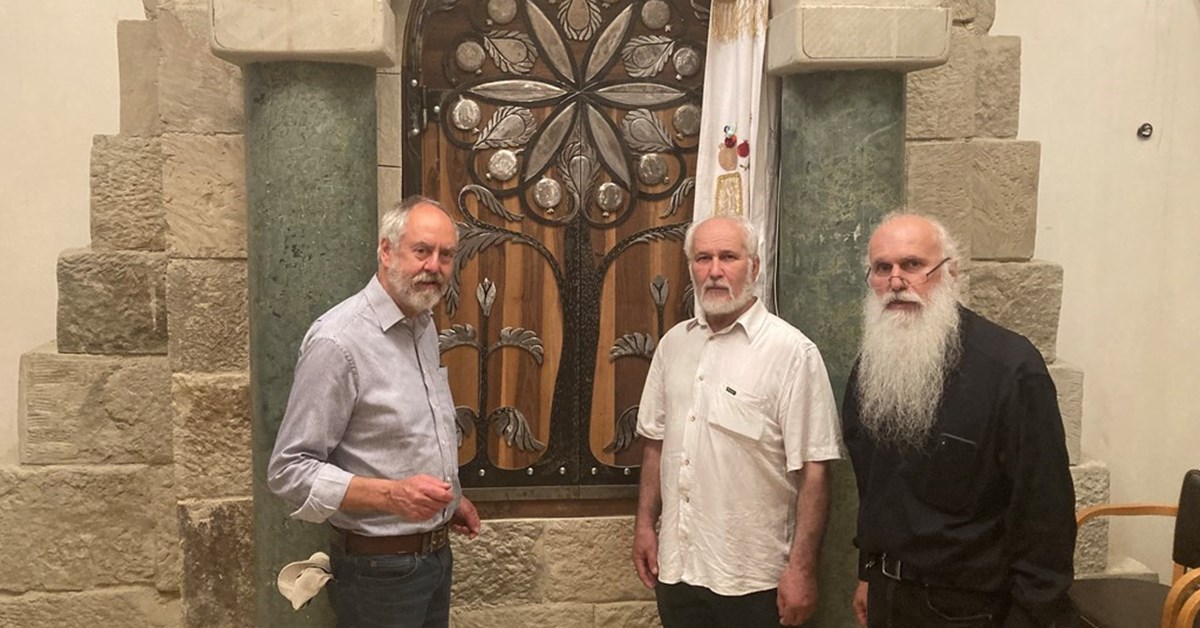
IT BEGAN two years ago, in Tbilisi, Georgia, when Bishop Malkhaz Songulashvili decided that his cathedral needed not only to preach dialogue, but to embody it. In a dramatic decision, one of the ancillary spaces was rebuilt as a fully functioning synagogue, while another was turned into a mosque.
For the first time, a church, synagogue, and mosque were operating within the same building, under the same roof, and with the same front door. It was not a matter of physical convenience, but of profound religious symbolism.
Sharing the roof reflected the God whose over-arching presence watches over the world and all of us. Sharing the door reflected openness to others and a welcome to all who wish to enter.
The internal architecture was carefully choreographed, too: all three sacred spaces conform to their own requirements — such as the synagogue should face Jerusalem — but, in addition, each contains two columns. This feature not only links them visually, but also represents the two fundamental principles that they all espouse: loving God and loving one’s neighbour.
The fraternal co-existence was further embedded in the extraordinary fund-raising principle by which money was raised for the building works: Christians could give to the Jewish or Muslim areas, but not to the Christian parts, and the same principle applied to donors from the other two faiths.
This meant that everyone was investing in the others’ endeavours, making a massive statement about not just tolerating one another, but actively supporting one other financially.
Also built was a communal area where everyone can enjoy food or hold meetings. Its name, The Abrahamic Hall, reflects not only the common spiritual ancestor, but also his association with hospitality (as described in Genesis 18).
WHILE the Peace Project, as the venture is known, may elicit much admiration, it has its critics, too, especially those worried lest joint services take place and blur the lines theologically.
The riposte of the three faith groups is that they have three separate places of worship, not a single one, and — while people will occasionally attend each other’s prayers — there is a big difference between sharing and merging: the Peace Project does not ask people to abandon their own faith, but to understand that of their neighbours.
Sadly, the project may have bridged the interfaith gap, but not the intra-faith one. The church is Baptist, and unacceptable to Roman Catholics; the mosque is Sunni, meaning that Shia Muslims ignore it, while the synagogue is run along Progressive lines, and shunned by Orthodox Jews. Internal divisions are often more intractable than outer ones.
There is also a political aspect, in that the Georgian government is seen by many as repressive. Many citizens hold weekly demonstrations against the authorities, but others are putting their energy into this religious reform as their way of expressing hopes for a more cohesive society.
I was surprised, therefore, to find no security around the building to prevent attacks or arson from unofficial pro-regime groups. But Bishop Malkhaz did tell me that he had a rucksack ready with plenty of books to read in case he is suddenly taken to prison.
MIGHT there be legal problems in opening up a church here in the UK for several types of worship? Possibly — but the shared building need not be an existing consecrated one, but a neutral place that is less subject to canon law.
Since the project’s foundation, all three communities have grown in size and activities. Newcomers include those who previously avoided organised religion, but who now identify the Peace Project’s values as being in line with their own.
News of this interreligious trinity has begun spreading, and has inspired many outside Georgia who feel personally challenged: should people of faith and good will consider following this example? Rather than mouth “Love your neighbour as yourself,” why not give physical expression to it through cohabitation? After all, if faith groups cannot live at ease together, what is the moral force of all our exhortations of others to do so?
Frankly, as well as religious motives, there may be good financial reasons for congregations with falling rolls to alter their buildings to accommodate other faith groups rather than have to close.
Will we see a three-in-one religious building being established in Britain, starting a new pattern in our towns and cities? It is unfamiliar territory, and would demand a spirit of religious adventure from anyone attempting it, but it might also be pleasing in the eyes of God to see religious harmony put into practice in such a forthright way.
Rabbi Dr Jonathan Romain is convenor of the Rabbinic Court of Great Britain and author of Confessions of a Rabbi (Biteback).