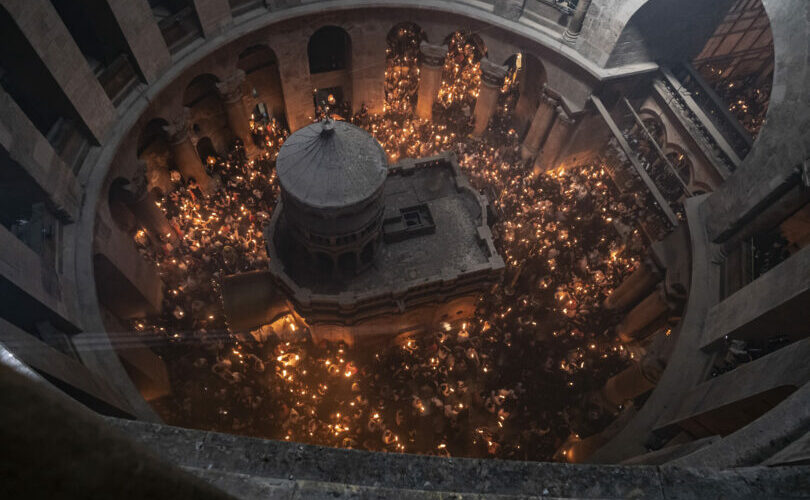
(LifeSiteNews) — The Church of the Holy Sepulchre in Jerusalem has been closed by Israeli authorities since February 28 when the Israeli and American governments launched their war of aggression against Iran.
As a broad precaution, the head of Israel’s governing body in the occupied West Bank announced March 5 that “all holy sites in the Old City of Jerusalem, including the Western Wall, the Temple Mount and the Church of the Holy Sepulchre, will remain closed” due to Iran’s retaliatory strikes happening in the region.
Since the prohibition, entry to the key religious sites in Jerusalem’s Old City have faced severe limitations.
According to Fr. Ibrahim Faltas, director of schools for the Custody of the Holy Land, the “Mother Church” of all Christendom, where Christians believe Jesus Christ was crucified, entombed, and resurrected, “has never been closed for such a long time.”
“Wars, dangers, tensions, and pandemics have restricted access to the Holy Site, but it has never happened for such a prolonged and uninterrupted period,” the Franciscan priest wrote for Vatican News.
And as the Church approaches its observances of Holy Week rites and the celebration of Christ’s resurrection on Easter, concern regarding the closure of the Church where these defining events took place, is reverberating across the Christian world.
On Monday, it was reported that fragments from missiles launched by Iran along with debris from Israeli interceptors fell to the ground around Jerusalem’s Old City. According to The New York Times, “a spokesman for the Latin Patriarchate in Jerusalem said a fragment landed several hundred feet from the church” and “at least one person was injured.”
A regional director for the Catholic Near East Welfare Association said on Tuesday that he expects Holy Week and Easter rites to be celebrated at the ancient Christian church with only religious and clergy in attendance, similar to arrangements made under the COVID-19 precautions several years ago.
The Church of the Holy Sepulchre operates under the Status Quo, a 19th-century accord that regulates the holy sites in Jerusalem. Converging all of Christendom together, east and west, the church hosts divine liturgies for Catholic, Greek Orthodox, Armenian Apostolic, Coptic, Syriac, and Ethiopian Orthodox rites.
According to Sami el-Yousef, chief executive officer of the Latin Patriarchate of Jerusalem, “the church leaders intend to meet with representatives of the (Israeli) police to impress on them the need to allow Easter celebrations, even if at a reduced capacity, similar to the pandemic restrictions,” he said. “We shall see whether that will bear any results.”
Unprecedented restrictions of Christian worship
In recent years, particularly since religious Zionist Jewish ultranationalism took power in the Israeli government in 2022, tighter restrictions on Christian worship during Easter celebrations have been exacted by Israeli authorities discouraging and curtailing Christians’ right to worship.
READ: Christian leaders decry Easter worship crackdown under Israel’s radical Zionist regime
In an early February address, before the current war, Patriarch Theophilos III of the Greek Orthodox Church of Jerusalem reported to diplomatic officials how the Israeli government had been imposing unprecedented restrictions on the numbers of worshipers permitted to attend liturgical events during Easter. He described these imposed limitations as being accompanied by aggressive police enforcement, ostensibly to maintain safety, as unacceptable violations of freedom of worship and human dignity.
Vatican: Faithful must be guaranteed ‘the unhindered right to access’ holy places
As part of the Holy See’s call for a two-state solution — along with around 96% of national governments of the world — is support for Jerusalem to be “established as a corpus separatum” (a separated body, or separated entity) as expressed in the original partition proposal passed by the United Nations General Assembly in 1947.
Reaffirming this position at the UN last year, Apostolic Nuncio Archbishop Gabriele Caccia stated in his July address:
Jerusalem is a city of universal religious and cultural significance. It is sacred to Christians, Jews and Muslims alike. Therefore, it requires a status that transcends political divisions and ensures the preservation of its unique identity. To this end, the Holy See reiterates its longstanding call for an internationally guaranteed special statute capable of ensuring the dignity and rights of all its inhabitants and the faithful of the three monotheistic religions, the equality before the law of their institutions and communities, safeguarding the City’s sacred character and exceptional religious and cultural heritage.
Furthermore, it must ensure the protection of the holy places, guarantee the unhindered right to access them, and to worship there. It must also preserve the “Status Quo,” where applicable. In Jerusalem, no one should be subjected to harassment. Therefore, it is regrettable that Christians feel increasingly threatened in the Old City of Jerusalem.
RELATED:
Tucker Carlson unveils ‘shocking’ treatment of Christians in Israel
Israeli investigative reporter spat on, harassed in Jerusalem while dressed as a Catholic priest
Latin Patriarch says new Israeli gov’t has emboldened Jewish extremists to attack Christians
Holy Land patriarch decries Israel’s devastation of Gaza, rising settler attacks in West Bank
Palestinian leaders: Christian communities risk being wiped out if US churches don’t intervene
Missile strike killing over 150 children at Iran school caused by outdated intel: report
Veteran shouting ‘No one wants to fight for Israel’ injured during Capitol protest
Palestinian Christian leaders sharply admonish USCCB for collaboration with Zionists
Holy Land bishops reaffirm Catholic Church’s rejection of ‘Christian Zionism’
The disturbing reality of how Christians are treated in the Holy Land
‘Faith in a Time of Genocide’: Holy Land Christians call for solidarity, repudiation of Zionism
Israeli extremist rabbis instruct soldiers heading to Gaza: ‘Kill all their children’