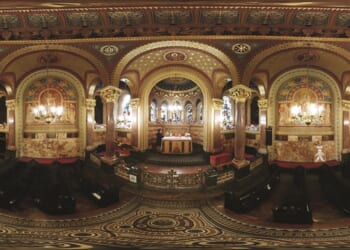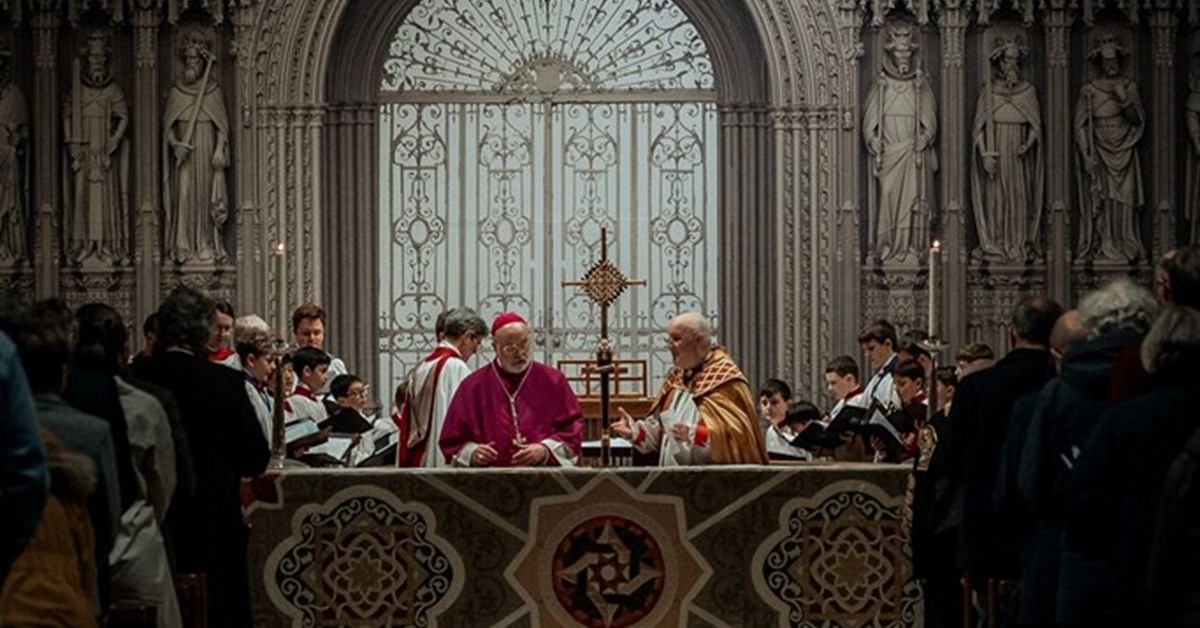
THE 98th Archbishop of York has pledged anew to “love and preach the gospel of salvation”, as his 12th-century predecessor, St William of York, had done. He was speaking at an 800th-anniversary service in York Minster, on Wednesday, to celebrate the canonisation, in 1226, of York’s “forgotten saint”.
William of York’s popular appointment in 1141 was challenged; he was deposed, reinstated, and performed his first miracle, calling on God to save the crowds who had come to cheer him on and whose combined weight on the Ouse Bridge caused it to collapse.
As he made the sign of the cross, his prayers were answered, and all were saved — so it is recorded. He died nine days later after falling violently ill at mass, and was buried in the cathedral. Poisoning was suspected, and his tomb became one of several shrines. The original was remodelled, carved in stone, and became a place of pilgrimage.
It was demolished during the Reformation in 1541. Scattered fragments unearthed around the city have been digitally reconstructed to form the centrepiece of a new exhibition and cinematic experience at the Minster (News, 6 February; Feature, 13 March); and the solemn evensong on Wednesday was part of the year-long celebrations of the saint.
“Here, on the bridge in York, there is no plaque to remember William of York’s most famous miracle. This is because no one died,” Archbishop Cottrell said in his sermon. “Everyone is saved. This, dear friends, is a sign of the gospel we share.
“We remember his life of devotion and holiness. We acknowledge the fraught political uncertainty of his age, and ruefully remind ourselves that not so much has changed.
“And, as his successor, I give personal thanks for his life and ministry, and pledge myself again to live and preach the gospel of salvation for everyone in a world of need, confusion, conflict, division, and deceit.”
St William of York and St Margaret Clitherow would always belong together, “side by side”, the Archbishop said, reminding the congregation of “another dark period in [York’s] history, when St Margaret was, in the divine economy of God, martyred by the toll booth on that very same bridge in 1586.
“Crushed to death at a time in our nation’s life and across Europe when we Christians were literally at each other’s throats, and at a time when many on both sides were martyred for their faith.”
Archbishop Cotterell recalled his the confirmation of his own election as Archbishop, in the summer of 2020, during the pandemic, when the strict rule of six for gatherings was in place.
In the absence of a big service, he had met the RC Bishop of Middlesbrough at the time, the Most Revd Terence Drainey, with others, at the chapel of St Margaret of Clitherow, in the Shambles. “We prayed there for the unity of the Church so that the world may believe.”
He reflected: “Today, in a world that is so easily divided, and in a Church which too easily resigns itself to scandalous disunity, we are called to build bridges. . . We are called to serve, to do in our day what William of York did in his.
“We are all called to represent Christ in the networks of our daily life: in our work, our homes, and in and for our communities, and, most of all, for the sake of our world. We are called to build bridges. It is what St William of York did. It is why he is worth remembering. It is what we must do, too. It is what our world needs.”
The RC Bishop of Leeds, the Most Revd Marcus Stock, took part in the service, and Bishop Drainey was also present.