There are few things quite like watching a politician finally agree with reality long after everyone else has already been dealing with it.
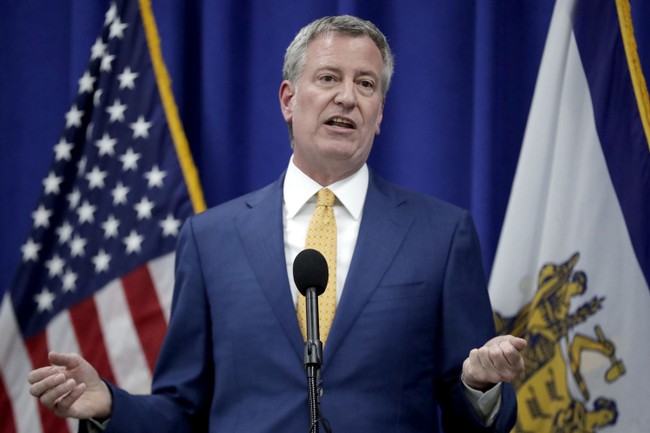
Enter former New York City Mayor Bill de Blasio (D), a failed 2020 presidential candidate who now says, after the fact, that “defund the police” was a bad idea. Not a complicated miscalculation or a nuanced strategic error, but something far simpler. It did not work.
Which, of course, is exactly what millions of Americans were saying at the time, including business owners boarding up storefronts, residents watching crime climb, and communities wondering whether public safety had quietly become optional.
But he is here now, armed with hindsight.
“In retrospect, the whole concept of ‘defund the police’ made no sense.”
“In retrospect” does a lot of heavy lifting there, compressing years of policy decisions, budget shifts, and consequences into a neat conclusion that feels almost incidental.
And just to make the point unmistakable:
“So defund was a mistake. And I understand where it came from, but it was a mistake.”
A mistake, but not the kind that fades quickly or gets corrected quietly. This was a governing decision that carried real weight, reshaped priorities, and played out in real time, long before anyone felt comfortable calling it what it was.
At the time, it was presented as leadership and reform, a necessary rethinking of public safety where funding was not being reduced so much as “reimagined” or “reallocated” into a broader vision that was supposed to produce better outcomes. Questioning that premise was not treated as a good-faith critique. It was treated as resistance.
Now, years later, that same idea is being described as something that “made no sense.”
Not controversial. Not complicated. Just fundamentally flawed.
So what changed?
Policies do not drift into nonsense over time. They either reflect reality, or they do not, and this one never did. It did not require years of hindsight to evaluate, only a basic understanding of what police departments do and what happens when their capacity is reduced.
Read More: Barbara Lee Praised Defunding Police; Now Her SUV Has Been Swiped From City Hall
Mamdani Told New Yorkers How He Felt About the Police, Now He’s Showing Them
After watching the policy unfold largely as critics predicted, the conclusion arrives not as a reckoning, but as a quiet acknowledgment that lands years after the fact, with little interest in revisiting the certainty that drove it in the first place.
And this was not abstract. New York City shifted roughly $1 billion away from its police department at the height of the movement, while tensions were already elevated. That was not messaging. That was governance, a real-time decision defended as the right balance and now reduced to something that “made no sense.”
Because the pattern is familiar. Advance a sweeping idea, dismiss the warnings, live through the results, and then, once the consequences are no longer theoretical, reframe the outcome as obvious.
“In retrospect,” it made no sense.
The problem is not that it took this long to say it out loud.
It is that the consequences showed up years before the apology ever did.
Editor’s Note: Do you enjoy RedState’s conservative reporting that takes on the radical left and woke media? Support our work so that we can continue to bring you the truth.
Join RedState VIP and use the promo code FIGHT to get 60% off your VIP membership!