This article is part of Upstream, The Daily Wire’s new home for culture and lifestyle. Real human insight and human stories — from our featured writers to you.
***
Netflix’s “Train Dreams” received four Oscar nominations this year, including Best Picture, and it walked away empty-handed from every one of them. Ironically, that might be the most fitting outcome for a film that does nothing to demand your attention but simply invites you to consider the mundane beauty that permeates even the most ordinary of lives.
In a dopamine-addicted world, where our senses are blitzed by ever-louder and ever-shorter demands for our attention, “Train Dreams” functions like an antidote for what ails us. It is an ode to the slow work of beauty and its power to transform the human heart.
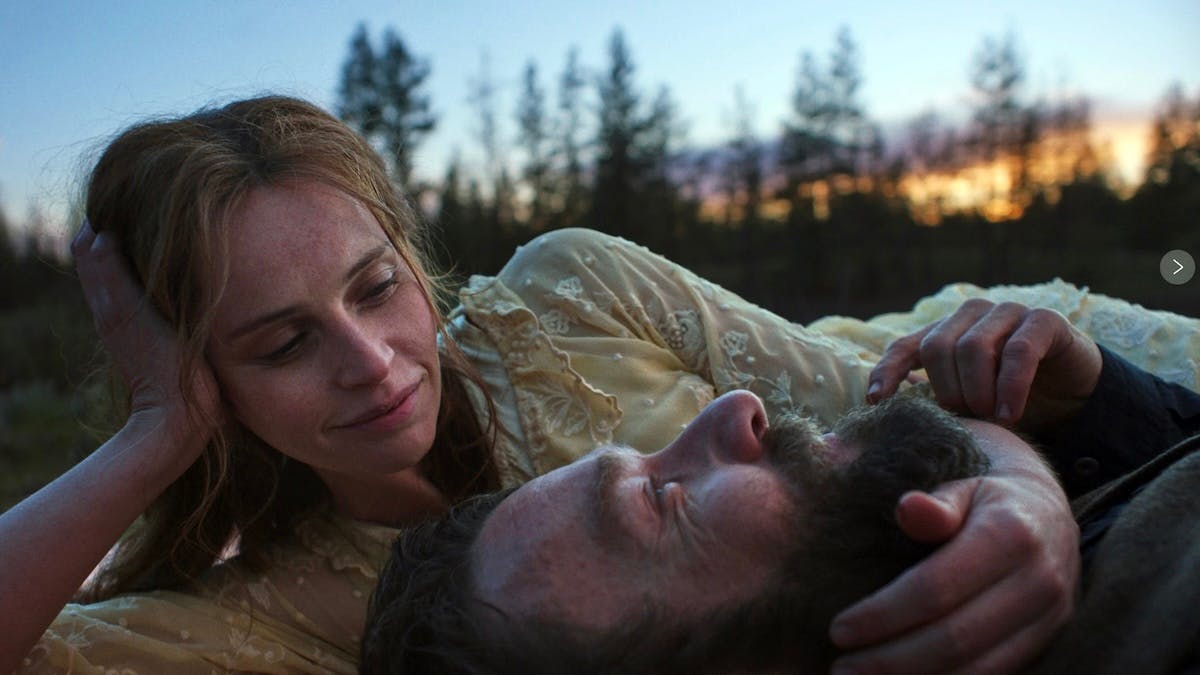
There is a scene early in the film where the protagonist, Robert Grainier (Joel Edgerton), and his wife, Gladys (Felicity Jones), walk to the edge of the Moyie River and begin laying stones in the dirt. Not a foundation — not yet. Just markers. Here is where the walls will go. Here is where the bed will be. Here, where the window faces east, is where the morning light will find them. Two people with nothing but timber and a river and each other, mapping out with rocks a future home that only exists in their shared dreams of a life together.
As the viewer, you’re invited to sit there with them in that moment and consider your own little slice of ordinary life. There is no Avengers-level threat to the multiverse. No high-octane pulsing synth or heart-pounding drums in the soundtrack. Not an ounce of the heavy-handed political preachiness we’ve become far too accustomed to either. Just the story of a simple day laborer in the early 20th-century Pacific Northwest as he makes his way through the joys and sorrows of an ordinary life in a world that is both beautiful and broken.
Edgerton’s character loses his wife, his daughter, his cabin, and his sense of place in a world accelerating past him, and yet this immense Job-like tragedy is juxtaposed against frame after frame of flawless natural beauty. Viewers could pause at any moment in the film and gaze at each frame as a distinct work of art.
That might even be an experiment worth trying because this is exactly the kind of spiritual exercise that “Train Dreams” invites us to do. Slow down, pay attention to the moment, and receive life, even with its troubles, as the gift that it is. Nick Cave — who wrote the film’s Oscar-nominated song — described the world that director Clint Bentley brought to life out of a Denis Johnson novella as a “world exploding all around with strange and beautiful and wonderful things.”
That’s the paradox the film holds without flinching. Robert’s life is small by every metric the modern world and most Hollywood films use to measure significance. He doesn’t build an empire. He doesn’t lead a revolution. He doesn’t even leave Bonners Ferry, Idaho. But his life is full — achingly, almost unbearably full — of the kind of meaning that seems increasingly difficult to find today.
While the amenities of our modern world have made most features of our lives far easier than Grainier’s life in the early 20th century, our attention has been captured by our screens in ways that make seeing the true meaning of life more difficult. The constant digital noise obscures the “vertical” dimension of life — the transcendent awe, beauty, and wonder — that is quietly nestled within the “horizontal” dimension of life with our families, our work, and our daily bread.
You feel it every time you pick up your phone for a two-second dopamine hit. You feel it in the endless scroll, the algorithmic feed designed not to nourish you but to keep you clicking. Our attention, perhaps our most precious commodity, is relentlessly in demand. We’ve been unconsciously conditioned to consume what is on our screens the way we consume fast food: quickly, passively, and in portions intentionally engineered to leave us hungry for more.
“Train Dreams” refuses to play that game. It is aggressively, almost defiantly slow. Clint Bentley shoots the northwest wilderness like a man who believes the natural world is sacred. The camera lingers on firelight, on river water, on the lines carved into Joel Edgerton’s weathered face. There are stretches of this film where nothing “happens” in the way we’ve been trained to expect things to happen. No twist. No reveal. No dopamine spike.
And yet something does happen, something deeper than what will make for a viral TikTok moment. What “Train Dreams” offers is an invitation to a mode of attention that has atrophied in many of us. You don’t watch “Train Dreams” so much as you submit to it. You let it wash over you. And if you’re patient — if you can resist the itch to check your phone, the reflexive hunger for the next stimulus — something starts to shift in your chest. A loosening. A remembering of what’s missing. A slow reforming of what you believe is worthy of your attention. You look at your spouse, your children, your family, and even the odd but slightly endearing coworker a little differently.
The realization hits you, “This is all a gift.”
This is what beauty does. Not the pseudo-beauty of Instagram filters or AI “companions” of lust-driven fantasies. I’m talking about the older and deeper kind. The kind that the poet Gerard Manley Hopkins was pointing to when he wrote that “the world is charged with the grandeur of God.” The kind that doesn’t perform for you but simply is. It’s not anxious to steal your attention. It knows that when you come around to your senses and behold it, you’ll begin to remember what truly matters.
It’s not that the big box office spectacle is bad, but the best spectacles — the ones that actually stay with you, the ones that shape your soul rather than just stimulate your nervous system — are grounded in something real, something human. The box office spectacle should serve the soul. When it doesn’t, when the spectacle is the point, you get content. You get two hours of sensory input that evaporates the moment the credits roll.
“Train Dreams” has no interest in being content in a world where content is unlimited. Instead, it dares to remind you that art and story, and even the world of your own ordinary existence, can be a kind of sacrament that unites the “vertical” and the “horizontal” dimensions of life together.
This is the kind of movie our culture is starving for. Not more deconstruction. Not another jaded anti-hero smirking at the camera. Not another cynical Marxist or postmodern take on the world, which strips away every ounce of the “vertical” dimension of life and reduces the whole world to being about nothing more than an endless conflict between oppressor and oppressed. Real beauty shows how impotent all of that stuff is.
So here’s to the slow work of beauty. It’s the only kind that lasts.
***
Paul Anleitner is a cultural theologian whose work focuses on the role of culture and story in our quest for meaning. He is the author of “Based on a True Story: Vibe Shifts, the End of Deconstruction, and the Reboot of Meaning.”
The views expressed in this piece are those of the author and do not necessarily represent those of The Daily Wire.