America’s allies are finally ready to step up to the plate after years of dithering on the Iranian threat.
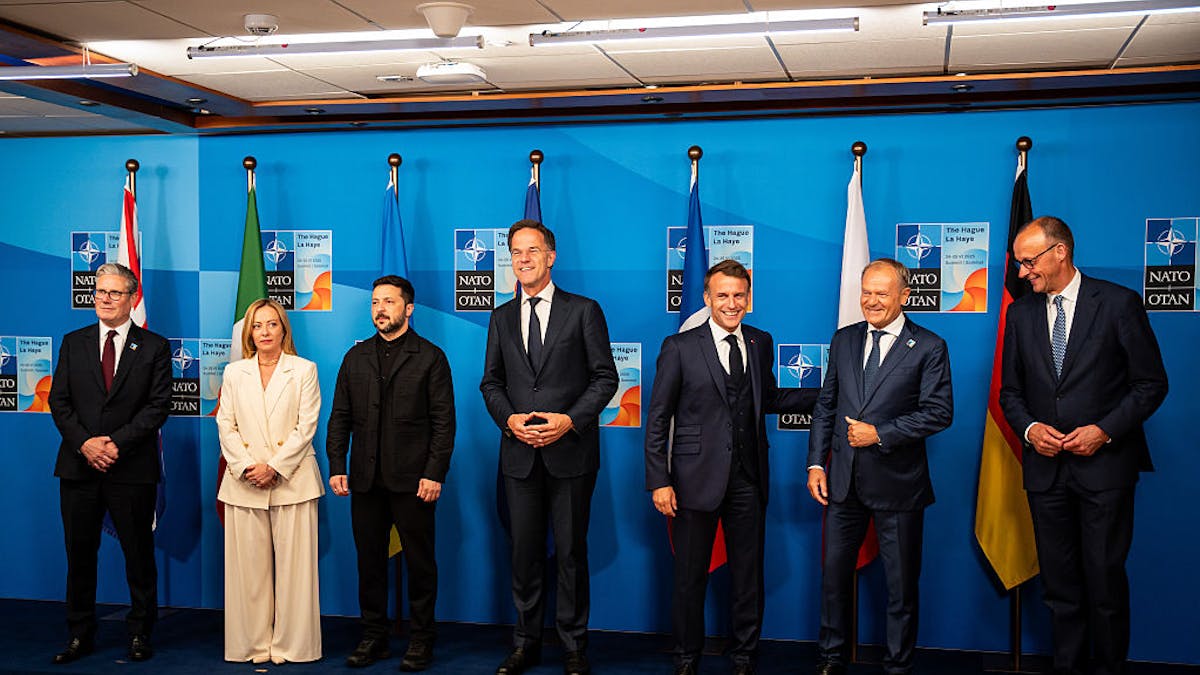
Those allies are ready with all their combined strength: Germany, France, UK, Italy, the Netherlands, Canada, and Japan. They are firing on all cylinders with urgency, resolve, and action.
Yes, that’s right. Our allies, who have been reliant on our largesse and mutual defense for decades, finally announced that they are going to help us, their patron state, the United States — with a very strongly-worded letter.
Our allies are doing what they do best. They are saying things.
At some point, the questions have to be asked: Who are our true allies? Who is actually stepping up to the plate? Who is merely judging from the sidelines?
In lieu of any real world support, our valiant allies have now issued a strongly worded letter.

Here’s what the letter says:
We condemn in the strongest terms, recent attacks by Iran on unarmed commercial vessels in the Gulf, attacks on civilian infrastructure, including oil and gas installations, and the de facto closure of the Strait of Hormuz by Iranian forces. We express our deep concern about the escalating conflict.
We call on Iran to cease immediately its threats, laying of mines and drone and missile attacks and other attempts to block the strait to commercial shipping and to comply with U.N. Security Council Resolution 28-17. We call for an immediate comprehensive moratorium on attacks on civilian infrastructure, including oil and gas installations. We call on all states to respect international law and uphold the fundamental principles of international prosperity and security.
Whoa, dude. Harsh stuff.
Iran must be quaking in its boots. Our allies are saying things.
The Europeans, Japan? They’re expressing “deep concern.” Not “regular” concern. “Deep” concern. They are calling on Iran to do things and to stop being so mean.
But wait, isn’t there some sort of commitment to action in the letter?
The statement does say this: “We express our readiness to contribute to appropriate efforts to ensure a safe passage through the Strait. We welcome the commitment of nations who are engaging in preparatory planning.”
That sounds good, right? But what does “appropriate efforts” mean? Who decides what is “appropriate?”
According to Axios, “On Thursday morning, NATO head Mark Rutte and British Prime Minister Keir Starmer spoke with French President Emmanuel Macron and convinced him to lift his opposition to the political statement of support, while leaving the discussion on the practical steps for later.”
Now, to be fair to Rutte, there’s not much he can do. He’s the head of NATO, but he can’t simply deploy force. He certainly recognizes the Iranian threat, and he would like to avoid alienating the United States.
He said, “We all agree, as we always did, that it was crucial for Iran not to get its hands on a nuclear capability, a ballistic missile capability. And what the U.S. is doing at the moment is degrading that capability of Iran. And I think that’s very important. This is important for European security, for the Middle East. It is vital for Israel itself.”
The Japanese are also paying lip service here; the Japanese prime minister told President Trump, “I firmly believe that it is only you, Donald, who can achieve peace across the world,” adding they would “reach out to many of the partners in the international community, to achieve our objective together.”
So what are our allies actually committing to?
Nothing. This sort of stupidity is nothing new for our allies, who are quite fond of empty verbiage as a substitute for credible threat of force.
Go all the way back to 1919, when the covenant of the League of Nations was integrated into the Treaty of Versailles. That attempt to form a family of nations — while it was not a success — led to 1928, when 15 countries came together to sign what was called the Kellogg-Briand Pact.
It outlawed war.
Did you know that? That war was outlawed in 1928? The signatories included France, the US, UK, Ireland, Canada, Australia, New Zealand, South Africa, India, Belgium, Poland, Czechoslovakia, Germany, Italy, and Japan. 47 more nations joined in as well.
And then, three years later, in 1931, Japan invaded Manchuria and nobody did anything. And by 1941, every single nation that had signed the treaty, with the exception of Ireland — which basically stayed out of the war and sided with Germany — was enmeshed in World War II.
Empty verbiage.
The same thing holds true today. For decades, our allies have pretended to oppose the Iranian terror regime while doing virtually nothing to hold them accountable. They’ve imposed some rather minor sanctions targeting specific officials, unless the United States has pushed them into broader sanctions.
We’ve had to do all the hard work, as per our usual arrangement.
So here’s the deal. If we’re going to do all the work and undertake all the sacrifice and spend the blood and treasure, then we ought to reap the benefit.
There’s been a lot of talk about what the United States ought to do next with regard to Iran. The most obvious move, and one I’ve been advocating, is for the United States to seize Kharg Island. President Trump has been suggesting for a while that this may happen.
Nearly 90% of all Iranian oil passes through Kharg Island. The Iranians have already, in large part, shut the Strait of Hormuz. They’ve already upped the ante in terms of attacks on surrounding gas and oil facilities. So the United States doesn’t have tremendous downside here.
What’s Iran going to do, attack more oil facilities? We ought to seize control of the oil, and then we ought to let American companies keep pumping it, and then we ought to send it to its final destination, China. China would then know that we are in charge of the spigot; Iran’s terrorist government would be deprived of their monetary flow.
What about the Europeans?
If the price of oil rises, they can buy it from us, not the Iranians.
If they’re not going to join us as allies, they can pay our companies for the oil.