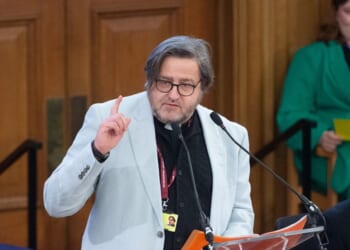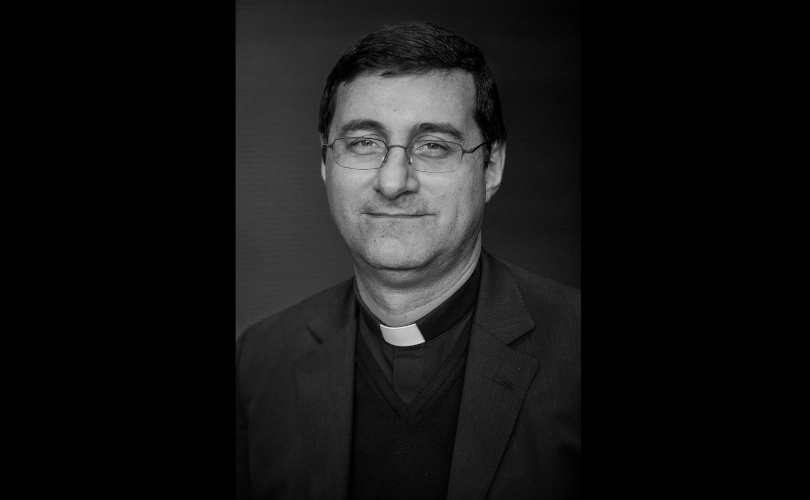
VATICAN CITY (LifeSiteNews) —Archbishop Paolo Rudelli will replace Archbishop Edgar Peña Parra as Substitute of the Secretariat of State, with an official Vatican announcement expected soon.
On March 20, Italian journalist Nico Spuntoni reported that Rudelli, currently apostolic nuncio to Colombia, has been chosen to succeed Peña Parra as Substitute for General Affairs in the Secretariat of State. The official confirmation by the Holy See Press Office is anticipated imminently, though it had not yet been issued at the time of reporting.
LOOK: New photos of future Pope Leo XIV in Pachamama idolatry emerge
Rudelli entered the diplomatic service of the Holy See in 2001, following formal ecclesiastical and canonical training. His early assignments included service in the apostolic nunciatures in Ecuador (2001–2003) and Poland (2003–2006). On September 20, 2014, he was appointed Permanent Observer of the Holy See to the Council of Europe in Strasbourg, France.
His diplomatic career advanced further on October 4, 2019, when he was named titular archbishop and apostolic nuncio. His episcopal consecration was conferred by Pope Francis. Among the co-consecrators were Cardinal Pietro Parolin and Cardinal Peter Turkson.
In 2023, Rudelli was appointed Apostolic Nuncio to Colombia. In that role, he emphasized the vitality of the local Church and the “importance of lay participation.” He encouraged the faithful to build what he described as a “participatory and inclusive Church,” urging them to “continue along the synodal path proposed by Pope Francis.” He also stated that the “Church in Colombia has a significant contribution to offer to the wider universal Church in the present period.” It is not clear what he was referring to.
According to sources consulted by LifeSiteNews, Rudelli is considered close to the cardinal secretary of state, Pietro Parolin. This perceived alignment suggests that he may continue the diplomatic approach associated with Parolin, including policies connected to the provisional agreements between the Holy See and China, which are currently set to expire on October 22, 2028.
These considerations also appear to be confirmed by what emerges from some of his public interventions. During his tenure at the Council of Europe, on July 28, 2017, he delivered an extensive lecture in Rovereto, Italy, titled: “The Promotion of Human Rights in the International Action of the Holy See.” In that address, he outlined a historical interpretation of the Church’s engagement with the concept of human rights.
According to Rudelli, the Church’s initial phase of criticism toward modern human rights frameworks extended from 1791 until 1963, when Pope John XXIII’s encyclical Pacem in terris marked a decisive shift toward acceptance. He identified subsequent pontificates, particularly those of Paul VI and John Paul II, as consolidating this position by linking human rights with human dignity and political legitimacy.
However, Rudelli also argued that since approximately 1995, a renewed tension has emerged. He pointed to the development of so-called “new rights,” including those related to sexuality, reproduction – namely, contraception and abortion – and identity, as a source of anthropological conflict.
In the same lecture, Rudelli contrasted the approaches of Popes Benedict XVI and Francis. He explained that Benedict XVI emphasized three essential criteria for a coherent understanding of human rights: universality, indivisibility, and interdependence, all grounded in the recognition of natural law. By contrast, Rudelli observed that under Francis, natural law is not denied but placed in a “secondary position relative to the evangelical message,” with greater emphasis on pastoral practice and witness.
He also addressed broader diplomatic themes, including the legacy of the Holy See’s Ostpolitik, that is, the diplomatic strategy developed by the Vatican during the Cold War, especially under Pope Paul VI, aimed at maintaining and gradually improving relations with communist regimes in Eastern Europe. Their promoters were Cardinals Villot, Casaroli, and later Silvestrini. According to the testimony of Father Charles Murr, Villot was among the high-ranking Masonic prelates identified by the Gagnon investigation, while, as the historian Julia Meloni proved, Silvestrini was the mastermind of the St. Gallen Group.
In his analysis, Rudelli suggested that this diplomatic model should be understood not merely as a political tactic but as an expression of a broader ecclesial and cultural judgment, one that prioritizes long-term engagement over immediate gains. He also complained that this process has not been uniformly shared across the Church, particularly among episcopates in Eastern Europe, which experienced communist regimes directly.
He also complained about the silence of the Eastern European bishops on an issue like the rights of immigrants, which in his view falls among the “older rights.”
READ: Israel’s extended closure of Church of the Holy Sepulchre sparks global Easter concerns
The Substitute for General Affairs of the Secretariat of State is the Vatican’s number two diplomat, essentially acting as the Pope’s right-hand aide in coordinating the Church’s global administration and daily governance. He oversees the Section for General Affairs, handling internal Roman Curia operations, correspondence, coordination among Vatican offices, and support for the Pope’s worldwide mission – much like a chief of staff who ensures smooth execution of the Pontiff’s directives.
He also belongs to the so-called Pontifical Family, that is, the curial office that serves the Pope in his capacity as the temporal sovereign of Vatican City, because of his recurring private audiences with the Pope. This privilege is shared only by the Secretary of State, symbolizing his intimate role in the Holy Father’s closest circle of personal collaborators.