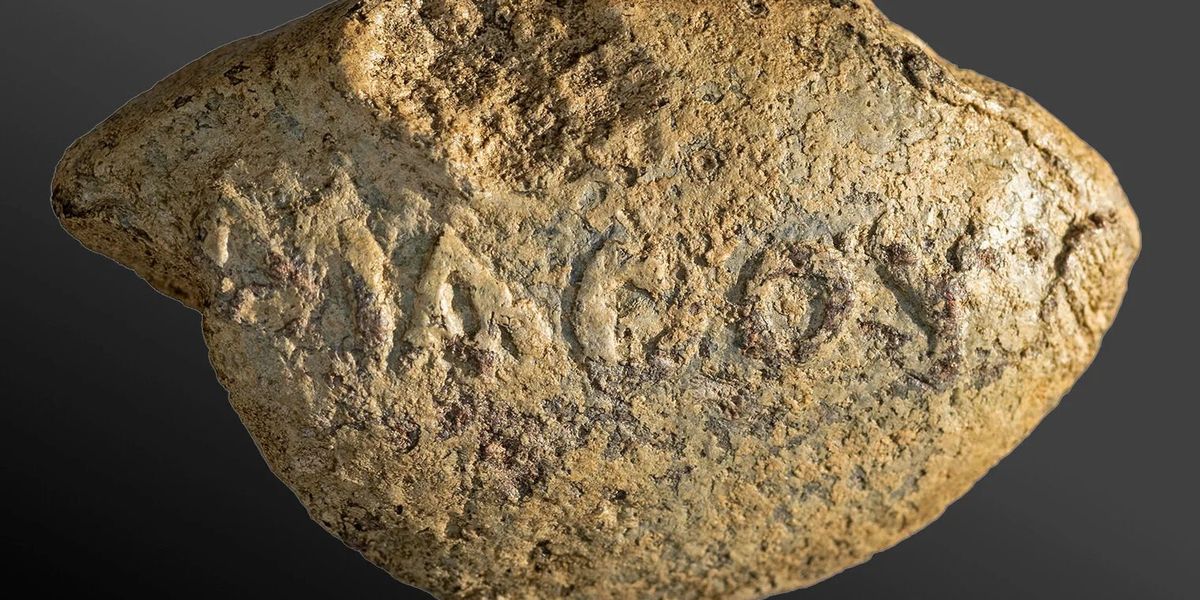
Archaeologists have been left stunned after uncovering a 2,000-year-old sling bullet in Israel inscribed with an ominous message.
The almond-shaped weapon, measuring 3.2 by 1.95 centimetres, was discovered at Hippos – a ruined city around a mile from the Sea of Galilee.
Researchers believe it was fired by Greek defenders and carries the taunting message “learn your lesson” in ancient Greek.
The artefact weighs 38 grams in its current state, though experts estimate it originally weighed around 45 grams before being damaged on impact.
“This is the first instance of the Greek word ‘learn’ attested on sling bullets – probably the local defender’s sense of sarcasm,” Dr Michael Eisenberg, of the University of Haifa, told the Daily Mail.
The projectile was found during metal detector surveys in 2025 near what would have been the main approach to the city’s entrance.
It lay around 260 metres from the defensive walls – highlighting the range such weapons could reach.
“This represents local sarcastic humour on the part of the city’s defenders, who wished to teach their enemies a lesson with a wink,” Dr Eisenberg said.

Researchers believe it was fired by Greek defenders and carries the taunting message ‘learn your lesson’
|
MICHAEL EISENBERG / UNIVERSITY OF HAIFA
The inscription, ΜΑΘΟΥ, was formed by pouring molten lead into an engraved mould.
Scholars say it is the imperative form of the Greek verb “mathaíno”, meaning “learn”.
While numerous sling bullets have been uncovered at Hippos – now known as Sussita – this is the first with this specific message.
Other projectiles found at the site carry similarly grim phrases, including “catch” and “take a taste”.
REMARKABLE FINDS – READ MORE:

The discovery was made at Hippos – a ruined city around a mile from the Sea of Galilee
|
GETTY
“Sling bullets were a cheap munition, a hand-thrown projectile, used for millennia,” Dr Eisenberg said.
Dating suggests the weapon was used in the late second century BC or early first century BC.
It may have been fired during clashes between the expanding Jewish Hasmonean kingdom and Greek-controlled territories.
“In 101 BC, we see Alexander Jannaeus trying to conquer Hippos and this region,” Dr Eisenberg added.

Dating suggests the weapon was used by Greek defenders in the late second century BC or early first century BC
|
GETTY
Researchers say alternative explanations include conflicts between rival Greek states or even military training exercises.
“We don’t know if it was a rock or a person, but there was definitely an impact,” he said.
The findings have been published in the Palestine Exploration Quarterly journal.
“At short distances they were highly effective at hitting individual targets, while at longer distances they were effective against a cluster of enemies,” Dr Eisenberg said.