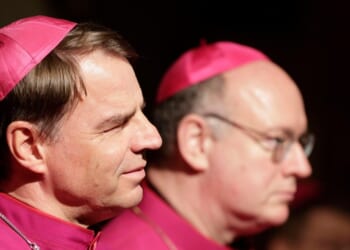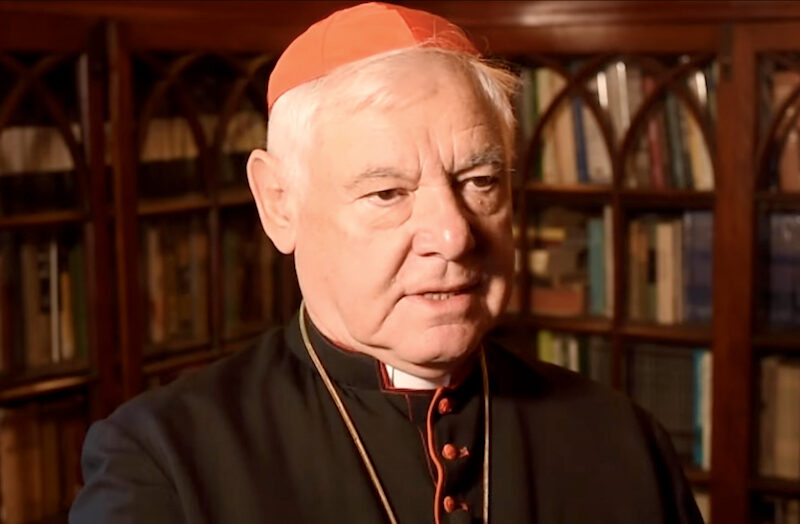
(LifeSiteNews) — Cardinal Gerhard Müller has warned the Society of St. Pius X (SSPX) that consecrating bishops without consent from the Holy See would cause schism and defended the orthodoxy of the Second Vatican Council.
In an extensive interview with the German Catholic magazine Communio, the former prefect of the Congregation (now Dicastery) of the Doctrine of the Faith answered questions regarding the hotly debated situation of the SSPX.
Müller stressed that the main conflict between the traditionalist Society and the Holy See is not about the liturgy but “the doctrine of the faith, which they also see as being compromised in the renewed liturgy.”
“Certain formulations of the Second Vatican Council are subject to questionable interpretations, such as the claim that Muslims, like Christians and Jews, acknowledge the Creator within the tradition of Abraham and worship the one God alongside us,” he said.
“[The SSPX] see this as a form of religious-historical relativism that posits a common religion of humanity beyond God’s self-revelation in Jesus Christ,” the German cardinal continued. “This overlooks the classical Catholic teaching that human reason is, in principle, capable of recognizing the existence and unity of God, while the mysteries of the Trinity and the Incarnation are revealed only through supernatural faith (Thomas Aquinas, Summa contra Gentiles I, 2 and 6; First Vatican Council, Dogmatic Constitution Dei Filius, Canon I, 1: DH 3026).”
“If one reads the statements of the Second Vatican Council—which the Society of St. Pius X has criticized—within the broader context of the Church’s entire tradition, then a relativist interpretation is ruled out,” he concluded.
Addressing the question of religious liberty, the prelate said that “it must be noted that the Church has not changed its position in substance, if one considers only the respective context in which this ambiguous term was used in various situations.”
“Bishop Wilhelm von Ketteler had already presented religious freedom during the Kulturkampf (Address to the General Assembly of German Catholics in Freiburg im Breisgau on September 1, 1875) as the natural right of every human being, rooted in the spirit and freedom of the person, to defend oneself against state interference in one’s conscience, just as the Second Vatican Council did in the declaration Dignitatis humanae.”
“The one is the right of every person, without external coercion or internal manipulation, to choose and practice their religion in accordance with their conscience; the other is, on a supernatural level, God’s call in the Word of His revelation in Jesus Christ, to which, with the help of grace and in the light of the Holy Spirit, the obedience of faith must be rendered with reason and free will (Dei verbum, Art. 5),” Müller stated.
READ: Bishop Schneider says excommunication of SSPX would be invalid
Asked about whether or not the SSPX’s “hermeneutic of rupture” regarding the Second Vatican Council was valid, Müller said: “In my conscience, I cannot discern any rupture in the continuity of doctrine, nor any negation or even diminution of an article of faith as it is founded in Sacred Scripture, developed in the apostolic and ecclesial tradition, and presented to me by the Magisterium—for the sake of my salvation—as something to be believed firmly and unbreakably.”
“That is why, in my discussions with the Society of St. Pius X, I have insisted that their criticism of certain statements of the Second Vatican Council would be justified only if the Council had actually taught what they attribute to it,” he noted.
“Rather, those who attribute grave errors in the faith to the legitimate Second Vatican Council are mistaken, contrary to the time-tested Catholic hermeneutics that the Church Father Irenaeus of Lyons had already developed in detail against the Gnostics.”
Speaking about the often controversially discussed Vatican II document Nostrae Aetate about the Church’s relation to non-Christian religions, the cardinal said: “What the Church presents to us for belief must be determined, within its graded authority, by the context of the teaching and by the intended meaning of the bishops and the Pope.”
“Although Nostra Aetate is, in terms of literary genre, merely a declaration, the statements of this conciliar document are binding like a dogma, for example, when it is said that all peoples form a single community and have their origin and goal in God (NA 1).”
“When the Council refers generically to the disputes between Christians and Muslims, it is merely stating a historical fact, without obliging the individual Christian to adhere to a magisterial interpretation of history,” he added.
The 78-year-old cardinal acknowledged that the SSPX “has every right to denounce… liturgical abuses and dogmatic errors.” However, “all such criticism remains fruitless if it is merely preached from the moral high ground of self-righteousness.”
In regard to SSPX’s questionable status, Müller said: “Better to be treated unjustly by church authorities than to leave the community of salvation—that was the motto of St. Hildegard of Bingen, whom we venerate today as a Doctor of the Church.”
Addressing the planned episcopal consecrations without the permission of the Holy See, Müller warned that “the communal character of episcopal authority is being violated, which is guaranteed by the Pope as the perpetual principle and foundation of the unity of the Catholic Church.”
“Excommunication for this grave offense against the unity of the visible Church, as a mortal sin, also entails exclusion from the life of grace and communion with God, as well as from the hope of eternal life,” he said.
“They cannot plead a state of emergency before God, because none of their followers are deprived of the sacraments of Baptism and Penance, which are necessary for salvation,” he continued. “On the other hand, it is not an emergency that without illegally consecrated bishops, their priestly community would not continue. For Jesus Christ promised the continuation of the Church until the end of history only to the universal Church, which He builds upon the rock of Peter, to whom He also handed over the keys of the Kingdom of Heaven and, together with the other Apostles, the power to bind and loose.”
“An episcopal consecration without the express permission of the Pope, or in obvious negation of his authority as the successor of Peter appointed by Christ and guided by the Holy Spirit, cannot be justified before God and man by anything or anyone,” Müller argued.
“Whoever confers or receives episcopal ordination without permission is indeed validly ordained, but the Holy Spirit bears witness against him, because he acts not out of love but according to his own discretion,” he stated.
“Woe to those who are responsible for this,” he warned. “May all those involved, in this hour of examination of conscience before the living God, take to heart the words of St. Augustine: ‘Whoever does not love the unity of the Church is not in possession of the Holy Spirit. For this reason, it is rightly said: Only in the Catholic Church is the Holy Spirit received.’ (De baptismo 3, 16).”