SIX months after the announcement in Canterbury Cathedral that the Bishop of London, the Rt Revd Sarah Mullally, had been nominated as the 106th Archbishop of Canterbury (News, 10 October 2025), the new Primate returned to the city to be installed in her new cathedral.
Although she her election was confirmed in January (News, 30 January), the enthronement on Wednesday marks the symbolic start of her public ministry. She makes history as the first woman to hold the position in 1400 years.
The Archbishop had arrived on foot in Canterbury as a pilgrim on Sunday, six days after setting out from St Paul’s Cathedral with her husband, Eamonn, and a small party of supporters. On Sunday, about 100 people joined her on the outskirts of the city for the last part of the journey to her cathedral, where she was greeted by the Mayor, the Dean, and the Bishop of Dover. Dressed informally in walking clothes and boots, she pronounced herself “relieved” to have completed the 87-mile journey, telling the BBC: “It’s been a real joy. It’s also a joy to know that we’re done.”
The service on Wednesday — attended by more than 2000 people — was an altogether more formal occasion, full of pomp and pageantry. Guests included the Prince and Princess of Wales, the Prime Minster, the Leader of the Opposition, the Commonwealth Secretary-General, and a delegation of the United Nations. Also, there were clergy from across the Church of England and the Anglican Communion, ecumenical and interfaith representatives, civic leaders, charity and health-care workers, schoolchildren, and the Archbishop’s family and friends.
More than 100 of the guests had travelled to the UK to represent Anglicans from the 165 countries whose Anglican Churches make up the Communion. Among their number were 26 Primates. Another four, prevented from attending by ill health or other commitments, sent representatives.
The Archbishop in Jerusalem — who was a member of the Crown Nominations Commission — was forced to send his apologies because of the situation in the Middle East. The Archbishop of Melanesia and the Acting Primate of Papua New Guinea were also said to have been prevented from travel because of the conflict. Also absent from the attendance list were the Primates of Nigeria, Uganda, Rwanda, Congo, Kenya, Myanmar, and Chile.
Ecumenical guests included delegations from the Holy See, the Ecumenical Patriarchate, the Coptic Orthodox Church, and other Christian denominations.
Closer to home, the Church of England was represented by parish clergy, ordinands, church musicians, churchwardens, and licensed lay ministers, as well as the full panoply of bishops and cathedral deans. There were representatives of charities associated with the Archbishop, both personally and also by virtue of her office, including Christian Aid, the Clergy Support Trust, and the bereavement charity At A Loss. Nurses and carers working in hospitals and hospices in Canterbury had also been invited, in recognition of the Archbishop’s nursing background.
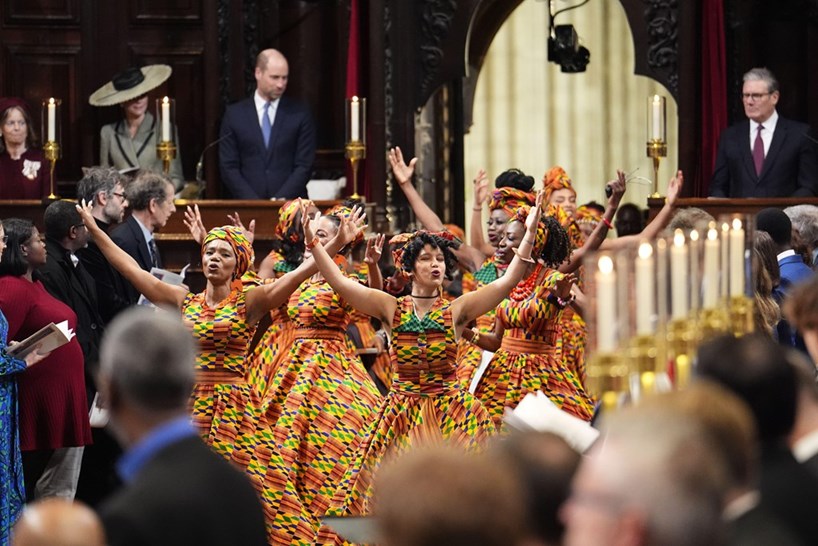 AlamyThe African Choir of Norfolk sing during the installation service in Canterbury Cathedral, on Wednesday. The Prince and Princess of Wales, and the Prime Minister, look on
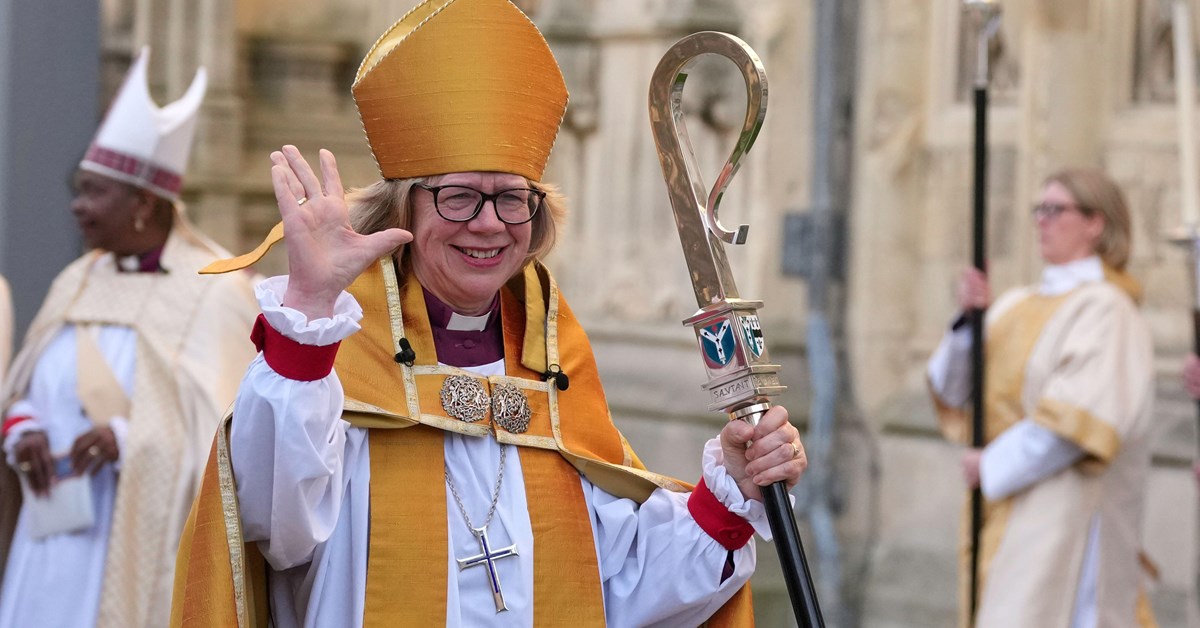
The Archbishop wore the cope and mitre that she commissioned when she was first consecrated as a bishop. The clasp on her cope is fashioned from the belt buckle that she wore as a nurse while serving in the NHS. And, as a symbol of the Church of England’s close ties with the Roman Catholic Church, she wore the pastoral ring given to Archbishop Michael Ramsey in Rome by Pope Paul VI, in 1966, which has been specially fitted for her by the Crown Jeweller.
The service was held on the Feast of the Annunciation — a date earmarked by the cathedral for the occasion well before the nomination, but particularly appropriate given its other name, Lady Day. Concerns that the meningitis outbreak in Kent might disrupt the event were raised last week, but the UK Health Security Agency advised that the service could go ahead as planned.
The weather was less considerate, however: the warm and sunny spring days that the Archbishop enjoyed during her pilgrimage were replaced by biting winds, flurries of snow and sleet, and blustery showers, sending guests and onlookers scurrying for cover, and even threatening to send the Princess of Wales’s wide-brimmed hat skywards.
As is customary, the service began without the Archbishop herself. Two long and colourful processions, a splendid royal fanfare by Onyx Brass, signalling the arrival of the Prince and Princess of Wales, a welcome by the Dean of Canterbury, the Very Revd David Monteith, and the hymn — “Praise, my soul, the King of Heaven”, chosen by the Archbishop, as were all the hymns — all preceded her entry into the building.
Only after the reading of the Mandate from the King was the congregation invited to turn towards the west door, where a windswept Archbishop was awaiting admission.
Following tradition, she struck the barred door three times with her pastoral staff, and, in response, a second fanfare sounded. There followed the traditional greeting by children, in this instance students selected from John Wallis Academy in Ashford, who asked: “Who are you and why do you request entry?” The Archbishop responded: “I am Sarah, a servant of Jesus Christ, and I come as one seeking the grace of God, to travel with you in his service together.”
The back-and-forth continued: Archbishop Mullally responded that she was “sent to serve” her people, and came “knowing nothing except Jesus Christ and him crucified”, and that she approached her task “in weakness and fear and in much trembling”.
Finally admitted across the threshold, the Archbishop led the congregation in a penitential rite, in which the Kyrie (“Khudya, rahem kar”) was sung in Urdu to a setting by Christopher Ouvry-Johns. Dean Monteith greeted the Archbishop and the procession moved from the west end to the nave altar.
A second hymn followed — “Thy hand, O God, has guided” — before the Archbishop of York — who has held the reins since the departure of Archbishop Welby — invited her to affirm her assent to the canons and creeds of the Church of England, and swear an oath on the scriptures. For this, a new Bible, the St John’s Bible, decorated with contemporary illustrations inspired by historical illuminations, was used for the very first time, in place of the sixth-century Augustine Gospels, which were used for this purpose until 2013, but are now too fragile to be moved.
After the signing of an ecumenical covenant, there followed the anthem “O Lord, give the Holy Spirit in to our hearts” by Thomas Tallis, once a lay clerk in Canterbury Cathedral Choir in the 16th century. The music of the service was led largely by today’s choir, marking the first enthronement of an Archbishop of Canterbury since the admission of girl choristers in 2014.
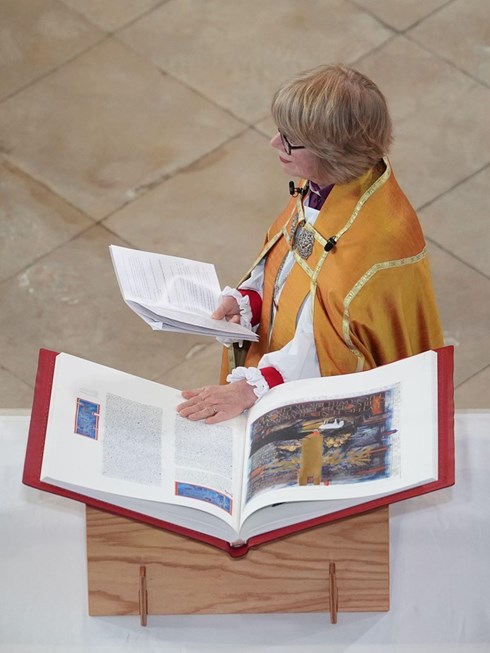 AlamyArchbishop swears an oath on the St John’s Bible
The anthem was followed by the hymn “Come down, O Love divine”. The Most Revd Richard Moth, the Archbishop of Westminster, read the Old Testament reading: Isaiah 7.10-14. The Gospel acclamation “Hata Milele, Jesu ni bwana” (“Even for ever, Jesus is Lord”), from Congo, was sung in Swahili by the African Choir of Norfolk, before the Gospel — Luke 1.26-38 — was read, in Spanish, by the Bishop of Mexico, the Rt Revd Alba Sally Sue Hernandez Garcia.
The African Choir of Norfolk sang for a second time before the installations, this time in Heroro, “Muhona matu kutanga” (“Our creator we praise”), a song from Namibia. Dressed in brightly coloured robes and swaying to the music as they moved through the building, their obvious joy proved infectious, judging by the expressions of those around them.
At this point, the Archbishop moved eastwards towards the quire, which houses the diocesan cathedra, dating from 1844 and a gift from Archbishop William Howley. The Archdeacon of Canterbury, the Ven. Dr Will Adam, installed her in the chair, with its “rights and dignities and all its opportunities for service”.
The Bishop of Winchester, the Rt Revd Philip Mounstephen, as Dean of the Province of Canterbury, blessed the Archbishop, and she was presented with a pastoral staff — symbolic of her role as shepherd to the people — once used by Geoffrey Fisher, the last Bishop of London to become Archbishop of Canterbury. He received this in 1961 as a gift from the 33 bishops and metropolitans of the Anglican Communion as it then was.
The Bishop of Dover, the Rt Revd Rose Hudson-Wilkin, prayed that the Archbishop would be a faithful shepherd in her leadership.
Another anthem was sung — a contemporary setting of Psalm 150, “O praise God in his holiness”, by Matthew Martin, once an organist of Canterbury Cathedral — while the procession moved on to the second cathedra, the Chair of St Augustine. This chair, made of Purbeck marble, dates from the early 13th century and sits near the site of Thomas Becket’s shrine in the Trinity Chapel.
This time, the Dean installed the Archbishop, praying that she would become “an instrument of communion”. The secretary-general of the Anglican Communion, the Rt Revd Anthony Poggo, presented her with a compass rose, before the Primate of Central Africa, the Most Revd Albert Chama, led a prayer in the Bemba language of Zambia.
And then came the moment when the Dean presented the newly installed Archbishop to the congregation, and they responded with whoops and prolonged applause, leaving the Archbishop visibly moved.
The hymn “There’s a wideness in God’s mercy” followed, before the Archbishop preached her inaugural sermon from the Chair of St Augustine, in which she touched on her recent pilgrimage, and the Virgin Mary’s trust in the promises of God.
“As a Church, we are a pilgrim people,” she said. “And, like Mary, we are called to trust that nothing will be impossible with God, even when we see so much in the world that makes hope seem impossible.”
The choir then sang an anthem based on famous words of Julian of Norwich — “All shall be well” — and composed by Joanna Marsh.
The prayers were led by a range of voices representing the diocese, including the Archdeacon of Ashford, the Ven. Darren Miller; a pupil from the Archbishop’s School, Canterbury; a member of the vacancy- in-see committee, the diocesan refugee project worker, and the chaplain of the Pilgrims Hospice in Canterbury.
And then, in a new departure, the Archbishop led the congregation in an act of commitment, before the final hymn, “Tell out, my soul”. She pronounced a blessing on the congregation before processing out of the cathedral. For a second time, the congregation burst into noisy applause, the sound rippling through the Cathedral and at one point even appearing to overwhelm the organ.
After greeting the Prince and Princess of Wales — who had joined in with the applause before leaving their seats — at the west door of the cathedral, the Archbishop walked through the Christ Church Gate of the Cathedral precinct to deliver a blessing on the city and the diocese, to the jubilant sound of a quarter-peal.
Before the service, Archbishop Mullally said: “As I prepare to begin my ministry as Archbishop of Canterbury, I am grateful for the prayers and support I have received from people here and around the world. To be welcomed into the city and diocese of Canterbury is an immense privilege — and I am grateful to be sharing in this moment with people of all ages and backgrounds from across the Church of England, the Anglican Communion, our nation, and the world.
“Our world today needs the love, healing, and hope that we find in Jesus Christ. I continue to pray that we renew our confidence in this good news, and recommit ourselves to sharing the joy of the gospel.”