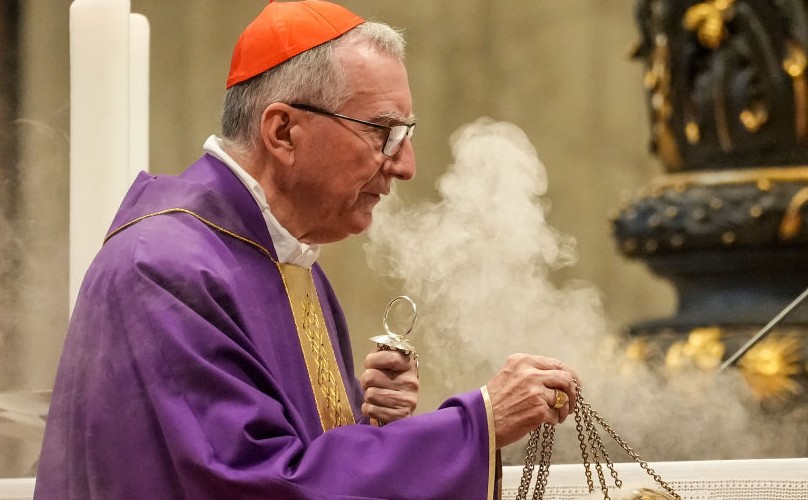
(LifeSiteNews) — Cardinal Pietro Parolin has said the liturgy must not become a source of “division.”
In a statement to the Catholic Herald, the Vatican Secretary of State signaled that he shared Pope Leo XIV’s approach toward the Traditional Latin Mass (TLM), which remains somewhat unclear, although bishops have freely continued to suppress the TLM under his pontificate.
“I think we all share this, let’s say, assessment that the Pope gives,” Parolin said, “in the sense that the liturgy must not become a source of conflict and division among us.”
Parolin echoed Pope Francis, who claimed that the offering of the TLM enabled through Pope Benedict XVI’s Summorum Pontificum has been a source of division in the Church and used this as a pretext to suppress it through Traditionis Custodes in his letter accompanying the document.
High-ranking clergy and scholars have argued, however, that if there has been any division after the implementation of both the traditional Latin Mass and the Novus Ordo Mass, the offering of the venerable and time-honored Latin Mass cannot be blamed.
Cardinal Raymond Burke has affirmed that the traditional liturgy is not something that can be excluded from the “valid expression of the lex orandi.”
“It is a question of an objective reality of divine grace which cannot be changed by a mere act of the will of even the highest ecclesiastical authority,” the cardinal wrote in 2021.
Liturgical scholar Dr. Peter Kwasniewski has pointed out that “the traditional liturgical worship of the Church, her lex orandi (law of prayer),” is a “fundamental” “expression of her lex credendi, (law of belief), one that cannot be contradicted or abolished or heavily rewritten without rejecting the Spirit-led continuity of the Catholic Church as a whole.”
In his remarks to the Catholic Herald, Parolin vaguely stated that “It will be necessary to find the formula … that can meet legitimate needs.” He added that such a solution must not “tur(n) the liturgy into a battlefield.”
His suggestion that a compromise can be struck regarding the liturgy recalls a recent message from Pope Leo XIV that Parolin delivered to the French bishops in which he urged them to seek “concrete solutions” including Catholics “attached” to the Traditional Latin Mass.
“It is troubling that a painful wound continues to open in the Church concerning the celebration of the Mass, the very sacrament of unity,” the Pope wrote.
To address the situation, he called for greater mutual understanding among Catholics with differing liturgical sensibilities and encouraged the bishops to develop practical measures. He expressed hope that the Holy Spirit would suggest “concrete solutions that would generously include those sincerely attached to the Vetus Ordo while respecting the orientations set forth by the Second Vatican Council regarding the Liturgy.”
Sacrosanctum Concilium, Vatican II’s Constitution on the Sacred Liturgy, states among other broad directives that “the use of the Latin language is to be preserved in the Latin rites,” but also that the vernacular may be used for prayers and chants as well as readings.