(LifeSiteNews) — Last week, LifeSiteNews broke the story that the future Leo XIV actively participated in the worship of the pagan goddess Pachamama while serving as an Augustinian friar in Peru.
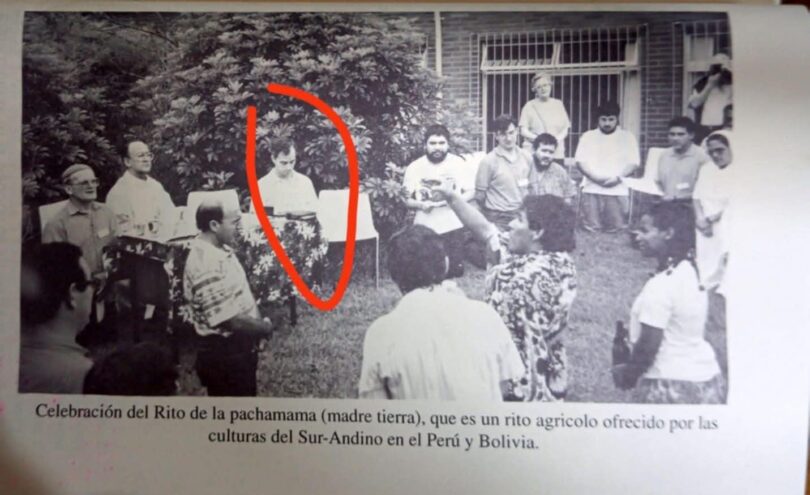
Rev. Robert Prevost OSA can be clearly seen kneeling with other worshippers in a photograph in the official proceedings of the IV Simposio-Taller “Lectura de San Agustín desde América Latina” (São Paulo, January 23-28, 1995), published as the book Ecoteología: Una Perspectiva desde San Agustín (México, 1996).
The official caption beneath the photo of participants reads:
Celebración del Rito de la pachamama (madre tierra), que es un rito agrícola ofrecido por las culturas del Sur-Andino en el Perú y Bolivia.
This translates into English as:
Celebration of the Rite of Pachamama (Mother Earth), which is an agricultural rite offered by the cultures of the South-Andean region in Peru and Bolivia.
The idol of Pachamama was worshipped in the gardens of the Vatican in 2019 on the vigil of the opening of the “Amazon Synod.” This ritual was attended by Francis.
The goddess Pachamama is associated with human sacrifice. In ancient Peru and Bolivia, children were sacrificed to Pachamama in a practice known as capacocha. The children would be drugged and then killed by various methods, including strangulation, a blow to the head, suffocation, or being buried alive.
And the sacrifices continue today. In 2024, a Bolivian newspaper reported the case of a young mother of two who was drugged and murdered – possibly buried alive – in what investigators believe was a human sacrifice offered to Pachamama.
The participation of any priest in the public worship of a false god associated with human sacrifice is surely newsworthy. But when the man concerned is widely considered to be the visible head of the Catholic Church, the story is clearly in the public interest.
Many Catholics have thanked LifeSiteNews for breaking this story, and for having the courage to tell the truth.
Others have reacted with hostility, either denying LifeSiteNews’ claims (despite the evidence provided), or stating that LifeSiteNews should have covered up the discovery rather than making it known.
Here we wish to explain why LifeSiteNews broke this story, and why we believe it is for the greater glory of God and the salvation of souls.
Idolatry is among the gravest of all sins
Idolatry is “the giving to any creature divine honour, e.g. sacrifices to Satan, to idols, to the elements, genuflecting to idols as to God.”
It is not by accident that idolatry is condemned in the first of the Ten Commandments revealed by God to Moses on Mount Sinai:
Thou shalt not have strange gods before me. Thou shalt not make to thyself a graven thing, nor the likeness of any thing that is in heaven above, or in the earth beneath, nor of those things that are in the waters under the earth. Thou shalt not adore them, nor serve them. (Exodus 20: 3-5)
Under the Mosaic law, idolatry was punishable by death (Deut 17: 2-5). Throughout Sacred Scripture, it is identified as an offense hateful to God. Speaking to Israel through the Prophet Jeremiah, God said:
I sent to you all my servants the prophets, rising early, and sending, and saying: Do not commit this abominable thing, which I hate. (Jer 44:4)
St. Thomas Aquinas argued that idolatry could be considered the gravest of all sins:
For just as the most heinous crime in an earthly commonwealth would seem to be for a man to give royal honor to another than the true king, since, so far as he is concerned, he disturbs the whole order of the commonwealth, so, in sins that are committed against God, which indeed are the greater sins, the greatest of all seems to be for a man to give God’s honor to a creature, since, so far as he is concerned, he sets up another God in the world, and lessens the divine sovereignty.
Idolatry in the Old Testament
The hostile reaction to LifeSiteNews’ reporting – and the widespread indifference to Prevost’s idolatry – demonstrates that the gravity of the sin of idolatry is not understood by many people today. Yet it is one of the main themes of Sacred Scripture.
Even while Moses was receiving the Ten Commandments from God on Mount Sinai, the Israelites were making an idol for worship:
And the Lord spoke to Moses, saying: Go, get thee down: thy people, which thou hast brought out of the land of Egypt, hath sinned. They have quickly strayed from the way which thou didst shew them: and they have made to themselves a molten calf, and have adored it, and sacrificing victims to it, have said: These are thy gods, O Israel, that have brought thee out of the land of Egypt. (Ex 32: 7-8)
When Moses descended from the Mount and discovered the idolatry, he destroyed the idol and 23,000 idolators were put to death that day.
This was the first of many such events. The struggle against idolatry is one the central themes of the Old Testament. Time and again, the people of Israel introduce the worship of idols alongside the true worship of God, repent, and then fall again.
One of the most striking incidents is the confrontation between Elijah and the prophets of Baal.
The king of Israel and his wife, Jezebel, had introduced the worship of Baal, along with its attendant cult of human sacrifice into the kingdom. They were also persecuting those who remained faithful to the true God of Israel.
Elijah’s response was to challenge the priests of Baal head on. At Elijah’s request, fire fell from Heaven and burned his offering while the priests of Baal were unable to obtain a similar response from their false god. The third book of Kings relates:
And when all the people saw this, they fell on their faces, and they said: The Lord he is God, the Lord he is God. And Elias said to them: Take the prophets of Baal, and let not one of them escape. And when they had taken them, Elias brought them down to the torrent Cison, and killed them there. (3 King 18: 39-40)
When Our Lord was transfigured on Mount Tabor before Peter, James and John, it was with Moses and Elijah – the killers of idolators – that He appeared and conversed.
Throughout the Old Testament, God made it clear that idolatry will bring His wrath down upon his people.
The division of the kingdom of Israel after the death of Solomon, the taking away of the 10 tribes into exile by the Assyrians and the 40 years’ exile in Babylon are all identified in Scripture as being God’s punishment for the sin of idolatry.
The condemnation of idolatry continues in full force under the New Covenant. The practice is condemned many times in the New Testament. For example, in the first chapter of the letter to the Romans, St. Paul connects the fall of the Gentiles into idolatry, with their descent into sexual immorality (Rm 18-27).
In his first letter to the Corinthians, St. Paul instructs the faithful not to have anything to do with Christians who fall into idolatry:
(I)f anyone who is counted among the brethren is debauched, or a miser, or an idolater, or bitter of speech, or a drunkard, or an extortioner, you must avoid his company; you must not even sit at table with him. (1 Cor 5:11)
St. Paul urges his converts to “fly from the service of idols” (1 Cor 10:14) and he identifies the gods worshipped as idols as demons: “the things which the heathens sacrifice, they sacrifice to devils, and not to God. And I would not that you should be made partakers with devils.” (1 Cor 10:20)
The Apostle teaches that there can be no communion between Catholics and idolators:
You cannot drink the chalice of the Lord, and the chalice of devils: you cannot be partakers of the table of the Lord, and of the table of devils.” (1 Cor 10:21)
For “what participation hath justice with injustice? Or what fellowship hath light with darkness? And what concord hath Christ with Belial? Or what part hath the faithful with the unbeliever? And what agreement hath the temple of God with idols?” (2 Cor 6:14-16)
Idolatry and apostasy
The Catholic Church, from the day of Pentecost, has preached against idolatry. Her missionaries have gone out among pagan and called them back from idols and to the worship of the living God.
Nothing could be more directly contrary to the mission of the Catholic Church than the worship of false gods.
The worship of idols by the baptized has always been considered to constitute apostasy from the Catholic faith. Apostasy is “a complete repudiation of Christian Faith by one who has been baptized.” To participate in the public worship of a false cult has been considered to be just such an act of repudiation.
During the Roman persecutions, Christians who offered a pinch of incense to idols out of fear were regarded by the Church as both idolators and apostates, regardless of their internal intentions.
The external act of idolatry constitutes the sin of idolatry, even if there is no internal worship of the false deity. Moral theologian Henry Davis, S.J. explains:
It is simulated or material if such honour is given externally only, and is then a grievous sin as it is an external repudiation of God.
Historically, idolators were considered apostates because by publicly participating in a rite of pagan worship they departed from the visible unity of the Catholic Church. (I have explained the consequences of heresy and apostasy on membership of the Catholic Church here, here, and here).
Indeed, during these persecutions, the Church even considered that those who paid for certificates, saying they had offered sacrifice to idols, were apostates even though they had not actually worshipped the idols. The fact they were prepared to hold such certificates was enough to visibly separate them the unity of the Church.
The close relationship between idolatry and apostasy is of obvious importance in the case of Robert Prevost because apostates are not members of the Catholic Church and cannot hold any ecclesiastical office or exercise any jurisdiction in the Church.
Pope Pius XII taught that apostates are severed from the Church:
For not every sin, however grave it may be, is such as of its own nature to sever a man from the Body of the Church, as does schism or heresy or apostasy.
Public apostates, along with public heretics and public schismatics, cannot be considered members of Christ’s Church. As theologian Msgr. Gerard Van Noort states:
Public heretics (and a fortiori, apostates) are not members of the Church. They are not members because they separate themselves from the unity of Catholic faith and from the external profession of that faith. Obviously, therefore, they lack one of the three factors – baptism, profession of the same faith, union with the hierarchy – pointed out by Pius XII as requisite for membership of the Church.
And those who are not members of the Church cannot hold ecclesiastical office. Cardinal Louis Billot, one of the foremost theologians of the 20th century, explains:
For someone outside the body of the Church is made incapable by that very fact of any ordinary jurisdiction, such as that of a bishop. The reason is that he who has ordinary jurisdiction, even episcopal jurisdiction, has the dignity of the head, and no one can be the head even of a particular church, if he is not a member of the Church. For what was ever a head which was not a member? For even though not every member is a head, nevertheless every head is a member.
And a non-member can never be validly elected to the Roman Pontificate, as renowned canonists Francis Xavier Wernz and Peter Vidal, SJ have explained:
All those who are not impeded by divine law or by an invalidating ecclesiastical law are validly eligible. Wherefore, a male who enjoys use of reason sufficient to accept election and exercise jurisdiction, and who is a true member of the Church can be validly elected, even though he be only a layman. Excluded as incapable of valid election, however, are all women, children who have not yet arrived at the age of discretion, those afflicted with habitual insanity, heretics and schismatics.
In the light of these principles, the significance of the revelation of Robert Prevost’s public idolatry should be obvious. It raises the possibility of the invalidity of his election.
While it would be unreasonable to assert that his election in 2025 was invalid solely on the grounds that he committed idolatry in 1995 without a fuller investigation of the intervening 30 years, it is undoubtably a data point of the greatest importance and alone justifies LifeSiteNews breaking the story.
Fear of scandal
Some critics have accused LifeSiteNews of causing scandal by reporting on this event. Such accusations have been heard before, aimed against those who reveal uncomfortable truths.
For decades, evidence of widespread sexual abuse of children by clergy was suppressed by those who feared that the truth would cause scandal and damage the reputation of the Church.
This approach caused untold suffering and trauma for thousands of children and, of course, the eventual exposure of the abuse, and the cover-up, caused more reputational damage than if the accusations had been dealt with properly in the first place.
The grooming gang scandal in the United Kingdom is another good example of how covering-up crimes never yields good results. For decades, gangs consisting mostly of Pakistani men who raped and abused white British girls.
This abuse was covered up by those who feared it would cause tension between communities and damage the argument that multiculturalism had proved to be a successful policy.
Once more, the cover-up led to thousands more broken lives, and vastly greater damage to inter-community relations than if the problem had been dealt with earlier.
The same story repeats itself throughout history. The lesson is clear. Covering up crime leads to more suffering for innocents and greater harm once the crime is eventually exposed.
Idolatry is among the gravest of all sins. It is offense committed directly against God. If clergy are engaged in it, it needs to be investigated and exposed for the greater glory of God and the salvation of souls.
Man-centered piety vs the honor of God
Other critics of LifeSiteNews have suggested that the revelation of Prevost’s idolatry should be ignored because it is not relevant to the spiritual lives of individuals. Some have even suggested that there is something wrong with the spiritual lives of those who are concerned about it.
This line of criticism is mistaken for two reasons.
First, the spiritual lives of Catholics take place under the authority and guidance of the Sacred Magisterium. It is not possible for a Catholic to pursue holiness as a “personal project,” indifferent to the teaching, sanctifying, and governing powers of the ecclesiastical hierarchy.
On the contrary, all Catholics are bound to give assent of intellect and will to all the authentic acts of the magisterium, to submit to the government of the hierarchy in all that pertains to the salvation of their souls, to submit their sins to the jurisdiction of the priest in the sacrament of penance, and to participate in the public worship of the Church.
In the encyclical Testem Benevolentiae, Pope Leo XIII noted the modern tendency, born of liberalism and exaggerated individualism, to divorce one’s spiritual life from external guidance. The Supreme Pontiff condemned the error whereby “all external guidance is set aside for those souls who are striving after Christian perfection as being superfluous or indeed, not useful in any sense.”
And he reminded Catholics that it “belongs to the ordinary law of God’s loving providence that as He has decreed that men for the most part shall be saved by the ministry also of men, so has He wished that those whom He calls to the higher planes of holiness should be led thereto by men; hence St. Chrysostom declares we are taught of God through the instrumentality of men.”
Questions concerning the legitimacy of the ecclesiastical hierarchy are therefore of the greatest concern to all Catholics, because there is no path to holiness other than that which is mediated to us by the hierarchy of the Church.
The second reason why the indifferentist approach is inadmissible is related to the first.
Holiness is the fruit of union with God, the Most Holy Trinity, who dwells in the soul of the Catholic in the state of sanctifying grace. At the Last Supper, after Our Lord had spoken to his Apostles about how He would abide in them and they in Him, he continued:
Greater love than this no man hath, that a man lay down his life for his friends. You are my friends, if you do the things that I command you. I will not now call you servants: for the servant knoweth not what his lord doth. But I have called you friends: because all things whatsoever I have heard of my Father, I have made known to you. (Jn 15:13-15)
Our spiritual lives are lives of friendship with Jesus Christ, not merely an individualistic effort to grow in the virtues.
What kind of friends would we be to Our Lord, if we remained indifferent to idolatry, professing instead how important it is for our “spiritual lives” not be troubled by such matters?
When the honor of God is impugned by idolatry, especially by those claiming to His priests and bishops, it should arouse a healthy indignation in every Catholic heart.
To be indifferent to this outrage and retreat to one’s own “spiritual life” is not an indication of piety or maturity but rather reflects a deep sickness in the spiritual life of modern man, which too often puts man, not God, at the center. This too is a symptom of the liberalism and excessive individualism which dominates the modern world.
Indifference of this kind may also conceal a profound fear of consequences.
Those who covered up the grooming gang rapes and clerical sexual abuse were often motivated by fear of what would happen if the truth became known. The same is true of those who pretend its “no big deal” that a man widely regarded as the pope worshipped an idol – let alone one associated with human sacrifice.
Many are afraid of the implications of this fact. Such fear is understandable, and nothing to be ashamed of. But covering up the truth and attacking those who have the courage to share it is truly shameful.
The honor of God
When Moses came down from Mount Sinai and saw the Israelites singing and dancing around the golden calf, he called on the people to choose between the worship of God and the worship of idols. Standing in the gate of the camp, Moses said:
If any man be on the Lord’s side let him join with me. (Ex 32:26)
All the Levites, the priestly tribe, rallied to him. Moses gave them this command from God:
Thus saith the Lord God of Israel: Put every man his sword upon his thigh: go, and return from gate to gate through the midst of the camp, and let every man kill his brother, and friend, and neighbour. (Ex 32:27)
That day, those who were faithful to God put to death 23,000 of their compatriots and received the blessing of God for what they had done:
And Moses said: You have consecrated your hands this day to the Lord, every man in his son and in his brother, that a blessing may be given to you. (Ex 32:39)
Passages like this shock the sensibilities of modern readers. Yet they are repeated time and again throughout Sacred Scripture. Time and again, God demands the destruction of idolators and all their works. These texts make it clear to us just how hateful idolatry is to God, and how strenuously we must oppose it and root it out of our midst.
We cannot remain silent in the face of the Pachamama idolatry or can we cover it up, or can we forever run away from considering its implications.
Indifference is not an option for those who love God.