ANGLICAN silence may seem an unpromising topic, because Anglicanism is so wordy. After all, Montaigne said that the Reformation was, in essence, “a quarrel over words”. A “verbal affair”, its “cardinal doctrine” was sola scriptura: the idea that Christian faith and practice are to be determined “by scripture alone”.
From this flowed the great Protestant biblical translations and the emphasis on preaching verbum Dei (God’s Word). In England, the Dissolution of the Monasteries meant the disappearance of any “structured forum” for meditation and contemplation. Lay silent prayer was discouraged because it smacked of Roman Catholic piety.
“It is euident [evident]”, observed the Cambridge theologian Thomas Playfere, “that as meate and drink, the naturall food of the bodie, must go in at the mouth: so on the other side, prayer, the spirituall food of the soule, must go out of the mouth.” In three stanzas, “The Quidditie” (1633), a poem by the Anglican priest George Herbert, establishes that composing words into verse is the very essence of the speaker’s relationship with God. Originally titled “Poetry”, it deploys considerable verbal resources to saying what a verse is not.
But all the words that have been used to specify what is not the case turn out, in the last two lines, to be the means by which the speaker can approach the divine: “My God, a verse is not a crown [. . .] But it is that which while I use I am with thee.”
The wordiness of Anglican meditational poetry has three consequences. The first is that only a few of the works of those great late-16th- and 17th-century Anglican writers John Donne, George Herbert, and Henry Vaughan are relevant. The second is that the search for Anglican poetic silence must look in less-than-obvious places, such as in sensory experiences other than the auditory.
Vaughan’s poem “Regeneration” (1650) is a case in point, with its vision of a church-like grove coloured with ingots of sunlight, azure sky, and “snowie fleeces”, the air perfumed with spices. Sight and smell are richly rewarded, but “all the Eare lay hush”. Here is a devotional space with a High Anglican, even Laudian feel.
The third is that a lesser-known “metaphysical” poet takes the spotlight: the clergyman-poet who made silence a major part of his religious thinking and practice, both fearing it and finding it the condition of spiritual bliss — Thomas Traherne.
LET us look at the better-known names. Excitable, querulous, chatty, John Donne is not an obvious candidate for a history of literary silence. A Roman Catholic until about the age of 27, he enjoyed splitting verbal hairs, testing language to its limits.
He wrote a number of meditational religious poems — “La Corona”, “A Litany”, the “Holy Sonnets”, “Good Friday, 1613”, “Riding Westward”, “Upon the Psalms”, and the hymns “To God the Father”, “To Christ on the Author’s Last Going into Germany”, and “To God my God in my Sickness” — but their baroque argumentativeness makes them anything but serene.
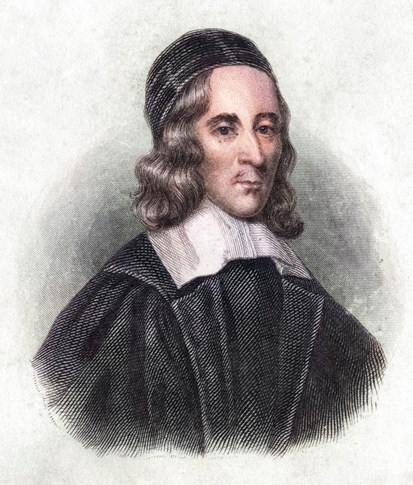 AlamyGeorge Herbert (1593-1633)
Only occasionally does he refer in his writings to the attractions of quietude. After hearing his hymn “To Christ” sung by the choristers at St Paul’s Cathedral in London, where he was Dean, he would return home with “an unexpressible tranquillity of mind, and a willingnesse to leave the world”.
But withdrawing from the world, for Donne, was fraught with difficulty. It occurred to him, as he prepared to cross the Channel with Viscount Doncaster on a diplomatic mission to some German princes, that departing from his loved ones was an action very similar to contemplation: “To see God only, I go out of sight.”
The alternative to the “stormy days” of everyday existence was the “everlasting night” of separation from everything that was familiar: not exactly a tempting advertisement for retreating into meditative solitude.
But there is a more significant silence in Donne than these occasional flirtations with retreat. It is the silence of ceasing to question, and, like withdrawal from the world, it did not come to him naturally. In his poem praising the translations of the Psalms by Sir Philip Sidney and his sister the Countess of Pembroke, he argues that those who try to comprehend God might as well try to square the circle (in other words, not bother):
Eternal God — for whom who ever dare
Seek new expressions, do the circle square,
And thrust into strait corners of poor wit
Thee, who art cornerless and infinite —
I would but bless Thy name, not name Thee now. . .
In “The First Anniversary: An anatomy of the world”, he complains that humankind’s attempts to analyse the planets’ perfect spheres serve only to “disproportion” their “pure form”. “The Second Anniversary: The progress of the soul” turns his critical gaze on those who concern themselves with such questions as “Why grass is green, or why our blood is red”. What Donne is denouncing here, as Louis Martz points out, is the curiositas (curiosity) which St Bernard held to be the first step towards the sin of pride.
Now, an incurious Donne might be hard to reconcile with the poet inquiring into such diverse fields as compasses and fleas, fluid mechanics, and geopolitics: this was a mind whose thirst for the obscure and the fascinating was seemingly unquenchable. But the two Donnes coexist. “He wanted a God he could expostulate with and understand”, John Carey writes in his classic biography of the poet; but he also needed “to imagine absolutes and infinites”.
And here is where Donne’s chief silence lies: in questions both unasked and unanswered, in the song of heaven that “no man hears”, in the music made by the spheres without tongues.
GEORGE HERBERT, for three years a rural clergyman in Wiltshire, wrote a guide for country parsons, A Priest to the Temple (1652), in which he advised his colleagues to be “exceeding exact [. . .] holy, just, prudent, temperate, bold, grave in all [their] ways”.
These are also the traits of his poetry. Careful, precise, economical, Herbert’s poems have a ceremonial deliberateness about them reminiscent of the measured movements involved in celebrating a religious ritual.
Like a lullaby, they have a halo of hush. These words must be spoken, written, and attended to with solemnity, accorded reverential silence.
“The Temple” is a three-part meditational sequence. The “exceeding exact” style is itself the subject of a number of its poems, which explicitly reject “quaint words, and trim invention”: “Jordan I”, “Jordan II”, and “The Forerunners”. Perirrhanterium enlarges on the merits of restrained language by providing a list of vitiae linguae (tongue-vices) — boasting, taking God’s name in vain, swearing, lying, dominating the conversation, angrily arguing — which should be excised from speech. The devastating silence of Christ is the subject of “The Sacrifice” and “The Denial”. In “The Quip”, the speaker refuses to answer questions, but asks the Lord to reply on his behalf.
The critic Stanley Fish wrote a book about Herbert’s habit of “Socratean catechising” in his poems, and, although Fish presents the technique as a process of prompting spiritual self-discovery, a side-effect is that there are many literally unanswered questions and hence “pregnant silences” in Herbert’s works.
Complementing the quiet restraint of Herbert’s poetic style, Perirrhanterium, “Content”, “Frailty”, “Conscience”, and “The Family” all recommend internal serenity and a tranquil demeanour. “Calmnesse”, Herbert writes, “is great advantage.”
In “A Priest to the Temple”, he explains why. If we take the time to reflect before we speak, by “dipping and seasoning all our words and sentences in our hearts, before they come into our mouths”, those who listen to us can clearly see (yes, Herbert uses the word “see” rather than “hear”) that “every word is hart-deep”. Deliberation begets sincerity.
Herbert’s tempered restraint is a descendant of sermo humilis, the quiet style of Christian Latin antiquity. In this tradition, it spreads beyond poetry and into lifestyle. Herbert was aware of the work On the Simplicity of the Christian Life (1496) by the Dominican friar Girolamo Savonarola, which pointed out that the holy men of both the Old and New Testaments loved simplicity and spoke of “the greatest tranquillity of heart” as a precondition for divine illumination.
St Francis de Sales also advised that the way of speaking of those who wished to live a devout life should be soft, frank, sincere, straightforward, naïve, and accurate, adding “there is no such good and desirable finesse as simplicity”. Herbert’s sermo humilis is a holistic quietude that avoids inner and outer noise and controversy in order to come closer to God.
His famous poem “Easter-wings” (1633) visualises what it means to experience the silence of divine closeness. The poem takes the form, on adjacent pages, of two wings, the outline produced by the lines reducing from eight syllables to two and then increasing back to eight again.
Spiritual health is aligned with singing Christ’s victories. When humankind and the speaker are spiritually sick, they are at their “Most poore” and “Most thinne”. They are at their most silent, too, as at these points the lines are down to their lowest syllable count of two.
But, at these spiritual nadirs, Christ is most obviously present, as the metrical arithmetic makes clear. “With thee” in both stanzas/wings matches the two syllables of “Most poore” and “Most thinne”. In the white space that gradually encroaches on the diminishing typeset lines — greatest in area around the two monosyllables in each of the wings — Herbert gives a visual idea of Christ’s presence in extremis.
This is an edited extract from Silence: A literary history by Kate McLoughlin, published by Oxford University Press at £30 (Church Times Bookshop £27), 978-0-19-285562-6.