Supposal v. Allegory
John Bunyan, Pilgrim’s Progress; C. S. Lewis, Letters
A COMMON criticism of the Narnia stories is that they are merely allegories — generally considered a rather limited art form, in which everything represents something in our own world. But, while that is how a novel like John Bunyan’s Pilgrim’s Progress works, that’s not what Lewis intended in the Narnia stories.
Instead, Lewis himself explained that he set out to write a “supposal” rather than an allegory. He began by asking himself the question: “Let us suppose there were a land like Narnia and that the Son of God, as He became a Man in our world, became a Lion there, and then imagine what would happen.”
FOR Lewis, the great value of stories is the way they allow their readers to experience ideas rather than simply think about them. In an essay titled “Myth Became Fact”, he notes the impossibility of feeling an emotion such as pleasure and simultaneously studying it. But if you aren’t roaring with laughter, how can you genuinely understand humour? If you are suffering from toothache, you will be unable to write. But once the toothache has subsided, how could you write a book about pain?
Lewis explains this paradox using the myth of Orpheus and Eurydice. Orpheus was permitted to lead his beloved wife out of the underworld, but the moment he looks back at her, she disappears. We can draw an abstract truth from this story about the impossibility of simultaneously seeing and experiencing, but it is not the only truth that this myth can communicate. If it were, it would be an allegory.
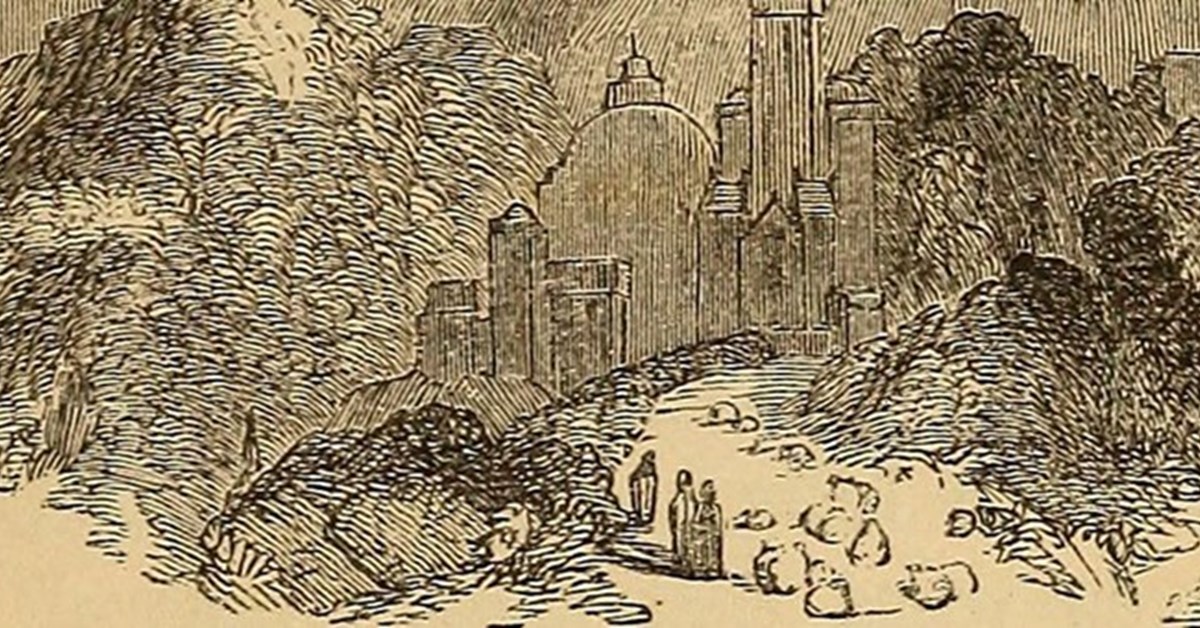
AS SUCH, an allegory is like a puzzle that must be solved by the reader to reveal its hidden meaning. Its one-dimensional characters straightforwardly signal the qualities they represent, as in Bunyan’s Mr Despondency, held captive in Doubting Castle by a giant called Despair.
Unlike allegory, myths are stories from which numerous truths may be abstracted. Instead of presenting the reader with a single message needing to be unlocked, myths instil a sense of longing for something much less tangible — “like a flower whose smell reminds you of something you can’t quite place”.
Like many of his critics, Lewis considered allegory to be a limited medium, since authors can only insert ideas that they already know, whereas a myth is of a higher order, since authors can fill it with ideas of which they are not yet conscious.
AN ENCOUNTER with ancient myth was one of the key moments in Lewis’s introduction to the concept of “joy”. As a young man he came across the following lines in Longfellow’s poem “Tegner’s Drapa”, lamenting the death of the Norse god Balder: “I heard a voice that cried, Balder the beautiful Is dead, is dead” (lines 1-3).
Although he knew nothing of who Balder was at that time, it provoked in him an intense desire for something that he could not describe or name.
As he came to know more about the Norse mythology, he was deeply attracted to its stories, as well as those told by the Greeks, Celts, and Egyptians. But this created a difficulty for him when it came to accepting the claims of the Christian religion, since he considered it to be just another myth, with its story of a dying and rising god, no different from any of the others. Why should he embrace its claims over theirs?
IT WAS a late-night conversation with his friends Hugo Dyson and J. R. R. Tolkien in the grounds of Magdalen College that helped Lewis to find an answer to this question. What he came to realise is that, when he encountered a god dying and being revived in pagan myths, he found it profoundly moving, suggestive of meanings beyond his grasp. But, when he met a similar concept in the Christian Gospels, he was unmoved.
What he took from his talk with Tolkien and Dyson was an openness to accepting the Christian story as a myth, with all its mystery and suggestive implications, but with one key difference from the Norse, Egyptian, and Classical myths: it really happened. But, by becoming fact, he argued, Christianity did not cease to be a myth: “That is the miracle.”
Reflection Read 2 Peter 1.16: “For we did not follow cleverly devised myths when we made known to you the power and coming of our Lord Jesus Christ, but we had been eyewitnesses of his majesty.”
How do Peter’s words challenge Tolkien and Lewis’s understanding of myth?
Professor Simon Horobin is Fellow and Tutor in English at Magdalen College, Oxford, holding the position that C. S. Lewis held at the college, and has lectured and published widely on C. S. Lewis and J. R. R. Tolkien. His latest book is C. S. Lewis’s Oxford (Bodleian Publishing) (Books, 24 June 2024).
This is an extract from Wardrobes and Rings: Through Lenten lands with the Inklings, published by Canterbury Press at £12.99 (Church Times Bookshop £10.39); 978-1-78622-690-7.