WE ARE fasting — in the hollow hunger of Lent. We are waiting — in the entombed darkness of Saturday. We are watching — for the golden dawn of Easter, the turning of death to life. And then we hear it. With unbelief and ecstasy, trembling and joy —the shout of great gladness: “Alleluia! Christ is risen.”
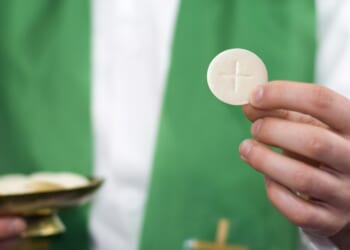
Except that he isn’t. He’s flat and tasteless, tidy and pre-cut, sealed in his hygienic packaging. During the “kitchen wars” of the Great Schism of 1054, the introduction of unleavened bread outraged Byzantine theologians. Leo of Ohrid sent an inflammatory letter to Rome describing the wafer as “dead and not enlivening”. Cardinal Humbert retorted, “You reject the very thing Christ sanctified,” before placing a Bull of Excommunication on the altar of Hagia Sophia
The Orthodox Church still uses exclusively leavened bread in the eucharist, while the Roman Catholic Church insists on the unleavened wafer for its symbolic sinlessness and continuity with Passover.
I STUMBLED on the bread debate after my daughter asked me, “How are communion wafers made?” We watched a short video clip, and saw a grim, strip-lit factory stamping out the body of Christ. The production line ended with the wafer passing under a pulsing red laser. My seven-year-old frowned at the screen. “Mummy, why does it go into hell?” she asked.
The next day, I found I was to act as deacon at our eucharist at Ridley Hall. I wondered whether I could persuade the powers-that-be to use a loaf instead of wafers. As a lowly first-year ordinand, I would need to pull out all the theological stops; so I began to build a case for leavened bread — with the tremulous thrill of trespassing the margins of heresy.
I WAS startled to discover that every eucharistic passage uses artos — the standard term for ordinary, leavened bread. This deliberate choice stands in contrast to azymos, the specific word for unleavened bread used elsewhere in scripture. Yet, in every eucharistic account, the Gospel-writers reject azymos and reach instead for artos: the leavened bread of the table. St Paul confirms this distinction, stating that on the night Jesus was betrayed “he took bread (artos) and broke it.” This was the common artos used as the Early Church “broke bread in their homes” (Acts 2.46). Excitement grew as I realised that a loaf returns us to the practice of the disciples and the Church for the first millennium.
Did the Reformers know this? It turns out that they did. Nicholas Ridley (the college’s namesake) fought with fierce conviction to reclaim “common bread” for the English Church. Cranmer’s Book of Common Prayer mandated bread “such as is usual to be eaten at the table”. The Reformers wanted the sacrament to look and taste like real food — Christ, the bread of life who feeds and sustains us.
The wafer returned to Anglicanism only in the 19th century, reintroduced by Tractarian clergy wanting to close the gap between Canterbury and Rome. I imagined Ridley and the other Reformers depicted in the stained glass of our chapel cheering me on from their windows.
JUST as I was proudly putting the final touches to my heresy, I discovered — like G. K. Chesterton — that it was, in fact, orthodoxy. As Canon B17 states, the use of leavened or unleavened bread is a matter of “indifference”. I shot off to the authorities at Ridley with my shocking new orthodoxy: leavened bread is not a modern innovation; it has deep scriptural warrant; it accords with canon law; and it faithfully follows the rationale of our reformed tradition.
“Yes, we know,” they said kindly. “We sometimes use leavened bread at Ridley.”
“Well, then,” I said, determined to cause some provocation, “it shall be gluten-free, and we shall say the words in Greek, and all be united by one loaf.”
“Great,” came the patient reply.
IN THE weeks leading up to the service, some advised me: “Make sure the loaf is big enough so we don’t run out,” and others: “It must be small enough so we don’t have lots left over.” I nodded, reassuring both, feeling inwardly like an anxious Goldilocks — already in trouble, but without a sense of what the “right” size might be.
“Oh, crumbs,” I thought as I browsed the Waitrose bakery aisle. And then another problem landed: oh — crumbs! The wafer was designed precisely to eliminate particulae: those loose crumbs that risk desecrating the host. A friend cautioned me, “You know, a gluten-free loaf will produce even more crumbs.” I began to feel hot under my imaginary dog collar.
ON THE day of the service, I handed over a gluten-free sourdough loaf to the senior student preparing the chapel, promising that all leftovers would be reverently consumed, and hoping that the crumbs would be minimal. I was struck by how pleasant it smelled: domestic and welcoming. Its plump roundness in the basket reminded me how baked bread literally outgrows its container, symbolic of God’s uncontainable love.
The service began, and I told the congregation: “Today, we gather around a single gluten-free loaf, a sign of unity. At this table, all may share and none are turned away.” An audible whoop came from someone often disqualified by food intolerance.
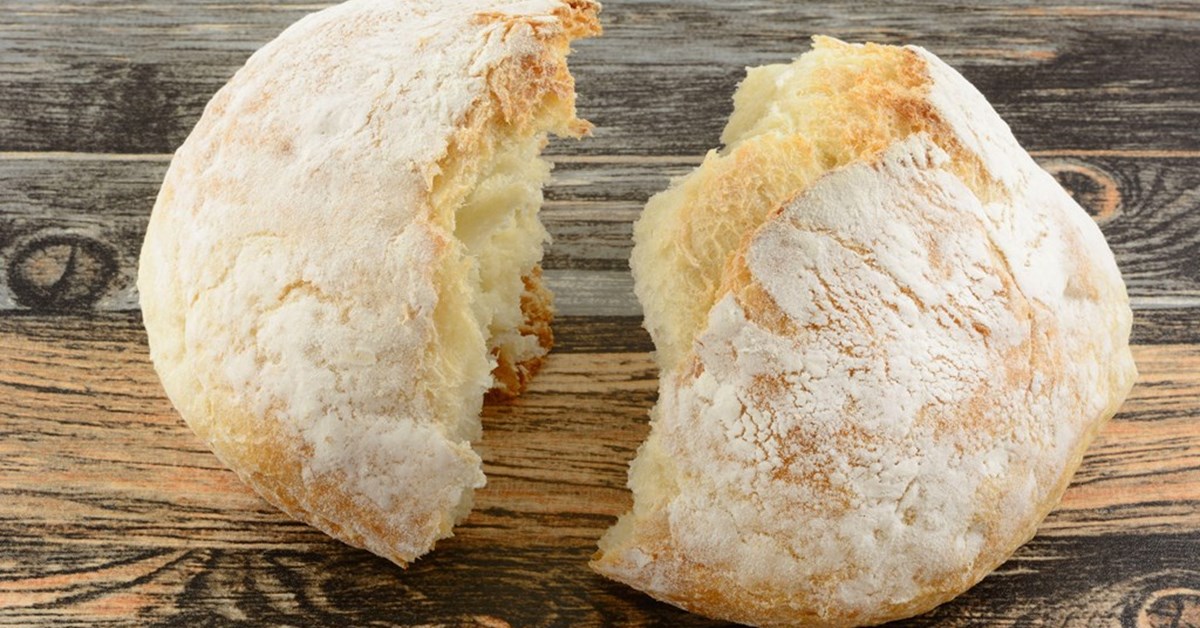
Then the children, beaming, processed the elements to the altar. The priest raised the loaf, and it broke with a gentle sigh, not the usual snap of a dead twig. A fellow ordinand commented that this was how he imagined the Last Supper: bread that looks like bread, torn and shared. I thought of Malcolm Guite’s words: “Come to me, broken, hungry, incomplete I Am the Bread of Life, break Me and eat.”
A large crumb fell, no doubt causing some unease; it was swiftly rescued by an observant congregant. I noticed that chewing actual bread takes longer than a wafer, which vanishes like a magic trick. I wondered if there was something valuable in taking time to consume the elements — to feed on him in our hearts (and our mouths). After worrying that I would need a larger loaf, there were significant leftovers. I offered the remaining bread at the end of the service: it turned into a kind of post-communion picnic, full of laughter and reverence.
WHILE most enjoyed the use of bread (especially the inclusivity of a gluten-free loaf), some worried that our communion was less sterile; and the crumbs remain a concern. But I wonder if God’s grace is often profligate and untidy, if it flows over and leaves crumbs. “We are not worthy to gather up the crumbs from under thy table”: perhaps we should leave them where they fall? Maybe the crumbs are part of the symbolism.
Martin Luther insisted that even a mouse eating the host receives the body of Christ. I began to feel sorry for the mice in our modern churches, with our spectral host. Yet, however careful we are — even with wafers — there is always some Jesus that escapes: tiny particles that the microbes consume. I pondered our reverent obsession with containing Christ, and wondered if Jesus minds sharing his body with the mice and the microbes.
“IT WAS nice we actually did what we always say we’re going to do — you know, break bread,” my daughter told me. “Normally, the priest just makes those little circles appear like a magician.”
While wafers are certainly neater, the leavened loaf brings an incalculable excess and a more visible unity. It seems better to represent Jesus, our living bread; Jesus, who offers us not the bread of affliction, but the bread of the new covenant.
There are certainly times in the liturgical year when unleavened bread carries its own apposite solemnity, but, at Easter, it seems fitting that our bread — like our Church, — should rise. For he is risen. He is risen indeed.
Dr Josephine Gabelman is an ordinand at Ridley Hall and the author of A Theology of Nonsense (Pickwick Publications, 2016). Her current research develops a “compostable theology” by exploring salvation through waste, sin, and filth.