HERE, David Bentley Hart publishes “the last volume of continuous theological reflection I shall ever publish”. He has been a prolific contributor to religious studies, featuring regularly in Church Times book reviews over the years. This final addition to his formidable oeuvre comprises the five Stanton Lectures that he delivered at Cambridge University in 2024, plus three provocative appendices.
The lectures are semantically challenging, with neologisms and esoteric terminology much in evidence. Those who attended the lectures may well be first in line to purchase this printed text to facilitate full comprehension of the argument, consistent as it is, with his established adherence to a “Neoplatonic and Vedantic view of theological metaphysics and dogmatics”.
Chapter One focuses on a distinction between “nature” and “genus” — the former implying a state of being while the latter conveys identity (“familiality”) — a single divine and human genos consistent with adherence to, e.g., Johannine and Pauline Christological conceptuality.
Chapter Two relies heavily on Origen to affirm the early Church’s angelomorphic Christology — a key categorisation essential to his argument. Deviation from this course resulted eventually in the Chalcedonian Definition, which, with uncharacteristic asperity, Hart describes as “an admirable but purely structuralist contraption that, by virtue of both its elegant economy and its semantic vacuity, merely prevents a collapse into pious gibberish”.
In Chapter Three, Hart cuts to the chase with focus squarely on Jesus as both human and divine. “Christ is both God and a man without any diminishment of his divinity or any dissolution of his humanity.” Divinity is compatible with humanity, and “divinity is an inherent possibility of humanity.” He describes this as a “fairly obvious” principle, which, he feels, he needs to rehearse only because, as he proceeds to argue at some length, even such subtle theologians as Rowan Williams and Jordan Wood incline towards contradicting it. But surely, notwithstanding Hart’s challenge to Williams and Wood, Christ’s uniqueness is an incontrovertible attribute that Hart puts at risk.
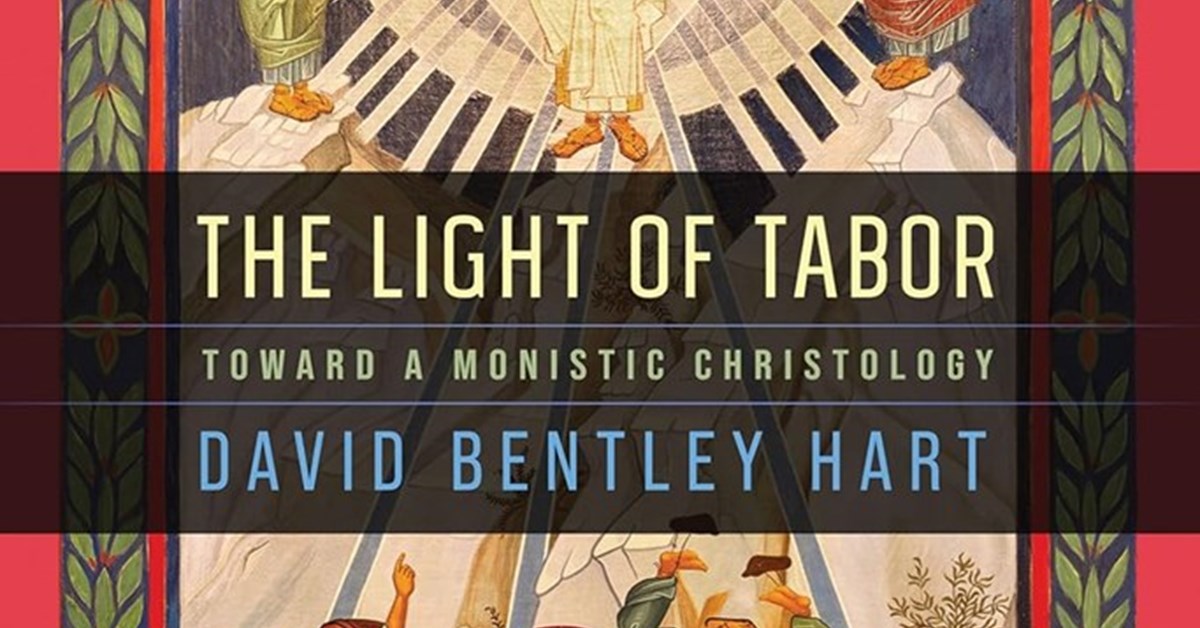
Drawing extensively on the monistic approach of Sergei Bulgakov, Chapter Four deconstructs the language of “persons” as used in received Christological discourse, and in Chapter Five Hart takes us to Mount Tabor and the transfiguration of Jesus, who is revealed as: “the one instance of the human in which no division from or duality with God exists: the perfect realisation of the human as divine ‘I am’ that is every spirit’s origin and end — the perfect adherence of everything human to its own inmost and potential identity.”
The three appendices challenge relatively recent theological orthodoxy relating respectively to nature and grace, resurrection and judgement, and spiritual and material as indefensible misrepresentations of concepts as understood by New Testament Christianity. They are not mere ballast to bulk out an otherwise slender volume, but further examples of Hart’s idiosyncratic but always creative theological legacy.
The Rt Revd Dr John Saxbee is a former Bishop of Lincoln.
The Light of Tabor: Towards a monistic Christology
David Bentley Hart
Notre Dame Press £21.99
(978-0-268-21041-0)
Church Times Bookshop £19.79