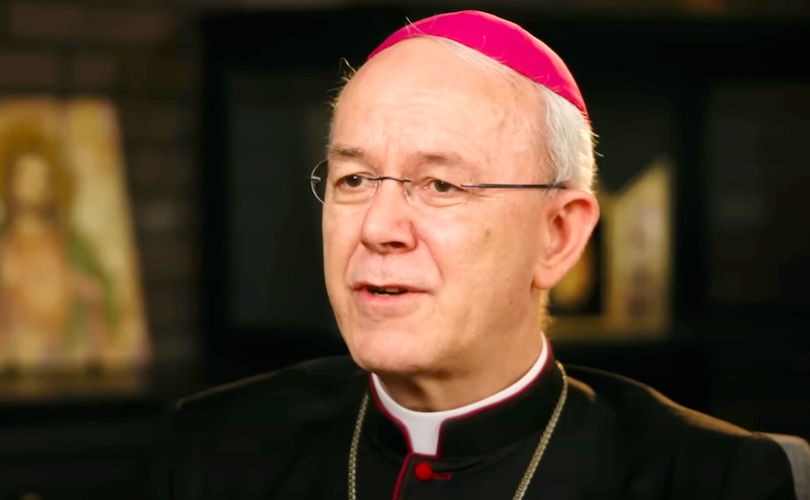
“I think all the traditional communities, good cardinals and bishops should make a common, united appeal to the Holy Father, ‘please grant them, in a generous gesture – exceptionally, because it is church law, it is not divine law – please grant them the permission of consecrations.” — Bishop Athanasius Schneider
(LifeSiteNews) — On March 25, Michael Matt, editor-in-chief of The Remnant, published an interview with Bishop Athanasius Schneider on the upcoming episcopal consecrations of the Society of St. Pius X (SSPX). The Kazakh prelate of German descent has a certain authority here since he was called in 2015 by Pope Francis to be part of the Vatican visitation of the SSPX seminaries and since then has had access to many Vatican documents in that position.
For Bishop Schneider, there is no doubt that Archbishop Marcel Lefebvre, the now-deceased founder of the SSPX, decided, in 1988, to consecrate four bishops without the approval of Rome “for the Popes” and “out of love for the Church” and that the SSPX is a “work of the Church.” As signs that this traditional Catholic priestly order is not schismatic, Bishop Schneider pointed out that these priests pray in their Holy Masses for the local bishop and for the Roman pontiff. They also have received permission from Rome to hear confessions and to administer under certain conditions the Sacrament of Matrimony.
Bishop Schneider also mentioned that one of the SSPX bishops, Bishop Bernard Fellay, once received the delegation to act as a judge in a canonical investigation regarding one of the SSPX priests.
Moreover, Bishop Schneider called for a “more balanced view of what is schism and of what is obedience in the Church.” Not every act of disobedience toward the Pope, he added, is “schismatic.” Even to illicitly consecrate a bishop against the Pope’s will is “not, per se, an evil act,” Schneider explained. It is “completely wrong” to state that such an act is “intrinsically evil,” as one statement of a former Ecclesia Dei community had put it.
In speaking with Michael Matt, Bishop Schneider regretted that some traditional communities, bishops and prominent cardinals “start in some way to attack the Society of St. Pius X, to call them schismatics, or to express threats to them that they will be excommunicated.” “It is not helpful,” Schneider commented. “It should be the contrary.” In light of the fact that there is such a confusion and relativization in the Church and that cardinals and bishops today who express “heresies” are not being reprimanded by Rome, and also in light of the spreading LGBT agenda and the muslimization of Europe, Bishop Schneider is of the opinion that “we should unite” with those who wish to keep “the integrity of the faith.”
The Kazakh prelate added, “In this context, I lament so much these attacks” on the part of other groups and prelates against the SSPX instead of opposing the enemy together.
Mentioning one of the major other traditional Catholic communities, the Fraternity of St. Peter, Bishop Schneider wondered “why the Fraternity of St Peter, or others, should publicly and continuously be attacking, and threatening the Society with (the claim that they) are schismatic and so on.” “I think all the traditional communities, good cardinals and bishops should make a common, united appeal to the Holy Father, ‘please grant them, in a generous gesture – exceptionally, because it is church law, it is not divine law – please grant them the permission of consecrations.” “Ecclesia Dei communities should do it,” he added, “but instead of doing that, they are attacking.”
“The intention of the Society (SSPX) is clearly not schismatic … and they only do it as a service for the Church and for the papacy, and I think later, the Church will be grateful and thankful to the Society after this huge crisis.” he insisted.
Michael Matt himself highlighted in this context that Summorum Pontificum, the freeing of the traditional Mass in 2007 under Pope Benedict XIV, was actually the fruit of the work of the SSPX since it insisted on that aspect when dealing with Rome at the time.
Bishop Schneider also insisted that the SSPX’s objections against certain elements of the Second Vatican Council’s teachings are legitimate and need to be discussed. Here, he mentioned the teachings of religious liberty, ecumenism, and collegiality, all of which he himself has doctrinal objections to. The principle of collegiality, Bishop Schneider stated, is “against the Gospel,” because Christ charged St. Peter with the leadership of the Church and did not include the Apostles. There is no “collective way” of leadership over the Universal Church. Schneider also showed concerns about certain elements of the Novus Ordo Mass as being problematic, such as the stressing of the character of a meal, rather than that of a sacrifice. We cannot “allow doctrinal ambiguities” in that liturgy or in general. We “must discuss” these problems and cannot avoid looking at them. The SSPX is a “huge help to honestly resolve these questions and problems,” he went on to say. “It will take time.”
As one of the aspects of the problematic teachings of the Second Vatican Council, Bishop Schneider pointed to the Council document Lumen Gentium, which teaches regarding Muslims that “together with us they adore the one, merciful God, mankind’s judge on the last day.” Bishop Schneider rejected this statement because Muslims adore God merely on a natural level, not through baptism and faith. Thus, their act of adoration is “essentially different” than that of Catholics. He called this council statement “highly ambiguous.” The result of such a statement is also that one wonders whether one needs anymore to convert the Muslims because they already adore the same God, according to the prelate.
Pope Francis, as Bishop Schneider recalled, pointed out that his controversial Abu Dhabi statement that the diversity of religions are “willed by God” is in line with the Second Vatican Council’s statements on other religions. This cannot be interpreted in a traditional way, according to the prelate, because there are things that are “highly ambiguous and must be corrected.”
To further stress his arguments, Bishop Schneider importantly recounted the appeal that Cardinal Dario Castrillón-Hoyos had made to the assembly of bishops in 2005, in front of Pope Benedict XIV: “I have also witnessed, in 2005, at the end of a Synod in Rome under Pope Benedict XIV – I participated there, and at the end of the Synod, in the full synod hall and with the pope, Cardinal Castrillion Hoyos raised (his voice) and said, ‘I appeal to all of you, please let us be generous and embrace the Society of St. Pius X. How can we be indifferent – at that time, there were at least 500 priests who really want to serve the Church, for so many lay people and families – I appeal to be generous to them.’ These words, I will not forget, I heard (them), I was present in the hall of the Synod, of Cardinal Castrillon Hoyos. He made a strong plea in favor that the entire Church should be more positively coming towards the Society (SSPX) and to help them to integrate her in the life of the Church.”
Matt was able to confirm Bishop Schneider’s words, inasmuch as he himself once interviewed Cardinal Castrillón-Hoyos, as head of the Ecclesia Dei Commission responsible for the traditional Catholic communities in the Church, about the status of the SSPX.
Matt asked the cardinal whether he should be using the term “schism” with regard to the SSPX, whether they are in schism, and the cardinal responded with the answer “no, this is an in-house dispute, that will be resolved in God’s own good time.” Matt added that we should rather say “thank God,” that “there should be a certain gratitude” to the SSPX.
Agreeing, Bishop Schneider went on to say:
“This is my appeal, I would like to invite all the communities in the Church, the Society (Fraternity) of St. Peter (FSSP), whom I appreciate and who are doing good and great work, and the other institutes, the other good bishops, really to unite more” so that “we form a unique power to restore our Holy Mother Church in this unprecedented emergency situation, and to pray for the Pope, that God really illuminates him that he will be our leader, because the Pope must be our leader of the Tradition.”
With regard to the upcoming July 1 consecrations of new SSPX bishops in Econe, Switzerland, Bishop Schneider hopes that Pope Leo “will, in some way, find a generous gesture, but even if not, God will permit it, even to be of benefit to the entire Church. God knows how to use it in divine providence.”
He concluded, “We must trust in divine providence, in Our Lady. She is the Mother of the Church; we should implore her and also Archbishop Lefebvre.”
The German prelate then reminded his audience of Archbishop Lefebvre’s anniversary of his death, March 25, adding, “I am convinced that one day, in the future, he will be recognized by the Church as a great bishop, and also I will not exclude that he will be one day, in the future, in some way, be canonized as a confessor bishop in difficult times who always loved the Holy See and the Popes. Nevertheless, he was persecuted and suspended, excommunicated, but until the end, he prayed for the Pope and loved the Holy See and Holy Mother Church.
Along these lines, LifeSiteNews once reported that another still living cardinal holds a similar view, stating, “Archbishop Lefebvre will one day be recognized as a Doctor of the Church. Therefore, ‘others’ have to measure up to him.”
Dr. Robert Moynihan recently revealed in an article published on his Inside the Vatican website:
“The late Senegalese Cardinal Hyacinthe Thiandoum (1921-2004) told me in a private conversation in Rome in the 1990s, not long after Lefebvre died, that he believed Lefebvre, because of his deep Catholic faith and personal virtue, would one day be canonized as a saint.”