HERE is a book that can take us further and deeper into the world of Christian worship. The list of contributors and their affiliated institutions is rather revealing, as there are no Church of England theological institutions or British university departments of theology and religious studies listed here. Happily, though, there are chapters by Bridget Nichols and Juliette Day, respectively based in Dublin and Helsinki.
The volume is edited by a foremost liturgist and ecumenist, Joris Geldhof, who for many years was a professor in the Catholic Faculty in the University of Leuven, and is now at the University of Notre Dame, in the United States. Unsurprisingly, then, many, though not all, the contributors write predominantly from a Roman Catholic perspective.
Nevertheless, as the arrangement of the book shows, the parameters here are far from being narrowly denominational. The collection is divided into five, albeit five unequal sections, and these show both the breadth of interest and the significant shift in the way in which academic liturgists work, from the focused historical view to a more interdisciplinary approach that draws from the social sciences and the humanities generally. Part One is broadly historical and provides a good overview of developments, including separate chapters on the Reformed Churches on the Continent and on Eastern Christianity.
The second section consists of four chapters and covers the celebration of the sacraments, daily prayer, and the Christian year, but what is missing here is a chapter on the calendar of saints and the corollary relation of the living and departed in Christ. This is a real omission, not least because of the denial of death in our contemporary Western culture.
The third part includes three offerings on the interface of liturgy, architecture, music, and the arts. The chapter on the arts presents some fascinating case studies, from reliquaries to Rembrandt, but little is said about the place of the visual arts in the worshipping space as part of the ensemble of worship. This topic could have made a welcome fourth chapter in this section.
The fourth section examines liturgy and the life of the Churches, and there is much to glean from these six chapters as they in turn recall the fundamental embodied nature of worship as the source of Christian life, and the expression of pastoral care as it is embedded in an ecclesial context. Here, Thomas Pott rigorously sets out our ecumenical horizons. The following chapter explores the questions of interfaith dialogue and praying with those of other world faiths and recalls as a proposed model the historic gathering of faith leaders in Assisi to pray for peace in 1986.
The final section is focused on the methods for the study of liturgy, and equal attention is given to what is done in worship (the ritual) as well the texts, of what is written, heard, said, and sung. The final short chapter on liturgical theology takes us back to the note in the editor’s introduction that our worship is deeply theological, not only because its forms are shaped by Christian convictions and understandings, but also because corporate worship itself is generative, yielding understandings of God, and shaping Christian identity and character. This makes “theology” the first and last word of the book and gives it its weight and coherence.
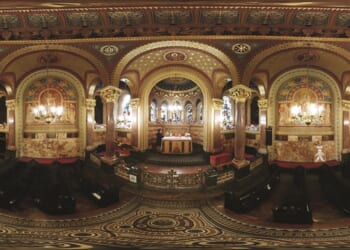
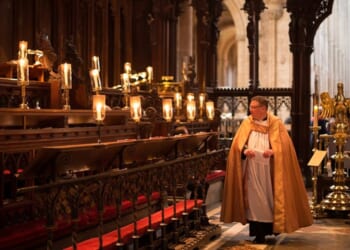
So, there is much to be quarried here, but let me conclude with a comment on the chapter on liturgy and architecture by Gilles Drouin, the liturgical consultant for the restoration of Notre-Dame Cathedral in Paris. Drouin not only tells this story, but convincingly shows how a church building articulates an understanding of God. Bringing this insight into conversation with the pressing concerns of our own time, namely the environmental and climate crises and the (related) question of population migration, he helpfully sketches out how new church buildings need to open out to nature and to be socially hospitable places.
The Revd Christopher Irvine is a teaching fellow at St Augustine’s College of Theology and teaches at the Liturgical Institute, Mirfield.
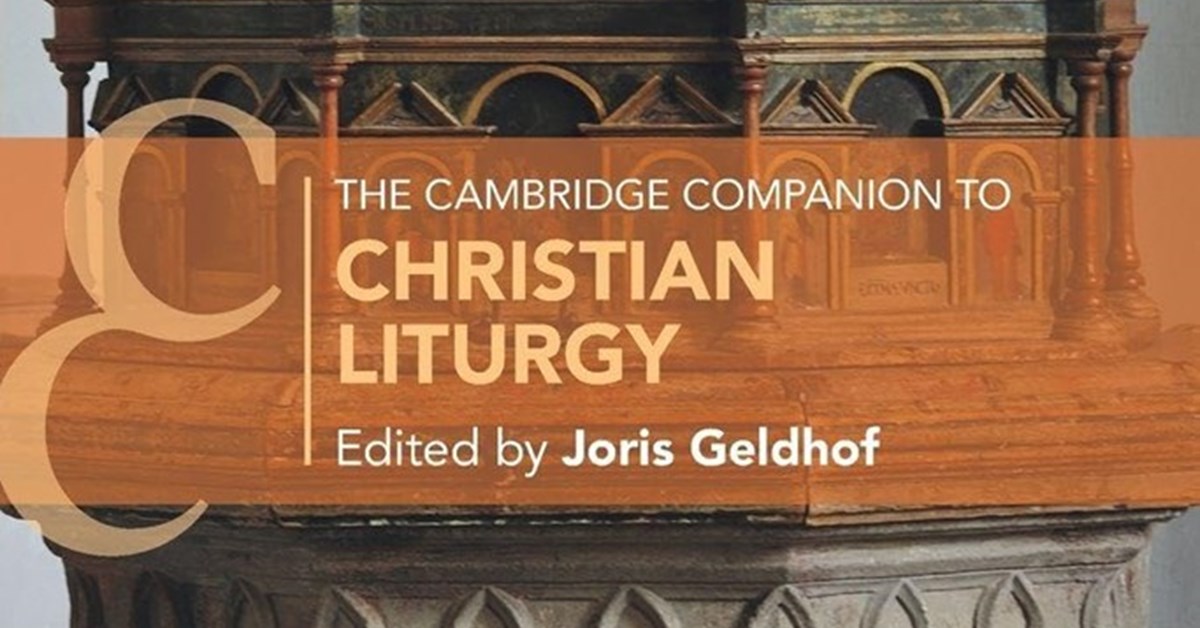
The Cambridge Companion to Christian Liturgy
Joris Geldhof, editor
Cambridge University Press £29
(978-1-009-18664-3)
Church Times Bookshop £26.10