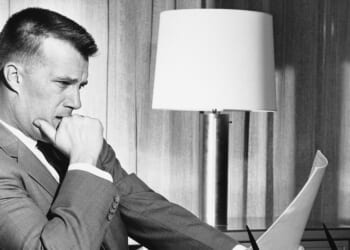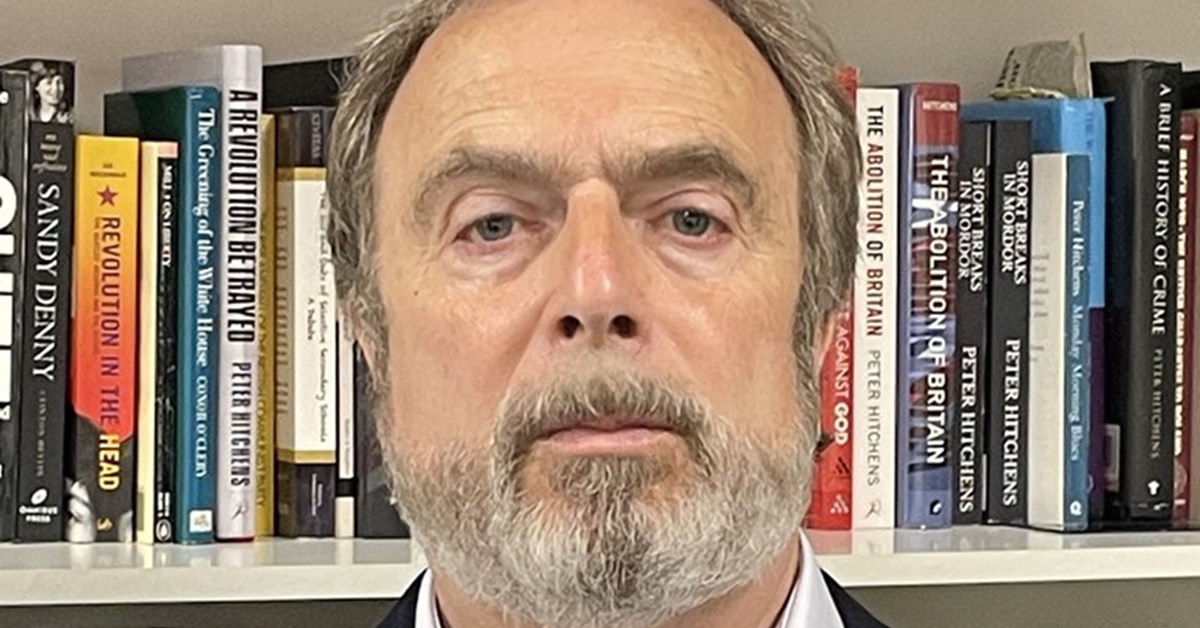
PETER HITCHENS, an Anglican conservative commentator and columnist for the Mail titles, has spoken about how he came, on the basis of his reading of scripture, to appreciate the ordination of women. He said that female priests had rescued the Church of England.
Discussing the introduction of women priests in 1994, and women bishops in 2014, Mr Hitchens said that “the more that I thought about it, the more it seemed to me that it really wasn’t something that I found distressing.”
Mr Hitchens was talking to the Church Times podcast after the installation of the new Archbishop of Canterbury, the Most Revd Sarah Mullally, who, he said, must be “given a chance”.
The journalist, who in the interview was repeatedly critical of fellow conservatives and others on the British Right, as well as President Trump, continued: “And I began to meet women who’d been ordained, who appeared to me to have a pretty sound grasp of the faith, and who in some cases, used the 1662 Prayer Book and the Authorised Version, and I thought: what can possibly be wrong with that? Nor do I think that it’s a biblical thing. It’s quite clear in the life of Christ that he saw women as equals, and, if he didn’t appoint them to be in the twelve disciples, it doesn’t seem to me to be decisive in saying that women can’t be in the priesthood.” He went on to point out that women were the first witnesses to the resurrection.
Mr Hitchens continued: “I think, given all the horrible child-abuse scandals and many other things that have been going over the past few years, if it hadn’t been for the ordination of women, there would be very few vocations.”
On women priests, he concluded: “If there’s nobody there in the Church to celebrate the services, then you don’t really have a Church, do you?”
Mr Hitchens, who described himself as a “soppy” Christian, said that he was an Anglican and not a Roman Catholic “because I’m English”. The writer, who went through an atheist phase in his teens, when he burnt a Bible with schoolfriends, continued: “The Church of England appealed to me because of its fundamental motto that you should not make windows into men’s souls, and because it was broad, and because it didn’t waste time on what seemed to me to be futile attempts to discover absolutes, but was, in general, pursuing the good.
“And so, I am soppy. I will resist any attempt to get me into a sectarian quarrel with any other member of the faith, whether in the Church of England or outside it, and I’m pretty opposed to attempts to pick quarrels with other religions as well. . . I slip from time to time, as everybody does, but that would be what it is, a slip rather than part of a set of beliefs. I really just don’t want quarrels with other people about God.”
He continued: “I have the enormous task of sorting myself out, and I really don’t have the time or the business or the skills or the knowledge to sort other people out; and it’s an important starting point, and it’s what you’re fundamentally saying when you say the general confession each week, as I do: that the faults lie in yourself, not in others, and that if the world needs reforming, it may well do, but you need to reform yourself first. I’ve tried reforming the world. It didn’t do anybody any good.”
Asked whether his faith was still evolving, Mr Hitchens said: “Yes.” He continued: “The purpose of the liturgy is edification, which means building up. And I think that, if you are frequently exposed to the essentials of scripture, and to the seasonal rhythms of the collects and the regular chanting, or saying, of the canticles and particularly the confession, the creed in the communion service, the Prayer of Humble Access, they work on you.”
Elsewhere, asked about so-called “Christian nationalism” of the sort espoused by Tommy Robinson, Mr Hitchens used the far-Right activist’s real name and said: “Well, I find Mr [Stephen] Yaxley-Lennon . . . not particularly persuasive as, say, the new John Wesley. Can I put it like that?”
On Evangelicals in the United States, who largely support President Trump, Mr Hitchens said: “They must have got it wrong somewhere, but I feel they have to find that out for themselves.”
And asked whether faith was the key difference between him and his late brother, Christopher, who was a prominent atheist and the author of God is Not Great: How religion poisons everything, Mr Hitchens said: “Well, it’s a good point at which to find a frontier between us. We’re totally different people. . . We have some similarities, the main one being . . . independence of mind.”
The younger Mr Hitchens, who rebutted his late brother’s book with one of his own, The Rage Against God, said that Christopher lived his life to the theme of “Go where you want to go; do what you want to do with whoever you want to do it with.” He continued: “Now, there was a time in my life when I very much believed in that as a principle of life. . . I found, after a while, that this wasn’t anything like as satisfactory an arrangement as I thought it would be. I think he continued to think it until the day he died.”
But reflecting, almost 15 years since Christopher died, Mr Hitchens said: “I was so fortunate to have had a brother like that, because he took me out of what would otherwise, I think, have been a normal suburban existence. . . I had, as a result, a much more adventurous and, to me, satisfying, life than I otherwise would have had. So, that’s a great gift.”