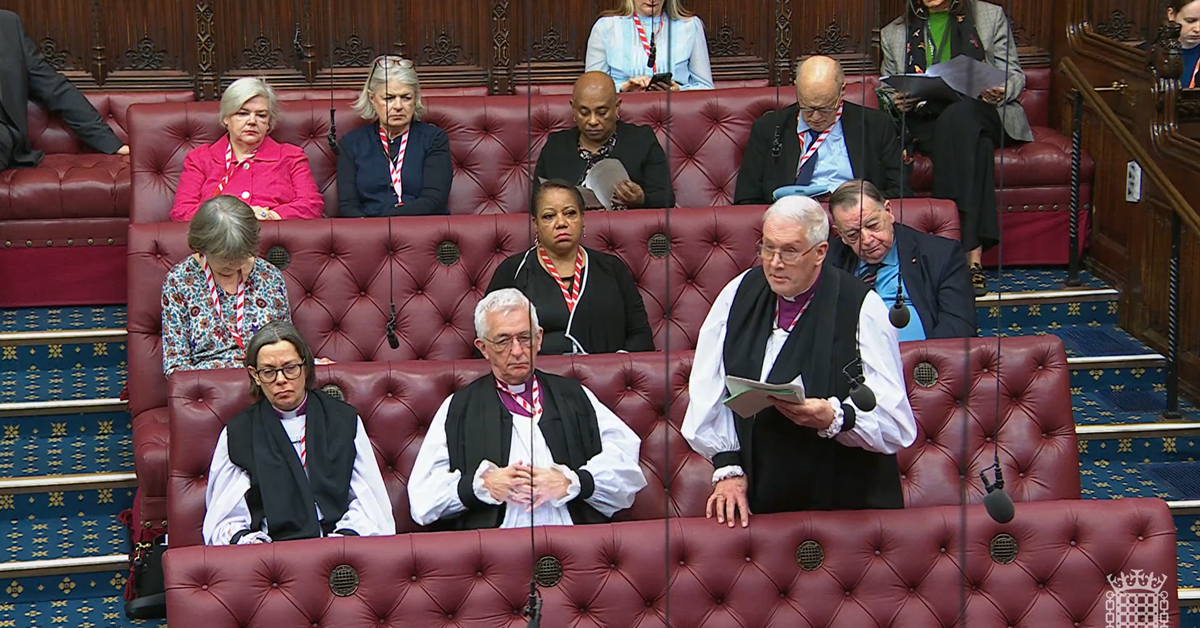
THE Bishop of Southwark, the Rt Revd Christopher Chessun, was among the speakers who last week expressed further doubts over the Terminally Ill Adults (End of Life) Bill when it was debated in the House of Lords.
Bishop Chessun raised the prospect of “pressure on all sorts of ancillary staff” who could be “co-opted, either directly or indirectly, into what becomes the final procedure, when the conscience of such an ancillary participant tells them that they should have nothing to do with such a procedure”.
The Bishop pointed out that, when it comes to assisted dying, “matters of acute conscience are not restricted to the immediate preparation of a lethal dosage or the medical oversight of the procedure.”
He went on to ask: “Is it right that they should face sanction or inhibition of their careers, or even dismissal? I suggest not.”
Lord Rook (Labour), an Anglican priest, raised what he called a “serious gap” in the Bill, concerning oversight. “Although records must be made, at the moment the commissioner who is responsible for the oversight of this system does not have access to, or visibility of, these records,” he said.
“By simply making available to the commissioner these written records of the preliminary discussion, oversight becomes evidence-based rather than simply allowing regulators to assume the best. This preliminary discussion is the gateway moment in what will be, for some, their final journey. In that moment, a doctor has first sight of the patient’s capacity.
“In that consultation, the patient first hears their full range of options. In that encounter, there may be the first warning signs of other problems — for instance, evidence of coercion or distress. Because, rightly, this conversation will go on in private, the doctor’s written record is the only durable account of what is likely to be a determinative discussion.
“As it stands, that account is not available to the scrutinising body, which is the very mechanism charged with monitoring the system.”
Lord Falconer, who is sponsoring the Bill in the House of Lords, said that Lord Rook’s proposal was not “necessarily unreasonable, but it may be that the right approach for the commissioner to take is to decide which documentation he wants to have on a habitual basis”.
Peers also discussed the part played by faith-based hospices. Lord McCrea of Magherafelt and Cookstown (DUP) spoke of the need to “safeguard the valuable work of faith-based hospices and care homes, along with other institutions, that have a conscientious objection to assisted suicide”.
He continued: “I speak as a member of a family in which loved ones — more than one — have committed suicide, and I know the pain of what that word entails and means.”