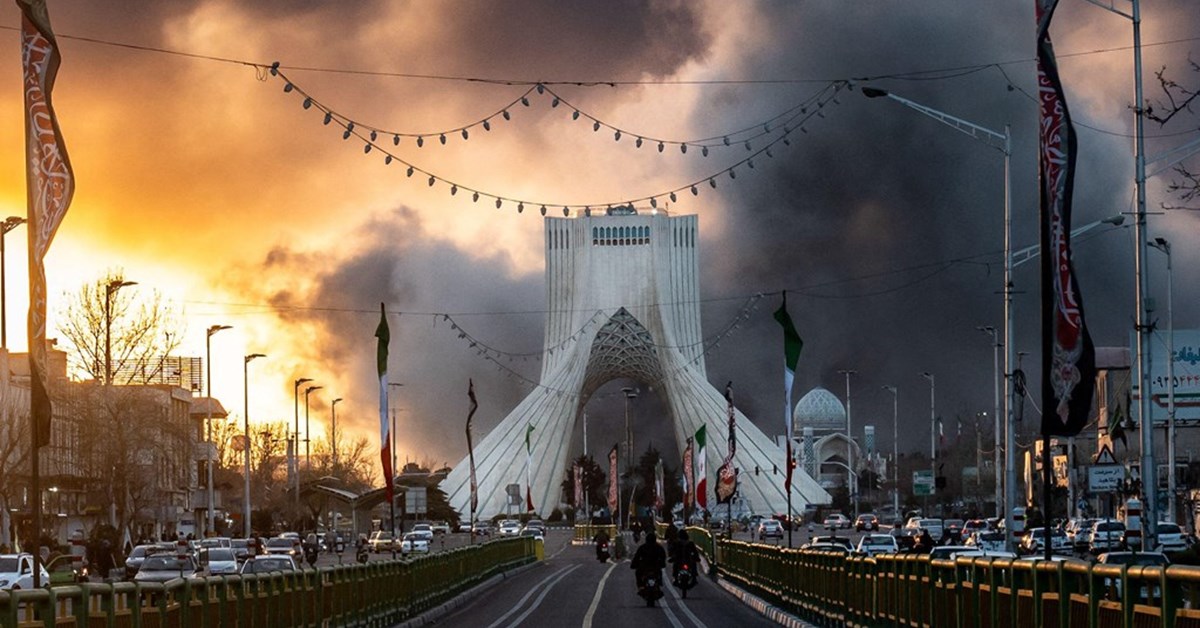
BOMBS rain down on the Middle East. In South Sudan, starvation kills thousands and threatens the lives of hundreds of thousands more.
Our journey through Lent into Holy Week has brought us to the extrajudicial murder of Jesus. It is hard to know how to respond to the reality of evil, to the destruction which faces us every time we look at a news website. Over and over again, I am reminded of the importance of lament as part of our spiritual practice.
There is so much to lament. The victims of conflict in Israel–Palestine, subjected to violence as a weapon of war, starved, wounded, broken; the horrors of ethnic violence, genocide, whole peoples stuffed into concentration camps and “re-educated” or killed, or so many massacred that rivers are blocked with the bodies of the dead; the destruction of the natural world: entire mountains mined out of existence.
This is the reality of what Christianity calls sin. It is the desire of humans to scramble up the dung heap, to gain power, to be the king of the castle. Sin is whatever comes between us and the Spirit of love. There is personal sin, my own pride, arrogance, or deceitfulness, the ways in which I wound others — and there is structural sin, the fallout from societal structures and governments, and companies which cramp or destroy the lives of the vulnerable or weak.
Where is the Spirit? Where is God in all this? What possible sense can we make of the yearning for the infinite when the now is so utterly dysfunctional, and the nasty brutish brevity of life seems unavoidable? What do we do? Do we look, or do we look away, horrified, but trying to evade the raw red agony on display?
We cannot make sense of pain or violence or destruction. They are all offences against the cosmos. The problem with evil is that it is all too real, and here, where I am based in London, we see it and feel it and touch it all the time. Social injustice, societal breakdown, the impenetrable barriers between groups; the increase in social isolation, the alarming upsurge in mental-health challenges among young people — it’s all too real to be ignored.
BUT is there another way to understand all this, which would put the pain and the violence in context — not to justify it, never to justify it, but to see how it fits in the jigsaw puzzle that is the intersection of life and death, spirit and matter, which forms the cosmos in which we live?
The question is not how, but why. Why do we experience pain, loss, grief, alienation, loneliness? Why is the human tendency so often to choose death rather than life, to go for the violent, easy option rather than the loving, difficult option; to seek fulfilment in the shortest term through trampling on the rights and hopes of our fellow human beings and fellow creatures rather than carefully build a different kind of world?
Spiritual direction has been described as a deep dive into the real, an unflinching look at all those multicoloured waltzing pieces, which, in a mad devil’s dance, swirl crazily into chaos. If we are to discover the reality behind the reality, we cannot avoid the pain. It has its place; it cannot be ignored; it cannot be undone.
In my own life, there is too much denial, too much turning away. I move too quickly from despair to hope. Hearing or seeing the sounds and images of destruction, or experiencing the consequences of childhood trauma in those around me — these are too uncomfortable: they make me sad, and I want to cover the world with stardust and pretend that everything is drenched in joy.
The journey into the spiritual has the potential to be transformative, to bring us into a new place of unimagined depth. In the New Testament, we hear often of the call to repentance, which is usually understood to mean turning away from sin, seeking forgiveness. But the word that is translated so often as repentance has a much richer meaning. The Greek word metanoia is formed of two roots: meta, meaning beyond or new, and noia, meaning mind.
So, we are being called not just to move on from the destructive (which is what I take sinful to mean) habits of our past, but also to move into a new place with a new mind, a new understanding of the world, a radically different place. The journey calls us into the depths and up to the heights, through the valley of the shadow of death and up mountain ranges to the thin air and bright light of the spirit.
TO TRAVEL along the path asks us not to shrink away from the darkness and woundedness of the world. We cannot make sense of the slaughter of the innocents, in Gaza, Ukraine, or Sudan, or anywhere else — but we cannot look away. We cannot make sense of our own will to power, or the traumas and disruptions in our own lives — but we cannot look away.
It is easy to feel despair. As the climate changes beyond the most pessimistic predictions of science, as border after border is overrun by autocratic dictators, as the world’s leaders seem to become more and more venal, self-serving, and corrupt, it is hard to find light in the darkness.
Perhaps that is as it should be. No spirit flourishes in a world that is dishonest. Denial distorts, and absolute denial distorts absolutely. If we are to be in deep connection with our siblings, we need to know them: to know their lives, to understand them, and to acknowledge them.
If our own spirits are to fly, we need to listen to the hurts that we have received, to name the pains and injuries that are intrinsic to being a person — to name them, and give them space, so that they can become part of our story and part of the new life that we are seeking.
Lament is not despair. Lament is how we give words to the ache that we feel at the suffering and sadness in the world. Lament is how our spirits come alongside one another, listening to the heartache and sharing the tears. Lament is the expression of compassion. It is the cry of conviction that life should not be like this. It is opening the gate to a better world.
Canon Giles Goddard is the Vicar of St John’s, Waterloo, in London. This is an edited extract, in part, from his book Exploring Spirit: Finding what matters in a broken world (Canterbury Press), reviewed on page 28.