
Hysteria about global warming stems from the fact that, as best one can estimate, the Earth’s average temperature has increased by around 1.1 degree C over the last century. Global temperatures have fluctuated widely in the past, and it has long been debated whether the current increase is anything unusual. At the Science of Climate Change, computer scientist Les Hatton recounts a relatively simple analysis that he conducted, using the oft-studied Greenland ice cores. From the paper’s abstract:
In this paper we first dissect the background behind this number and what it means. Second, we use the Epica-Vostok Ice core dataset, a single proxy dataset for temperature data sampled every century for the last 800,000 years or so and ask the question “Is a 1.1°C temperature rise in a century unusual in this dataset?”
The answer is surprising. By considering interglacial onsets and decays as well as intermediating Ice Ages, it turns out that a rise of this amount would have been considered unusual more than 200,000 years ago, but this rise is not unusual in the current interglacial which started some 20,000 years ago with around 16% of all centuries since the last Ice Age exhibiting a temperature rise of at least 1.1°C. None of these could have anthropogenic components as they pre-dated the industrial era. This result suggests that attempts to partition the current rise into anthropogenic and non-anthropogenic components are questionable given that it is not even unusual.
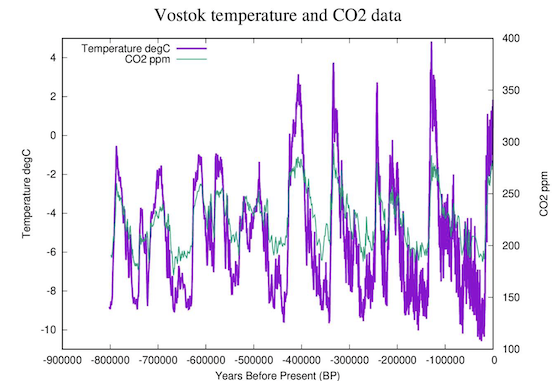
This chart shows temperatures and CO2 levels over the last 800,000 years, as reflected in the Vostok cores. You can see the Ice Age cycles clearly:
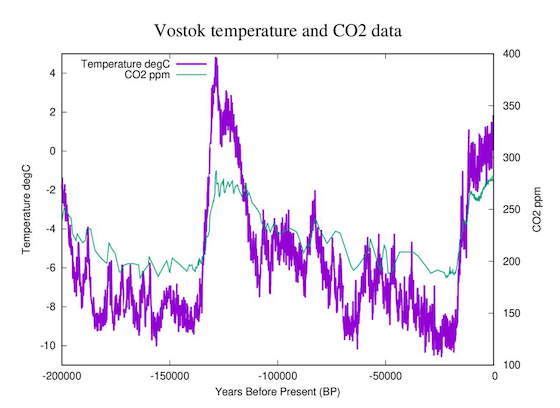
Usually, the Earth is caught in a deep freeze. Happily, we are living in an inter-glacial warm period. In fact, the Earth has been warmer than it is today the overwhelming majority of the time since the end of the last Ice Age 20,000 years ago. This is the temperature and CO2 chart for the last 200,000 years. There is a correlation between temperature and CO2 in part, at least, because warmer temperatures force more CO2 out of the oceans:
The overwhelming weight of scientific evidence refutes the global warming catastrophism that is relentlessly propagated for reasons of political gain and economic self-interest.