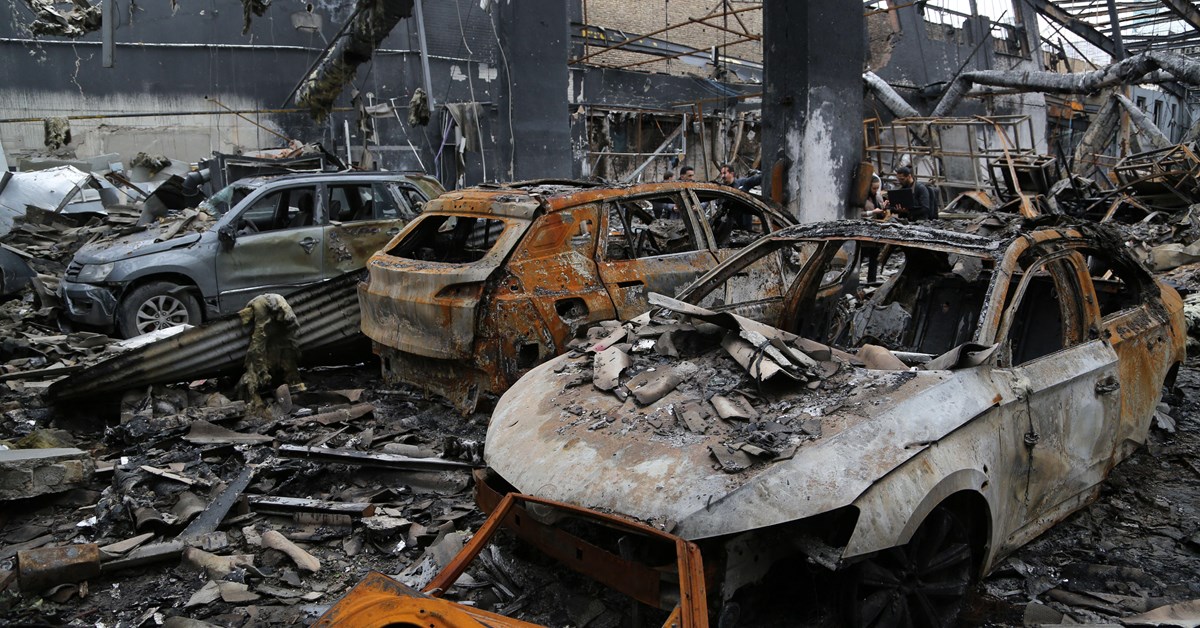
I AM not a fan of biblical prophecy, but it’s still remarkable that, in a year’s time, we’ll be able to look back and see that Israel has brought two mighty empires to conclusive and humiliating defeats in the span of 72 years. It will have done so not by attacking them, but by allying with them. In 1955, the British were persuaded into the attack on Suez; in 2026, the Americans were brought into the Iran war.
In both instances, there was an extraordinary lack of preparation: although the British army had occupied the Canal Zone for the whole of the 20th century, shortly before the invasion the consul at Ismailia (as it happened, my father) was sent a top-secret enciphered telegram asking where the main post office was. Similarly, although on a much larger scale, Lawrence Freedman, the Emeritus Professor of War Studies at King’s College, London, reported on his Substack last week: “It is hard to convey the gloom that has overtaken Washington. All the structures that are vital to crisis management have either been attenuated or disbanded. There is hardly anyone left on the National Security Council staff. A friend described an empty State Department where you could hear your own footsteps.”
After running through the expensive and uncertain military options, Freedman concludes: “Success in war, though, is judged not by damage caused but by political objectives realised. Trump’s problem is that . . . however he plays this the US has been defied — so far successfully. He can take an off ramp but if he stops at this point the result of this operation will be to leave the US less respected and trusted than before and allies grappling with a problem not of their making. As things stand, this counts as a defeat.”
This really does feel like a rerun of Suez, on a very much larger scale, even if there are obvious differences: in 1955, after the Gulf States cut Britain off from their oil exports, the US was in a position to supply the oil, and the money, that we needed, and to withhold both if we did not accede to its demands. No one state stands in that relation to the US today. But that is also because no one state will succeed to its empire.
The war will also hugely damage Israel’s standing in the US. It is not fair to blame Israel entirely for the war, but to do so will become a salve for American pride. Freedman again: “There are many around Trump prepared to blame Netanyahu for leading him astray. One of the most striking features of the Washington mood is its irritation with Israel. Nobody believes that a future president will be as sympathetic to Israeli concerns as Biden and Trump. It may continue to act in the West Bank and Gaza with impunity but in practice the country is more isolated than ever before.”
From a wider perspective, the very shrewd American political scientist Michael Lind, writing in Unherd, sees the ultimate victor of this war as China. “Post-Cold War America has repeated the strategic mistake of leaders in London in the three decades after 1945, when Britain imagined that it was still a major power because its troops were still machine-gunning natives in places like Kenya and Oman, even as it lost its manufacturing leadership to Germany, Japan, South Korea, and Taiwan; Uncle Sam is the new Colonel Blimp.
“Why wouldn’t people in nations all over the world have a more favorable view of a repressive but unwarlike state like China, which makes first-rate consumer products and offers trade and investment opportunities, than they would of the United States, which, under any president of any party at any given time tends to be killing people in multiple foreign countries while boasting that it is the greatest country ever?”
One would like to believe from all this that there was a simple solution, which is to stop being beastly to the Iranians. But here, finally, we come to the role of religion in the conflict. The American journalist Claire Berlinski had a long Substack analysing Khomeneist Shi’ism, which she distinguishes clearly from the mainstream: “The central drama of Shi’ism is Imam Husayn’s martyrdom at Karbala. Karbala is the paradigmatic revelation of the truth about this world, and that truth is that the righteous are often outnumbered and defeated. Truth is stifled. The righteous are called to suffer, witness, and die rather than submit to illegitimate rule.
“Khomeinism isn’t a cynical veneer over an otherwise conventional state . . . [it] instructs the Islamic Republic’s elites, particularly the IRGC [Islamic Revolutionary Guard Corps], in the meaning of history. It teaches them that the longed-for redemption of history will emerge, and can only emerge, through struggle, catastrophe, and blood.”
Obviously, this is not the view of those ordinary Iranians whom the regime massacred in their thousands at the beginning of this year — but it is what animates the men with the missiles, and will be only strengthened when, as now seems inevitable, America fails to conquer them.