IN 1994, the BBC was at its most imaginative and creative. Starting on the Eve of Palm Sunday, it broadcast the première of Sir James MacMillan’s Seven Last Words from the Cross over seven nights. To my mind, this work stands as the equal of anything written in the past half century, by any composer, anywhere in the world. It’s worth looking theologically at what MacMillan is doing musically.
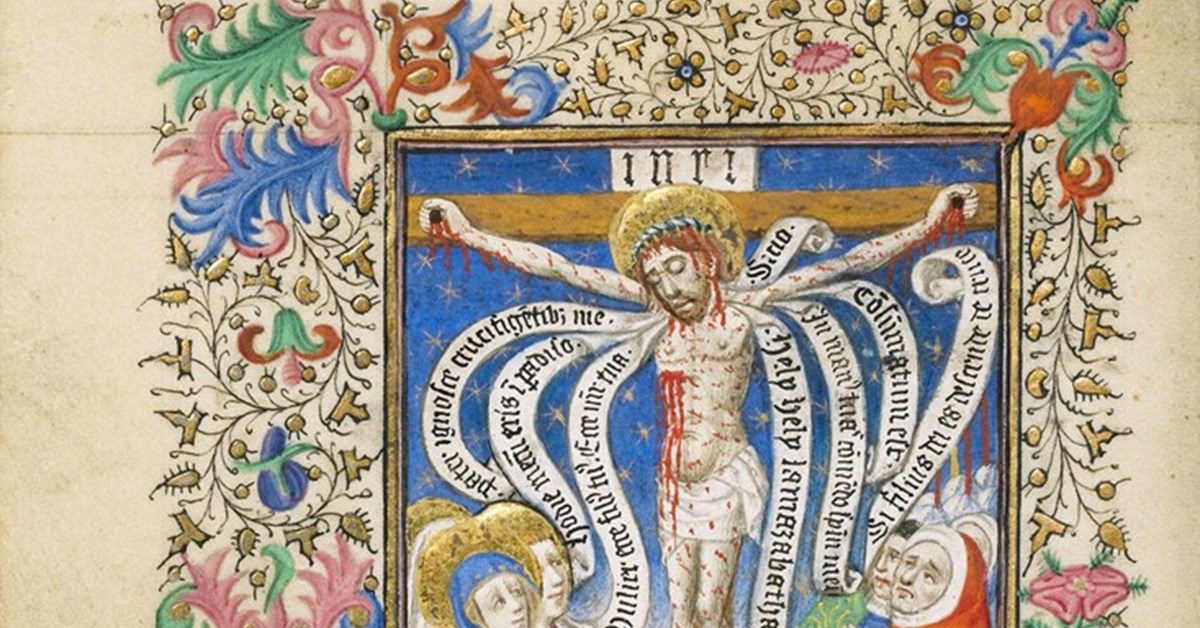
The tradition of seven “words” collects Christ’s utterances from the cross (“word” used here to refer to any phrase or sentence in a list, as when the Ten Commandments are called the Decalogue: the “ten words”).
Since no Gospel records all these utterances, their precise order is not laid down. Some, however, seem earlier, others to come just before Christ’s death. MacMillan follows a traditional sequence. The biblical texts furnish only a few words for each musical movement. MacMillan responded by combining them with texts from the Holy Week liturgy, almost all taken directly from the Bible.
1. “Father, forgive them; for they know not what they do” (Luke 23.34)
WERE we to have these ten words only, and nothing of the rest of scripture, they would still deliver the message of God’s grace in Christ. Indeed, MacMillan sometimes finds all he needs in the first three words — even only the first two. It is as if, in his agony, Christ’s whole mind is contracted to the shortest expression of his attitude towards sinful humanity.
His words are combined with the crowd’s acclamation on Palm Sunday: “Hosanna to the Son of David . . . to the King of Israel” (Matthew 21.9; John 12.13). Those are the words, but the tone is that of the next time the crowd cries out (“Crucify him!”); this statement of his kingship belongs not to Palm Sunday, but to the inscription attached to the cross (“Jesus of Nazareth, King of the Jews”).
A third text is repeated to a simple chant: “The life that I held dear I delivered into the hands of the unrighteous and my inheritance has become for me like a lion in the forest. . .” (based on Jeremiah 12.7-11). It is with this text that the movement fades out, this repetition not reaching its end. The work was written to be performed, at first, on successive evenings, each evening ending with a depiction of Christ’s death.
2. Woman, behold thy son! . . . Behold, thy mother! (John 19.26-27)
THIS movement opens with the words “Woman, behold thy son!”, set like a majestic chorale, the voices moving almost entirely in step, with a different chord for each syllable. From repetition to repetition there is a disorientating swerve of harmony, and the interweaving of parts becomes increasingly complex. None the less, the sonorous top voice always works with the same five notes or pitches, returning to the first version for the sixth statement of the words. Christ’s love for Mary and for John, and the intensity of his desire to provide for them, in creating a new family from the cross, remains steadfast, amid all the musical changes. After a string interlude, these words are repeated five more times. Only at the very end do we hear “Behold, behold, behold thy mother”. Christ is overcome with pain, and can speak those words only once, almost entirely on a single note.
3. Verily, I say unto thee, today thou shalt be with me in Paradise (Luke 23.43)
THIS movement opens with the acclamation of the cross from the liturgy of Good Friday: “Behold the wood of the cross, on which hung the saviour of the world!”, followed by the customary response “Come, let us worship!” As in the litany, it is sung three times, each at a higher pitch (here, passing from basses to tenors to altos).
The first word “Behold” (Ecce in Latin) picks up the beginning of the previous movement (“Woman, behold thy son”). The words that gesture to the cross are chant-like, although with a melody that sounds more Eastern (more melismatic and modal) than the Western plainsong melodies we hear elsewhere in the Seven Last Words, and more complex and discordant than we would find in any Christian liturgy. In contrast, “Come let us worship” is harmonically peaceful, with the accompaniment of a soaring countermelody on the violins, supported by arching broken chords. Only at the end, after a string interlude, do we hear “Verily, I say unto you, today thou shalt be with me in Paradise, thou shalt be with me in Paradise.”
4. Eli, Eli, lama sabachthani (Matthew 27.46)
IT TYPIFIES the absence of sentimentality in MacMillan’s Seven Last Words that the central “word” among the seven should be Christ’s cry of desolation. It is given in the Aramaic reproduced in the Gospels. There are three sections: one ascending; one highly complex, with eight interwoven parts, often discordant; and one largely descending. We might think of the complex middle section as showing that it takes the cries of many overlapping voices even to begin to express Christ’s anguish.
5. I thirst (John 19.28)
THE composer combines the shorter “word” — about thirst — with a line from the Good Friday Reproaches: a part of the liturgy where God’s goodness is contrasted with human wickedness, expressed in the crucifixion. He has chosen the verse to do with drinking: “I have given you to drink of life-giving water from the rock, but you have given me to drink of gall and vinegar.” It is to be sung “staggered, individually or in groups”, sometimes on a single note, sometimes whispered.
The repetitions of Christ’s words “I thirst” move from quiet to loud, and harmonically from simplicity to complexity. Their final statement lacks all vigour. A section for strings, with which the piece ends, contains a sudden, disconcerting tremolo, rising then falling in intensity, labelled in the score “like a violent shuddering”.
6. It is finished (John 19.30)
THIS movement starts with discordant, percussive chords, at first in pairs, and then becoming rhythmically more complex. Our attention is caught by the soprano line, singing words from Lamentations (1.12, 16) which are used in the service of Tenebrae on Good Friday: “My eyes were blind with weeping. . . Consider all you people, is there any sorrow like my sorrow. . .” The three lower voices sing “It is finished!”, but this is no statement of triumph: the melody and harmony are full of chromatic tension, and the words are partly submerged under the soprano part.
Those words of Christ eventually take on an upward trajectory, and then something more like melodic completeness. The modesty with which they are treated is therefore no denigration of what Christ has accomplished, but simply a refusal to turn from the cost of how it was achieved; and the movement ends with the words from Lamentations: “Is there any sorrow like mine?”
7. Father, into thy hands I commend my Spirit (Luke 23.46)
THE final movement begins with a series of extraordinary chords, the first using all seven notes of the scale at once (here in the Lydian mode). This saturated harmony expresses, perhaps, the plenitude of God addressing God.
This movement offers remarkable parallels and contrasts with the second movement (“Woman, behold thy son”). There, with Christ’s humanity to the fore (as a man addressing his mother), the harmony is beautiful but straightforward: it is diatonic (i.e. with no notes from outside the home key), at least in the first statement. Here, in the final movement, Christ addresses God according to the definitive character of his divinity: as Son to Father. With the eternal divine relationship to the fore, the harmony dazzles and lurches (as some object from a higher dimension would, appearing in three spatial dimensions).
And yet, if we follow the top line of the opening words (“Father, Father, Father”), for all they are supported by that string of remarkable chords, we trace out exactly the same melody that first rang out for “Woman, behold thy son!” MacMillan is pointing out the parallel — better than I have ever heard it preached — between Christ addressing his mother and addressing his Father; between commending Mary and John to each other, and commending his own spirit to his Father.
THE words “Father, Father, Father, into thy hands I commend my spirit” take about a minute and a quarter to perform, after which comes a string passage lasting about another seven minutes. Seven Last Words is often distinctly Scottish, but never more so than here. MacMillan’s masterpiece ends with a simple Scottish lament for two string parts.
The work deals with that which is most universal in scope: with death and loss, with sin and redemption. It does so, as the greatest art always does, in a way that is highly particular. Here is a Scottish composer responding to the death of the man who is Lord and God (and, importantly, MacMillan’s Lord and God) as might a composer from northern Britain. As he has written, “In this final movement, with its long instrumental postlude, the liturgical detachment breaks down and gives way to a more personal reflection: hence the resonance here of Scottish traditional lament music.”
THE composer has still one more remarkable idea left. The string music fades in volume and becomes no more than notes, a semitone apart. The notes get shorter. They become further apart. Their spacing becomes erratic. They fall into silence. These are surely the final breaths of Incarnate God.
Could anything be more moving than that? Perhaps, if we recall the work that had brought MacMillan to public attention two years before: his concerto for percussion Veni, Veni, Emmanuel (“O Come, O Come, Emmanuel”). Woven right through that concerto is the heartbeat of the Incarnate God: infant, perhaps still unborn. What he had depicted there at its beginning he depicts here at its end.
The Revd Dr Andrew Davison is Regius Professor of Divinity in the University of Oxford and a Canon Residentiary of Christ Church.
The Seven Last Words: Passion music beyond Bach’s Passions
ALTHOUGH settings of the full story of the Passion get the most attention around Holy Week (notably those by Bach, Handel, Telemann, Penderecki, and Pärt, for instance), the words from the cross have also been set to music many times. The most famous example is also the most unusual, by Josef Haydn. These started out as an instrumental work, written to be performed on Good Friday 1786 in Cadiz Cathedral between sermons on each of the words. A final movement depicts the earthquake. The following year, Haydn adapted it for string quartet, only in 1796 reaching a version for choir and orchestra.
Earlier musical treatments of the words include a short work by Heinrich Schütz (c.1645-1650). Nineteenth century France gives us settings by César Franck (written in about 1859, rediscovered in 1977), and Theodore Dubois (1867). Sofia Gubaidulina (1982) followed Haydn with a purely instrumental response in her Seven Words for cello, bayan (a form of accordion), and strings, in which she quotes the Schütz.