DEPRESSION sears the soul. So do the memories that can prompt it — memories that can remain with you for a lifetime, no matter how hard you try to tell yourself that they belong in the past and should stay there.
I have an enduring memory of a particular moment when I fell prey to depression. It was triggered by one of many failed attempts to get to know my father. I had turned up unannounced, only to be met with the door being slammed in my face, and, as I was leaving, my own reflection repeated into infinity by mirrors on either side of the hallway. It was a visual echo of the slamming door as they threw my own reflection back to me into what seemed like eternity.
MOST people who have experienced depression, whether only occasionally or as a lifelong condition, will recognise the double-mirror effect that it has on the way we see ourselves. They will know it for the way it distorts a person’s sense of worth, and even of their personhood: replicating, but also confining and limiting who you believe yourself to be, in an endless cycle of destructively repetitive thoughts about the self you have learned to hate, to the point that you cannot bear the sound of your own name.
Depression robs you of personhood, so you believe yourself to be unnameable. It follows that you have no place in anyone’s story — or at least not in the story of someone who matters to you and on whom you may depend for a basic validation of your existence — a parent, or God, perhaps.
I THINK the story of Christ’s descent into hell on Holy Saturday has much to teach us about managing depression. He descends into the hell of our own non-being when we experience depression at its worst, when it becomes an abyss of loneliness and often of despair, where those in their darkest moments consider suicide.
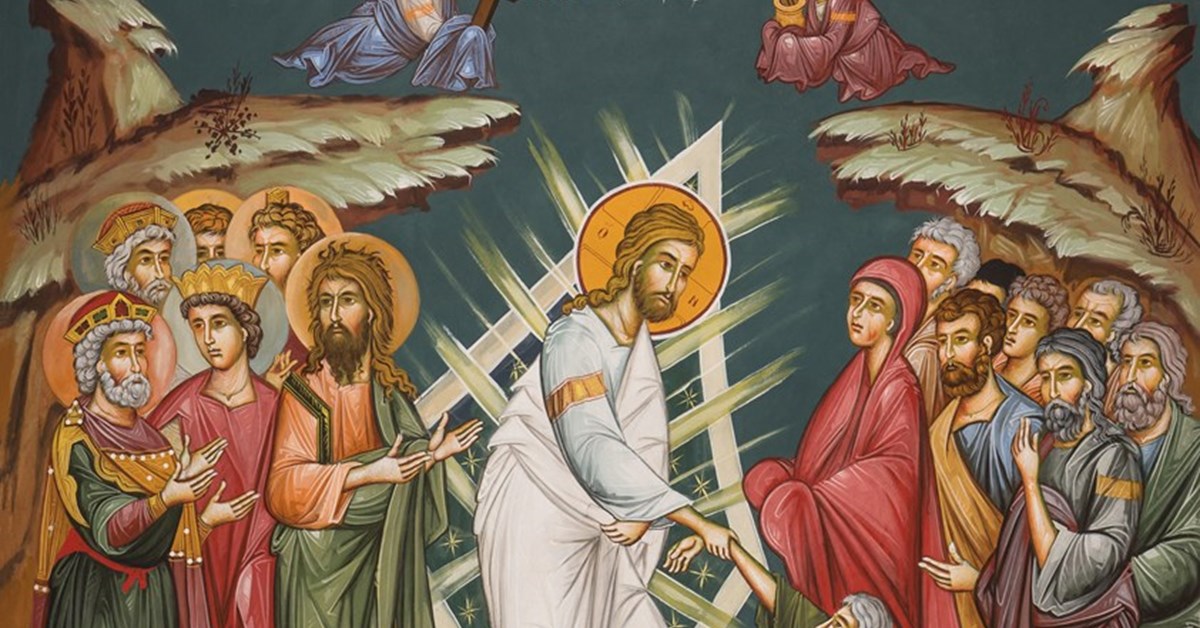
If, in these dark moments, we can keep our eyes trained on Jesus, we see that he meets one, or possibly two, individuals at the bottom of the pit into which he has descended. First, Adam: the archetype of the human condition when it comes to that state of alienation from God and from all living beings which is often experienced in the worst moments of depression; second, poor old Judas, who believed himself to be beyond redemption, unnameable and unforgivable. He also meets us there, when we believe ourselves to be beyond redemption.
IF WE are to speak of God’s anger, in regard to human folly and sinfulness, it is more likely to be caused by our determination to believe that we are beyond redemption — and thereby beyond forgiveness — than by any thought, word, or deed that is inherently sinful.
God’s anger, if that is what we can call it, is more likely to be caused by our wilful determination to be left alone to lick our wounds, like Job; or Jonah, sitting under his tree and refusing to be comforted when it is suddenly gone; or Judas, who despairs of forgiveness and condemns himself to a hell of his own making.
In our worst moments of alienation from God, or from another person, we want things to be that way. We make a hell for ourselves, a hell that can shape itself to every kind of grief and to every incident of loss or abandonment. But Christ pursues us to the farthest reaches of our own hells, defying the constraints of time as we know it. He pursues us like the poet Francis Thompson’s hound of heaven, “down the nights and down the days. . . Down the arches of the years. . . Down the labyrinthine ways Of my own mind.”
JONAH, Judas, Adam, and Job — each, in their own way, believes himself to be alone in the hell he has made for himself. But none of these people are alone. Christ’s descent into hell on Holy Saturday refutes that idea for all time. Hell as a place of eternal alienation and despair will never be the same again. After Holy Saturday, it will be only what we make it.
We are faced with the choice — or temptation — to make a hell for ourselves, or other people, or for any created being, every minute of every day. In this respect, we live in an eternal present, waiting for Emmanuel to come once again to our rescue. The name Emmanuel, “God with us”, is not emptied of meaning on Holy Saturday, the day when God appears to be absent. It is completed.
THIS is where praying with icons can be helpful. Icons, especially icons of the resurrection, are a reminder of the way history itself has been completed and healed. In his grasping of the hand of Adam, or of Judas, Jesus effects an ultimate reparation. What is lost is now found. What was broken is now mended. All things are made new.
Icons are also personal. In hearing our name, as we contemplate the icon, we are also invited to enter into the loneliness of others — practically, wherever this is possible, but also by being present to all those who are secretly despairing; who believe themselves to be utterly alone. Christ grasps their hand without them having even to proffer it. If they are willing to listen, even for a second, they will hear their name being called, as Mary Magdalene heard hers outside the empty tomb.
THE moment when Mary Magdalene hears her name called echoes or pre-figures the redemption of all things. Every time we allow ourselves to hear the risen Christ call our name is the ultimate vanquishing of the powers of hell — however they manifest themselves in our lives.
The incarnation begins with the call of an angel to a young girl, and with her response. It finds its completion in the response of Mary Magdalene, in her uttering of the name by which she knew the Teacher, as it is echoed down through the ages in the hearts and minds of those who recognise and answer Christ when they, too, in their darkest moments, hear their own name being called.
The Revd Dr Lorraine Cavanagh is an author, and a priest in the Church in Wales. Her latest book is Silence in Ordinary: Contemplative living for busy people (Ameo Books, 2025).