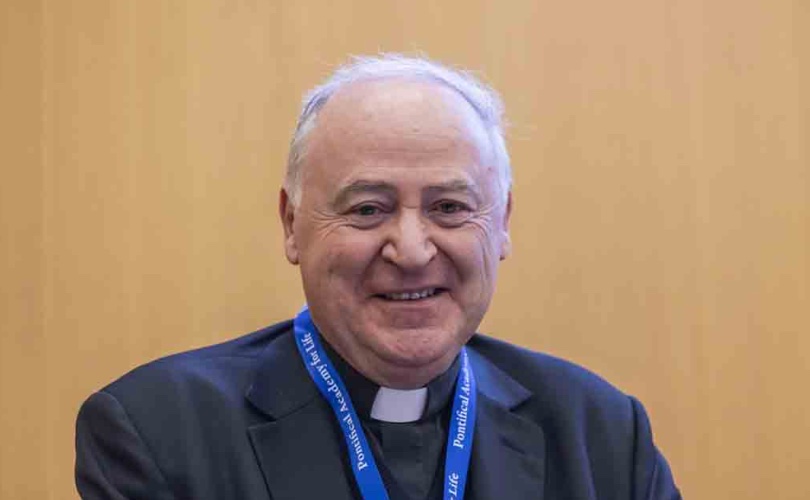
VATICAN CITY (LifeSiteNews) — Pope Leo XIV has elevated the president of the Pontifical Academy for Life, Renzo Pegoraro, to the rank of archbishop, prompting renewed attention to the prelate’s past statements on palliative care and sexual ethics which stand against perennial Catholic Church teaching.
On March 25, Pope Leo XIV raised the president of the Pontifical Academy for Life, Monsignor Renzo Pegoraro, to archbishop. This appointment, although predictable given Pegoraro’s position, is nonetheless significant due to his previously documented positions on moral theology and his stated intention to maintain continuity with his predecessor Archbishop Vincenzo Paglia’s direction – a direction which is incompatible with the Church’s longstanding bioethical doctrine.
Pegoraro’s leadership of the Pontifical Academy for Life began on May 27, 2025, when he succeeded Paglia, under whom he had previously served as chancellor. In public remarks reported at the time, Pegoraro indicated that his approach would follow the same trajectory established during Paglia’s tenure, particularly with regard to engagement on ethical issues such as end-of-life care.
In an earlier interview with the Wall Street Journal in 2022, Pegoraro addressed the question of contraception, stating that while the norm against it “signals values to be preserved in married life,” other values might justify exceptions. He cited as an example situations involving “a conflict between the need to avoid pregnancy for medical reasons and the preservation of the couple’s sexual life.” These remarks diverge from established magisterial teaching, including the 1988 affirmation by Pope John Paul II that the prohibition of contraception belongs to the permanent patrimony of the Church’s moral doctrine.
Pegoraro declined to respond to inquiries concerning those earlier statements to LifeSiteNews back in June 2025.
Beyond the doctrinal issues, there are additional details that strongly suggest Pegoraro’s inadequacy for the role he holds. For example, during the 30th General Assembly of the Academy, he employed the term “polycrisis,” a concept promoted by globalist figures such as World Economic Forum founder Klaus Schwab. Pegoraro is also listed as a contributor to the Global Solutions Initiative, an organization supported by the German government and linked to partners such as the World Economic Forum and the Open Society Foundations founded by George Soros.
In a 2021 paper titled “Human-centric AI,” Pegoraro outlined a proposal for global governance of artificial intelligence grounded in principles including “meaningful human control, fairness, equity, justice, sustainability, and inclusivity.” All these categories belong to the vocabulary of progressive liberal‑democratic ideology, not to the Catholic moral tradition.
The paper presents itself as an ethical guide for G20 governments, but the conceptual framework it adopts is that of fundamental human rights as defined by the European Commission’s expert group, and it makes no reference whatsoever to either the Church’s social doctrine or natural law.
Among the recommendations to governments, the paper explicitly calls to “endorse the OECD AI principles.” The OECD is a secular international body whose AI principles include respect for “diversity” and “inclusion” in alignment with those of pro-LGBT advocates, and without any grounding in natural law.
The paper is signed by three members of the Pontifical Academy for Life – an institution founded to defend human life from conception to natural death. Yet its final recommendations on “healthcare” and “welfare” as areas of AI application do not contain a single line about the risks of AI when applied to sensitive bioethical issues.
All of this is the obvious consequence of institutional developments dating back to November 4, 2016, when Pope Francis promulgated new statutes for the Pontifical Academy for Life. Under these norms, members were no longer required to sign the “Declaration of the Servants of Life,” a formal commitment that had previously bound them to reject practices such as abortion, euthanasia, and destructive research on human embryos.
The revised statutes also introduced terminological and thematic changes, including the use of the term “gender” in place of “sex” and an expanded mandate encompassing environmental concerns and collaboration with academic institutions representing various cultural and intellectual traditions.