Scroll down to read an extract of Dr Sixsmith’s new book, ‘When the Music Fades: Power, surrender and the Soul Survivor generation’
YOU can still find footage on YouTube of the Christian band Delirious? performing a sold-out farewell show at the Hammersmith Apollo in 2009. A camera sweeps across a sea of people holding their arms aloft and singing the words back to the band: “Is it true today that when people pray Cloudless skies will break, kings and queens will shake? Yes, it’s true and I believe it I’m living for you.”
“History Maker”, first released in 1997, is one of the band’s most loved songs. Bookended by verses envisaging miraculous events, the chorus has congregations singing “I’m gonna be a history maker in this land.”
Dr Lucy Sixsmith can still “almost get into” the song, she reflects, “because it’s a good song, even though it also stirs up a sense of 16-year-old me, really excited by the idea of ‘God is with us to bring hope to the world.’”
Such excitement was accompanied by “a kind of pressure”, she recalls. “What I was interested in was: what happens if that big vision comes in before you’ve learned how to do quite ordinary things, like apply for your first job . . . manage a friendship?”
The “History Maker” vision is, she observes, “very, very ambitious”.
DR SIXSMITH’s new book, When the Music Fades: Power, surrender and the Soul Survivor generation, is dedicated to “History Maker evangelicals” — all those “who have known, or might be persuaded into, that deep need to surrender, to fling wide our arms and be carried away by glory”. Among the questions that it poses are: “Why did it all seem to matter so much? And what do we do now with our memories, dreams, and hurts, our hope and weariness, in the Church or out of it?”

The catalyst for the book was the revelation that Mike Pilavachi, the founder of Soul Survivor, was — in the words of the National Safeguarding Trust investigation — the perpetrator of an “abuse of power”, including spiritual abuse, and coercive and controlling behaviour (News, 8 September 2023). Dr Sixsmith, who grew up going to an independent Charismatic church that grew out of the house-church movement was among the hundreds of thousands of young people who attended the Soul Survivor festivals that ran between 1993 and 2019.
She writes, she says, as “neither a survivor nor a safeguarding expert, but just someone who was in the crowd”.
This crowd was substantial: attendance at Soul Survivor festivals hit a peak of 30,000 in 2014. The charity Youthscape has observed that “a significant proportion of Christians in the UK and beyond will feel some connection to the ministry of Soul Survivor.” It was, Dr Sixsmith writes, “the whole country’s evangelical youth group”.
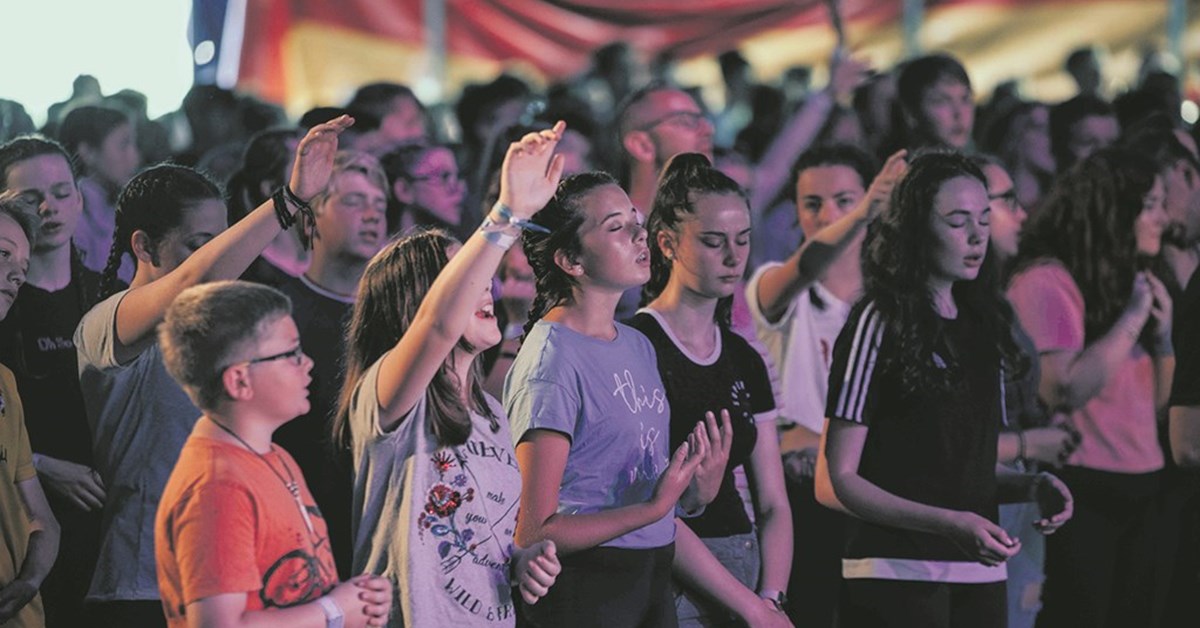
Her book captures “the excitement of scale and the safety of belonging” that this group experienced (“here, it seemed, were thousands of our own tribe, people who loved Jesus the same way we did”), and the joy of big-top gatherings — of the crowd singing unaccompanied, “as if we could not help worshipping, as we were half in heaven already, where the worship never ceases”.
Lyrics pepper the book. “The songs had always mattered to me so much,” she tells me. “I had always wanted to be in that space of stepping into the presence of God with your arms in the air and everything else is gone.”
A practical prompt for the book was not knowing what to do with these songs, now — feeling unable to add them to the rota at the church where she worshipped.
“If I had known who the songwriter was, and known that in their workplace, while they were writing the song, they were experiencing that kind of emotional abuse and more. . . The words are the same, but I am hearing the words completely differently, and it doesn’t feel comfortable to sing them any more.”
AMONG the revelations that emerged after news of a safeguarding investigation was first announced, in 2023, was testimony from Matt Redman, the songwriter who led worship at Soul Survivor as a teenager, before going on to a Grammy-award-winning career. In 2024, he spoke on film about being “stonewalled”, having added a worship song to a set without first checking with Mr Pilavachi (News, 12 April 2024).
Dr Sixsmith’s title is taken from one of Mr Redman’s most well-known songs, inspired by a period in Soul Survivor’s history when, according to Mr Pilavachi’s account, there was concern that sung worship had drifted from a focus on God to watching a performance. Its lyrics are among several that she reassesses in the book, eyeing them — and Mr Pilavachi’s emphasis on humility in his worship team — in a new light.
She is struck by how many of the worship songs of the period concerned surrender, and by the space for “a kind of self-forgetting in which your whole body and mind and being became focused in that upwards desire”. The flipside of surrender, she writes, is power: “Who gets to look round calmly, triumphantly, as each worshipper falls?”
WHEN the Music Fades goes beyond Soul Survivor to the wider culture of Charismatic Evangelicalism in Britain in the 1990s and early 2000s. Dr Sixsmith describes to me a culture “in which experiencing the Holy Spirit is the most important thing that there is. . . It’s all about that sense of encounter and the practices that go along with that, where we meet with God is in his presence in worship; almost like an Old Testament sense of ‘We are stepping into the cloud.’”
While Charismatic Evangelicalism has become a significant component of the broad Church of England, it remains alien to some. Others openly disdain it.
I suggest that grappling with the theological dimensions of what happened at Soul Survivor is difficult, because nobody wants to be accused of portraying such abuse as contained within one wing of the Church, or to denounce practices that are widespread in the Church. Charismatic Christians would also point to scripture and church history in defending practices such as asking people to be filled with the Holy Spirit.
“I think it is really difficult, and I didn’t want to come down too strongly on ‘This is what I think we should do,’” she says. “It’s something that I could probably question within myself even now. Is the book too emphatically saying one thing or the other, when I kind of want to open up the question of ‘What does it mean to — in a healthy and safe way — invite the Holy Spirit to work in people?’”
 SOUL SURVIVORSOUL SURVIVOR
One of the aims of the book was to try to evoke this environment, “to put out into the world: this is what it was like, this is what a lot of us who are now 30- or 40-somethings experienced as teenagers.”
It can be valuable for clergy outside the tradition, but likely to come across this generation in their congregation, to listen to such descriptions, she suggests: “why it seems so good, and why it matters so much, and, ultimately, why it’s so hard when anything goes wrong.”
Soul Survivor was “unusual” in conducting prayer ministry in silence rather than with musical accompaniment, she recalls. “There would be times where it was 10,000 people in complete silence — teenagers as well — which is kind of mad.” The silence would sometimes be broken by the sound of someone crying, somewhere in the tent.
Today, she wants “to take that person out of the tent, give her a cup of tea, and get her away from the other 9999 people”. But, at the time, she remembers the assumption that “that outward expression is God working in people, and maybe healing can come really fast, and Jesus can sort everything out, and that will be fantastic.”
She is conscious that practices may have changed since she stood in the crowd in the tent. Perhaps, she suggests, people may read the book and “use it as a springboard and say ‘This is what we are doing differently now’”.
WHEN the Pilavachi allegations were first made, Youthscape offered advice to youth workers, suggesting that — even if the allegations were substantiated — “it doesn’t undermine everything that happened at the festivals, programmes, or church. . . If you have had an experience of God through Soul Survivor, and this seemed real to you, you don’t have to abandon it, whichever humans were involved in leading at the time.”
“I did feel quite strongly that I wanted to honour what people had come away with that still seems good there,” Dr Sixsmith says. “I wouldn’t want to be taking that away from people.” But she is also conscious of those with other experiences — including those no longer in the Church: of people who feel “we really did our best to be history makers, and we were not good at it, in that sense of life can be quite hard and ordinary.”
In her book, she observes that some people “instinctively shrink from the emotion and melodrama of Charismatic prayer, which means that those who believe that it really is God are instinctively defensive”. The latter, she writes, “may think that I’m rushing to judgement, seeing the worst and not the best, rejecting the good fruit of those prayer-ministry times”.
“I believed it was God, too,” she writes. “But I also remember a friend of mine crying while we all knelt round and prayed for him. I never found out whether ‘Jesus was meeting with him and dealing with him’, or whether that meeting ripped the scab off something that would have healed better if kept covered and clean. My friend mattered, the one kid in a crowd of thousands. It matters whether or not the one kid is actually OK.”
Some will be left asking a “pragmatic” question, she says. “If it really was God, could God not have told someone to question the leadership of Soul Survivor slightly earlier?” It is hard to speak for everyone’s experiences, she observes. “Things are complicated. We can let them be complicated.”
Listen to the full interview on the Church Times podcast
An extract from When the Music Fades by Lucy Sixsmith
 SOUL SURVIVORSOUL SURVIVOR
THERE were moments when I wondered whether the sense of surrender had actually changed anything. Having thrown yourself out on the tide of God’s glory, flung wide your arms, knelt down over and over, how could you know whether God had made anything good come from your life or through your clumsy words, your awkwardness, the unskilled works of your hands? How many times did you need to lay down your soul on the carpeted floor of a former cinema before God would scoop it up?
Was there any way of confirming whether God had included you in his purposes, or whether you were repeating “Here I am, send me” while remaining unsent? You’d been told that a good tree bore good fruit, so the unfruitfulness of your own life had to be a worry. It would have been nice to know whether the procedure took, so to speak; whether it was a surrendered life, in fact, that you were actually living.
That worry was a background concern, though, because sur render wasn’t fundamentally the point. The fundamental point was worship. Surrender was a regular practice, a place you came back to again and again, not because it didn’t work the first time but because there was nowhere better to be: better was one day in his courts than a thousand elsewhere, as the psalmist and Matt Redman both said.
A turn or return in a song might represent the first return of a repentant heart back to the father like a prodigal son, or it might mean that we are coming back again and again, “many times”, as in Matt Redman’s “Once Again”: “I’m in that place once again”. Or there was Craig Musseau’s song: “Here I am, once again, I pour out my heart.” Here I am, we kept saying, and it wasn’t strictly necessary to add Isaiah’s eager-to-be-useful send me; because this was worship, after all.
It was about God, not about us. Yes, we believed that worship was meaningless without action, and went hand in hand with intercession, and was intimate with God’s heart for justice; but we didn’t worship with a utilitarian need to crack on with the real work afterwards.
Here I am, we said, and when we poured out our hearts, it was simply to say, “I love you, I need you, I’m thankful, you’re wonderful.” Here I am, we said again, and again, for no more complicated reason than that God was our God, altogether lovely, altogether worthy, altogether wonderful. There was nothing more to it than that: the simplicity of kneeling at Jesus’ feet. “Here I am to worship” said Tim Hughes, aged 19. “Here I am to bow down.”
And Mike Pilavachi told him to play the song more often, and the song took over the world. And I think what really gets me, today anyway, is the word “lovely”. With all the needfulness of saying that he is God, with all the rightness of saying that he is worthy, with all the solid doctrinal soundness of saying that he is the light of the world or oh-so-highly exalted, with all that said, for this songwriter it seemed important also to say that he is wonderful, and even beyond that, to say that he is lovely, loving and lovable and beautiful and gracious.
”Lovely”, a word that takes the risk of being either warm praise or a generic compliment. You need to know the speaker and be able to judge their tone when someone says, “Oh yes, so-and-so is really lovely”, because it could be sincere, or just the standard thing people say. “Lovely”, which is close enough to “worthy” that it works as a declaration of worship, narrowly avoiding the Jesus-is-my-girlfriend category: whatever your mood, even if soppiness makes you cringe, you can start off comfortably with “Light of the world, you stepped down into darkness”. But by the chorus, the song will ask you to say that God is lovely and wonderful.
When Stevie Wonder asked, “Isn’t she lovely, isn’t she wonderful?”, the song was about a minute-old baby and a father who was head over heels. In “Here I am to worship”, a very young songwriter considered adjectives for God and chose one that verges on soppiness. This makes the singer seem, if not mawkishly sentimental, then overly sincere. It can be a vulnerability to wear your heart on your sleeve.
At Soul Survivor, worship seemed to be all about that simple lifting up of praise, and it seemed so wholehearted and whole some that we didn’t notice any vulnerability. Upbeat, boppily guitar-led music was another way to sing about the wonder and beauty of God and still have the kids jumping and dancing and doing conga lines in the aisles.
“BEAUTIFUL ONE” was also by Tim Hughes: “Beautiful One, I love you; Beautiful One, I adore.” The song has the lightness and brightness of long summer evenings at Soul Survivor festivals: crowds milling into the big top, tents and camping chairs and tin mugs, sunshine and breeze. The words might seem overly honeyed on the page, but even in the more mellow bridge section there’s a plain cheeriness to the step-by step tune, and soon the drums will build momentum up, and the bass line will drive into the chorus again.
Having sung that his glory fills the skies and his mighty works are displayed for all to see, the worshipper can keep that picture of beauty in mind while singing, but the point of the song is to proclaim that God is beauty beyond the natural order, beauty beyond beauty, creator and sustainer, wonderful and marvellous. Worship was about lifting your gaze from ordinary and trivial things, beholding God’s beauty and glory. Beauty and glory, greatness and holiness: “Holy, holy, are you Lord God Almighty.”
There was a song called “Agnus Dei”, one of many that use the words “alleluia” and “holy” over and over. This one had an unstoppable sort of chorus: the last “holy” circles smoothly back into the first “holy” without settling into musical resolution. The natural thing is to keep singing it, so the crowd would keep singing. These were the sorts of moment when the band could let the backing music drop away and the crowd would be singing still, as if we could not help worshipping, as we were half in heaven already, where the worship never ceases – not, presumably, because it just never bothers to land on the home key, but because the King of Heaven is so beautiful and glorious and holy and worthy.
So simple a song could be lifted up in any moment of silence, unplanned, because someone in the crowd started singing. I loved those moments so much: when it seemed like the big tent held the awe of a grand cathedral, a high pass in the mountains, the ocean deeps. When one little person lifted their voice in worship and led the crowd, and we didn’t need the band.
As a teenager, I sometimes worried about hype. Unavoidably, when several thousand teenagers are all in the same giant tent, there are high spirits: jumping, shouting, throwing toilet rolls high over the heads of the crowd, which wasn’t considered a spiritual practice even in the charismatic church.
There would always be kids who started up chants like “Je-sus (clap clap clap) Je-sus (clap clap clap)”, whether at appropriate moments, or during quiet lulls. Mike Pilavachi would hush them from the stage sometimes, with apparent gentleness. Kids will be kids; no doubt some energy came from the joy of the Lord, and some was whipped up by the unusualness of the occasion. I wanted to be sure that it all really was for Jesus (clap clap clap); that there was reverence behind it, that there would be uninterrupted moments in which everything fell away as you gazed on his beauty. I knew that emotion could be stirred up by the music. And I wonder if I was taught, rather than deciding for myself, that it was beautiful if the crowd’s worship silenced the band.
One wet day the sound system cut out entirely, a swath of water dropped through a loose flap in the roof, and we all carried on singing. It’s all about Jesus, Mike would say, or anyone might say, because it was said many times. It’s all about you, Jesus. When the music fades, all is stripped away. It feels important, now, to say that Soul Survivor seemed sound and good at least partly because of the music, the kid-friendly conga-appropriate praise-party songs, the slow and steadily reverent songs, the rehearsals you could hear across the campsite, the late-night worship sessions for the extra-keen, the CDs and songbooks you could buy to take home.
All this seemed healthy because of its simple, serious purpose: to shew forth his praise, just as one might pray in a traditional liturgy, “O Lord, open thou our lips.” “I’m lost in wonder, I’m lost in love.” “I see the King of glory coming on the clouds with fire.” “Always loving, always true, always merciful and good, so good.” That was a line by Vicky Beeching, who had the clearest voice and coolest stage presence of all the worship leaders. There weren’t many on-stage female role models, and I obviously wanted to be Vicky Beeching.
We had no idea that in the Evangelical world she was having to hide herself, harming herself. She shared the truth long before the allegations about Mike Pilavachi reached the press. Looking back now, I wonder about the way Vicky Beeching’s book doesn’t point fingers, but ponders the general impact of the evangelical world on her as a young, faithful, gay woman. I think I should have questioned more, looked more deeply and more sharply askance, when she was telling her story alone.
It seemed as if the joy and gift of Soul Survivor was the freedom to worship God through music, there at the festivals with thousands of others, and in your bedroom when you got home. And yet it also seemed wise and wholesome that Soul Survivor downplayed the importance of music, telling us again and again that the band didn’t matter, the sound didn’t matter, their skills didn’t matter. It seemed, at the time, like a principled resistance to Christian celebrity culture. I might even agree that there are few things more beautiful than a cappella spontaneous singing. Equally, the whole approach seems now like a fantastic way to make talented, trained, hard-working musicians and sound engineers feel really, really small.
This is an edited extract from When the Music Fades: Power, surrender and the Soul Survivor generation is published by Canterbury Press at £16.99 (Church Times Bookshop £13.59); 978-1-786-22615-0.