IT IS a cold, damp Sunday afternoon in March, and, inside a pretty village church nestled on the Oxfordshire-Warwickshire border, three generations of a family and two American tourists are scrabbling around on their hands and knees, searching for church mice. But these are not proverbial ones, but ornate wooden ones, lovingly carved on to oak furniture in churches across Britain by Robert “Mouseman” Thompson and his company since the early 1900s.
Five generations on, and 150 years since the birth of Robert Thompson in 1876, the company is still going strong from its base in Kilburn, North Yorkshire, employing about 20 craftsmen who still use the traditional techniques and tools from more than a century ago.
Ian Thompson Cartwright now owns the company, with his two brothers, Peter and Giles, and his son, Simon. Ian, now 71, is the great-grandson of the original master- craftsman Robert, and trained as a cabinet-maker straight after leaving school.
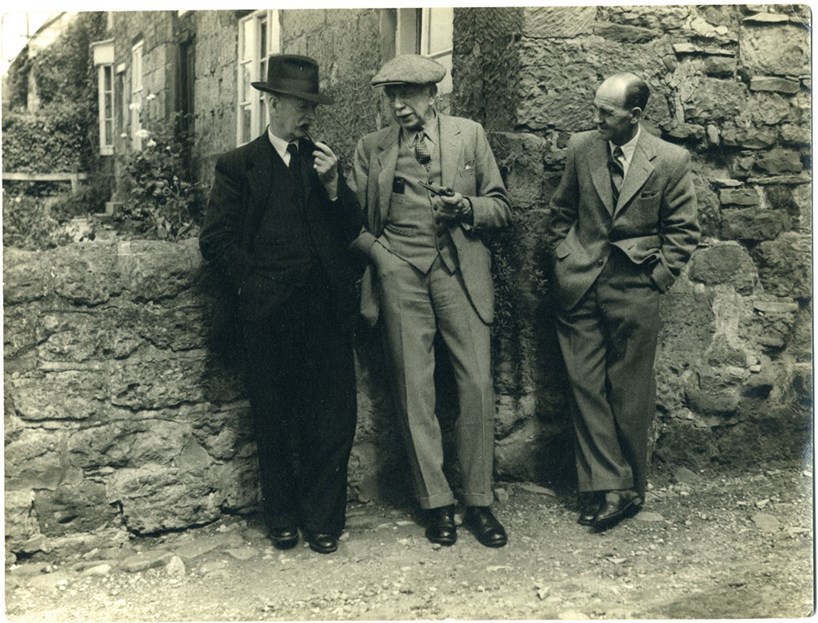 Mark Pickthall/Robert Thompson Craftsmen LtdRobert “Mouseman” Thompson, centre
It seems unlikely that there was ever going to be an alternative career path for him. The company has strong links with the Church, and Ian emphasises how the commissions from churches were instrumental in the early success of the company. “The business was built on the ecclesiastical work,” he says. “It was born in the Arts and Crafts movement [which reacted against industrialisation and mass production], and there’s quite a crossover with what William Morris was doing in the 1800s. Great-grandfather had an aspiration to do the same work that traditional craftsmen had been doing back in the 15th century.”
That traditional craftsmanship involves the use of the adze, an ancient tool similar to an axe, with an arched blade set perpendicular to the handle, used for shaping and carving wood. “Jesus might have used them: he was a cabinet-maker,” Ian says, extending the Christian connection even further back in time. “Great-grandfather employed 40 men in the workshop between the wars, as labour costs were quite reasonable, and material costs were not high. Now, it’s the other way around. We still only work with naturally seasoned English oak, which we dry for a minimum of four years.”
WHILE demand for Mouseman furniture in church buildings is lower than it was at its peak in the early- to mid-20th century, as many churches have started replacing wooden pews with stacking chairs, the list of places of worship and buildings that contain Mouseman furniture runs to more than 1000.
Prominent locations range from Westminster Abbey to St Davids Cathedral, York Minster to Eton College, and even two chairs that were on board the former aircraft carrier HMS Ark Royal. Many are in churches and buildings in the vicinity of the Mouseman base in North Yorkshire. The company built up a strong rapport with Ampleforth Abbey and Ampleforth School in “God’s own country”, Yorkshire.
“Robert enjoyed working with the monks at Ampleforth,” Mr Thompson Cartwright says. “Fr Paul Nevill was the Roman Catholic priest at Ampleforth, and great-grandfather carved a wooden cross for him in 1919. He then became the head at Ampleforth College, and started ordering more pieces. That was really the start of the ecclesiastical work on a commercial basis. After that, he started doing all sorts of different things for churches, for all different denominations.”
Fr Chad Boulton, the novice master at Ampleforth Abbey, said that Robert Thompson worked with the architect Giles Gilbert Scott — who designed the red phone box and Liverpool Cathedral — to rebuild the Abbey. “Their histories are interwoven here. Scott was working on the redesign of the church, and he was going to use a craftsman from London, but was won over by Robert Thompson after they were put in contact by Fr Paul Nevill.” Underneath Thompson’s choirstalls at Ampleforth, there are letters chiselled into the woodwork that read “by Thompson and Scott”.
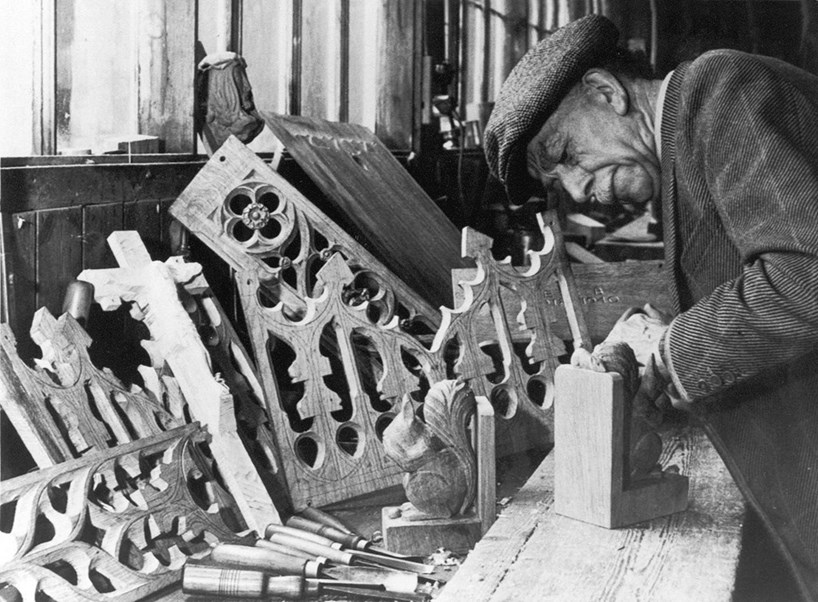 Mark Pickthall/Robert Thompson Craftsmen LtdRobert Thompson at work, carving a squirrel bookend
“It’s a big part of our history, and the use of oak certainly gives us a local connection,” Fr Boulton says. “There are also several wooden reredoses above the altar, a wonderful lectern which we still use, and carved mice everywhere.” He believes that the woodwork gives a sense of security to the monks at Ampleforth, who are part of the English Benedictine Congregation. “Us monks take a vow of stability, and the oak choir stalls here are so stable, we get a sense of strength when we pray in these stalls.
“The Thompson family are still based in Kilburn, which adds another layer of stability, and it’s a great privilege to pray in this beautiful context. The mouse emblem was also described by Robert Thompson as ‘a symbol of industry in a quiet place’, and that’s what we as monks are called to do; so there’s another link between us quietly going on with our monastic life as Robert Thompson did with his work.”
THE scope of the Mouseman woodwork is broad: there are handcrafted wooden pulpits, lecterns, pews, altar tables, candlesticks, doors, crosses, and memorial boards adorning places of worship across the country, even as far afield as Kathmandu, in Nepal, where the Speaker’s chair in the Nepalese parliament was delivered in 1992 by the Mouseman craftsmen.
Diane Sinnott is a general valuer and valuers of 20th-century design at Tennants Auctioneers in Leyburn, North Yorkshire, and both a fan of, and an expert on, Robert Thompson’s work. Much of her job involves auctioning off Mouseman furniture, and items from the 1930s sell for thousands of pounds. Last year, two Mouseman dining tables from Moorlands High School, in Leeds, sold for a combined total of £78,000. She will be giving a lecture in June to mark the 150th anniversary of Thompson’s birth on 7 May 1876. The sheer durability of the furniture, she says, is part of the reason for its success.
“Robert Thompson started using English oak, which is indestructible: it’s a very, very robust material. But along with that it’s the whole story of it. Robert did an apprenticeship in engineering, and, when he was returning home from that, he used to see the master craftsmen at work at Ripon Cathedral. But his heart was in the countryside. So, he patented the mouse symbol, which was a great trademark, and makes every piece of furniture seem like it is really different.”
The idea for the mouse motif is believed to have come about when Thompson was carving a cornice in 1919, and a fellow carver said that he was as poor as a church mouse. He then decided to add the hand-hewn mouse to every piece of furniture he made.
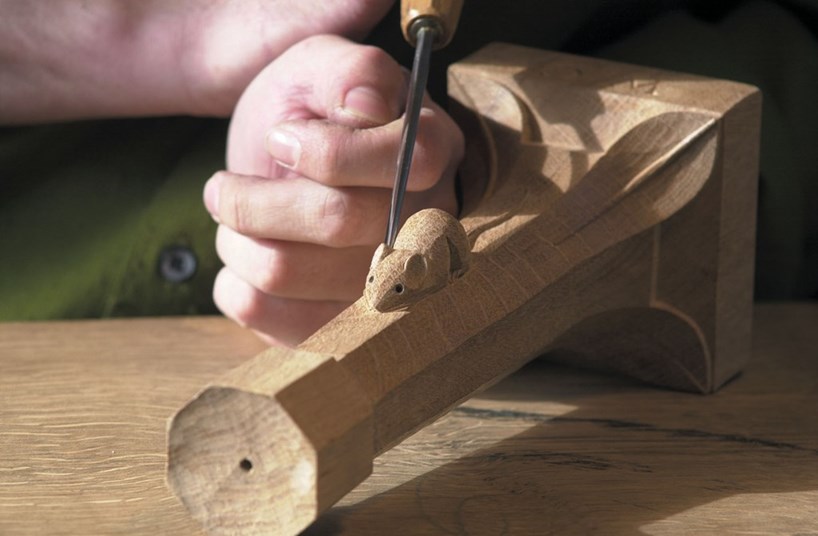 Mark Pickthall/Robert Thompson Craftsmen LtdA mouse carved by the current generation of Robert Thompson Craftsmen
In more recent times, the Mouseman company has even come to the attention of the King — according to David Lusted, a former churchwarden at St Michael and All Angels, Hubberholme, near Skipton, in North Yorkshire: as Prince of Wales, the King visited the church in the early 1990s, and took part in a spot of mouse-hunting.
“The King has a great interest in farming, and this is a sheep-farming region. . . [He] was walking across a country path to the George pub in the village. There’s a photo of him in the vestry standing outside the church. I’m sure he was looking for the mice on his visit.” Mr Lusted reckons that the presence of 28 mice on wooden chairs and pews at the church attracts thousands of visitors a year.
The tourism lead at the National Churches Trust, Sarah Crossland, is also an avid Mouseman fan, and regularly spends weekends searching out Thompson’s creations. She believes that the furniture is a huge asset to churches to bring people through the doors. “Robert Thompson’s mice are a great way for kids to engage with churches and to make them feel at home. They are special because they are hand-carved and they’re all unique.
“It’s wonderful when you go into a village church and discover something that someone has spent so much time on, and put in so much care and love to design. It ties in with the idea of John Ruskin, that everyone should be able to see beautiful things — these creatures are so alive and characterful.”
As for the 150th-anniversary celebrations at the Kilburn workshop and museum, Mr Thompson Cartwright says that they are currently so busy that they haven’t got around to organising anything. “We’ve got ten months of work ahead of us at the moment, and, with 18 in the workshop, we’re extremely busy. It’s a bit tricky.”
Back to the scene in that cold country church in Warwickshire. The three generations of that family — me, my son, and my father-in-law — are having little success locating all of the mice in St Mary’s, Ilmington, in the diocese of Coventry. “Here’s one,” shouts one of the American tourists, a retired schoolteacher from California, who spies one of the tiny Mouseman rodents on the wooden lectern. “This is such a fun way to spend a Sunday afternoon.”
Great fun indeed, and a splendid way to honour the 150th anniversary of Robert Thompson, the “Mouseman” whose works continue to be loved, cherished, and searched for by people up and down the land.