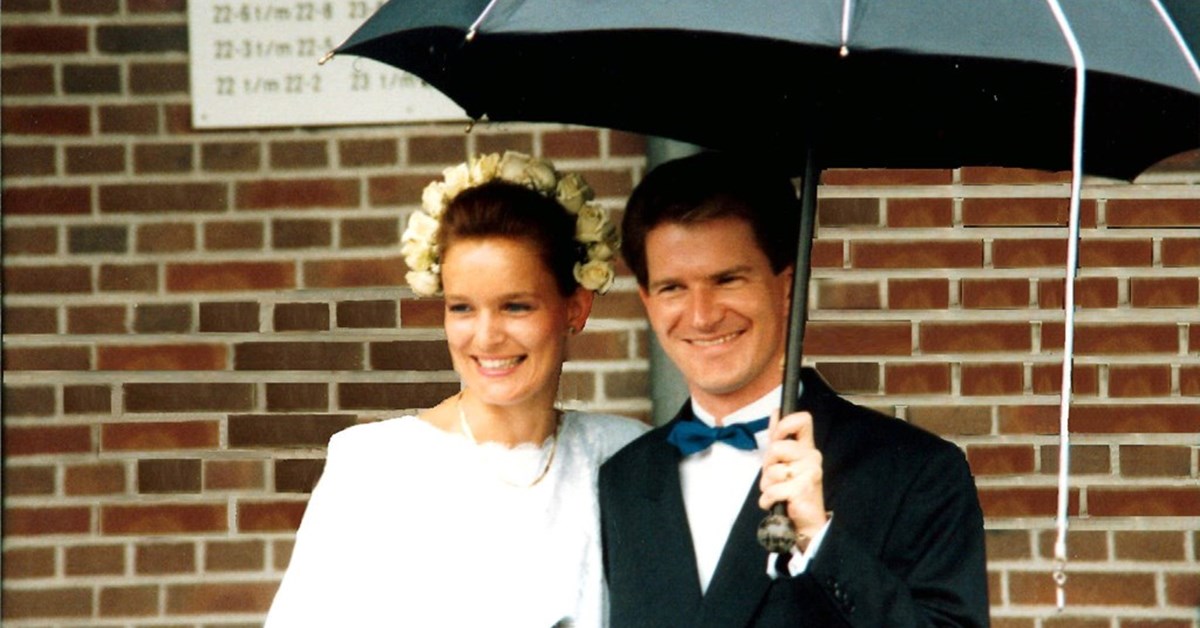
LIEUTENANT Colonel Philip Holmes had been married for ten years when he came home one lunchtime and found his wife, Esther Benjamis, dead in the hallway of their home in Aldershot. She had taken her own life. A Dutch lawyer, she had been appointed a judge the previous year. Lt. Col. Holmes was an army dentist.
“We had a very happy marriage,” he says. “She was an Orthodox Jew, and I had been brought up Presbyterian in the Northern Ireland Bible Belt. It was an unusual mix, but one that worked extremely well. We had great respect for one another’s religions: she would come to church on Remembrance Sunday; I would go to synagogue on Passover.”
The horror of the day of Esther’s death will never leave him, he says. The couple had been unable to have children, and, within days of her death, he had decided to leave the army to set up a children’s charity in Nepal.
“This stemmed only from the town we lived in being home to the Gurkhas, the Nepalese who have served in the British Army since 1815,” he says. “I had never been to Asia before. Once I made that decision, it felt as though everything was falling into place — coincidences, as some would call them. Others call them ‘God-incidences’. They were frequent: sometimes small, sometimes massive.”
One example stands out. A month after Esther’s death, a friend — aware of his plans in Nepal — sent him the book Don’t Let the Goats Eat the Loquat Trees by Tom Hale, an American medical student who had felt called to Nepal and had founded a hospital there.
Lt. Col. Holmes didn’t read it immediately, but, six months after leaving the army, he fulfilled an ambition to walk a coast-to-coast route across the north of England.
“I began reading it while staying at a friend’s B&B before setting off. I was astonished. Tom Hale described exactly my experience: feeling called to a country he had never visited; coincidences; people appearing at the right time; doors opening. I remember saying to my friend, ‘This has been exactly my experience.’
“Ten days later, in a tiny village in the North Yorkshire moors, I met an older man in an otherwise empty pub. ‘Look,’ he said, ‘if you’re going out to Nepal, I can introduce you to an old friend of mine who I’ve known since I was at university. He knows everything that’s to be known about Nepal. His name is Tom Hale.’ I felt goosebumps up and down my neck, and I said, ‘I’m reading his book at the minute.’ I walked with him for the next two or three days as we headed towards Robin Hood’s Bay.”
“IT WAS an incredible time for all kinds of reasons, and I think those coincidences convinced me that there was something ‘going on’ around me. I wouldn’t have described myself as a Christian at that point, but I remember looking skywards and saying, ‘You’ve got me.’”
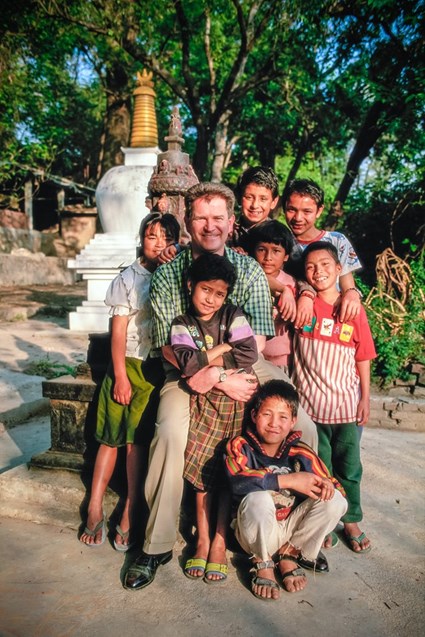 Graham UdenThe first seven children freed from prison in Esther’s name, on 4 December 1999On his first visit to Nepal, in November 1999, Lt. Col. Holmes saw a newspaper article about the imprisonment of children with their parents, simply because there was no one else to look after them.
“There were about a hundred such children nationwide,” he recalls. “I had a modest lump sum from leaving the army. This felt like something concrete where I could make a difference. On 4 December 1999 — exactly 11 months after Esther’s death — I brought the first five children out of Kathmandu jail.”
He used part of the army payment to pay for care for the first five children at a local children’s home, after getting consent from their parents to remove them from the prison and provide alternative care.
“A year that began in utter misery ended with hope, and that was the start of my bringing out children in twos and threes. My commitment was that we would look after these children, at the children’s refuge I’d set up, for as long as it took before they could be reunited with their parents.”
In March 2000, Lt. Col. Holmes was contacted by Fionnuala McHugh, a Hong Kong-based journalist, and the pair went into the Central Jail, Kathmandu, with a photographer.
“In my initial interview, I told Fionnuala how, before Esther had become a lawyer, she’d been a social worker, and her client base consisted of the survivors of the Holocaust and their families. . . I told Fionnuala all of this, and how I wanted to rekindle the light of such a genuinely good and genuine person, and keep not only her memory alive but her values as well.”
Lt. Col. Holmes had not previously managed to get inside the prison, but, as he went in with the journalist and photographer, he had a moment of self-doubt.
“It all looked totally benign. There were prisoners sitting there, strumming guitars, and it didn’t feel remotely threatening. In that moment, I thought I’d made a terrible mistake: what on earth was I doing inside this prison, talking to this journalist about circumstances in a country I knew nothing about? I felt like a fraud.
“And then, I looked around, and, at the margins of the crowd gathered around me, there was a little boy standing there with a shaven head and striped pyjamas. He was just staring at me. At that moment, I knew I was in exactly the right place. Sharp-eyed Fionnuala had seen him, too. As we left the prison, she turned to me and said, ‘Did you see anything in there that reminded you of anything else?’”
THE resulting article first appeared in the South China Morning Post, and then became the cover story of the “Weekend” section of The Daily Telegraph, leading to a twin-track approach for Lt. Col. Holmes: “On one hand, we were bringing children out of prisons, and, on the other, doing a lot of international media work, highlighting the issue.
“In 2001, the government of Nepal suddenly outlawed the jailing of dependent children. I cannot claim cause and effect, but I like to think maybe my work caused a bit of embarrassment with all the high-profile coverage right around the world.
By 2004, he had married again, and “headed back out to Nepal with my wife, Bev, a former TV producer who had invited me on to her programme after reading Fionnuala’s article. I pledged that I wasn’t going to return to the UK until I’d resolved the trafficking of Nepalese children — mainly girls to Indian circuses. Their average age was nine, and many were abused physically, psychologically, and sexually.
“I allowed myself two and a half years to do that, which was optimistic in the extreme. Bev and I lived there for eight years, and, while there, adopted our two Nepalese children.”
Taking on the traffickers was gruelling and dangerous. “I might easily have turned on my heel and returned to the UK, had Bev not supported me so closely,” he says.
In March 2011, the Indian Supreme Court ruled that children under 18 could no longer perform in circuses, closing the trafficking route permanently. “To me, that landmark ruling was Esther’s memorial. That court ruling had put the seal of sustainability on to the work we had done.”
FOUR years after the court ruling, Lt. Col. Holmes set up his current charity, Pipal Tree. Again, his work was focused on Nepal, and he was appointed OBE in the 2023 New Year Honours in recognition of 23 years’ service to vulnerable people there.
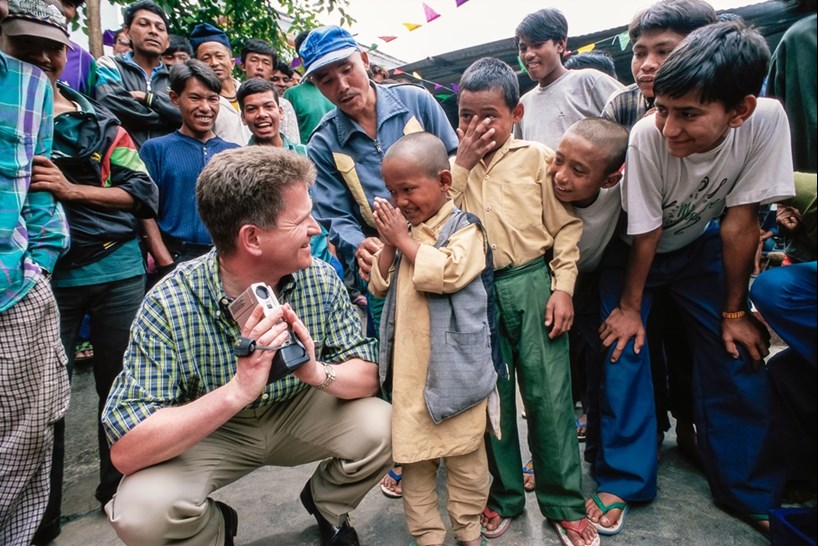 Graham UdenPhilip Holmes inside the Central Jail, Kathmandu, with children in free association with adult criminals
“What’s confronting us now in terms of climate change is very acutely felt in Nepal. It’s even more daunting than my previous challenges. We are planting Miyawaki forests in Nepal. These are fast-growing, biodiverse, carbon-rich ecosystems, and, as before, combining that with media activity and raising awareness. We’re making really good progress.
“Over the past few decades, it feels very much as though events have unfolded around me, and that my success has been a consequence of just ‘showing up’ and making full use of the God-given talents entrusted to me. It is genuinely humbling to discover that when, for example, a fund-raising effort that I try to drive forward fails and I step back, everything required — and more — arrives from an unexpected direction. Sometimes it feels like someone, somewhere is having a laugh, but I can take that.
“God has been good. I went to Nepal with a deep respect for people of all faiths, shaped in part by Esther’s devout Judaism. That was where I stood for many years.”
Reading the work of theological writers such as the mathematician and bioethicist John Lennox and Professor Morna Hookershifted his perspective. He now attends St Peter’s, Buckland-tout-Saints, in Devon, where his family now live.
“That’s where I get my batteries recharged on a Sunday. I am 66 this year, and have no intention of retiring. In fact, this year I am aiming to raise £60,000 for Pipal Tree’s work in Nepal through running six European marathons, alongside Bev, as part of our ‘Year of the Sixes’ challenge. I am overjoyed that Esther lives on in the growing work of my charity — so tangibly, and in such great measure.”
For support visit samaritans.org