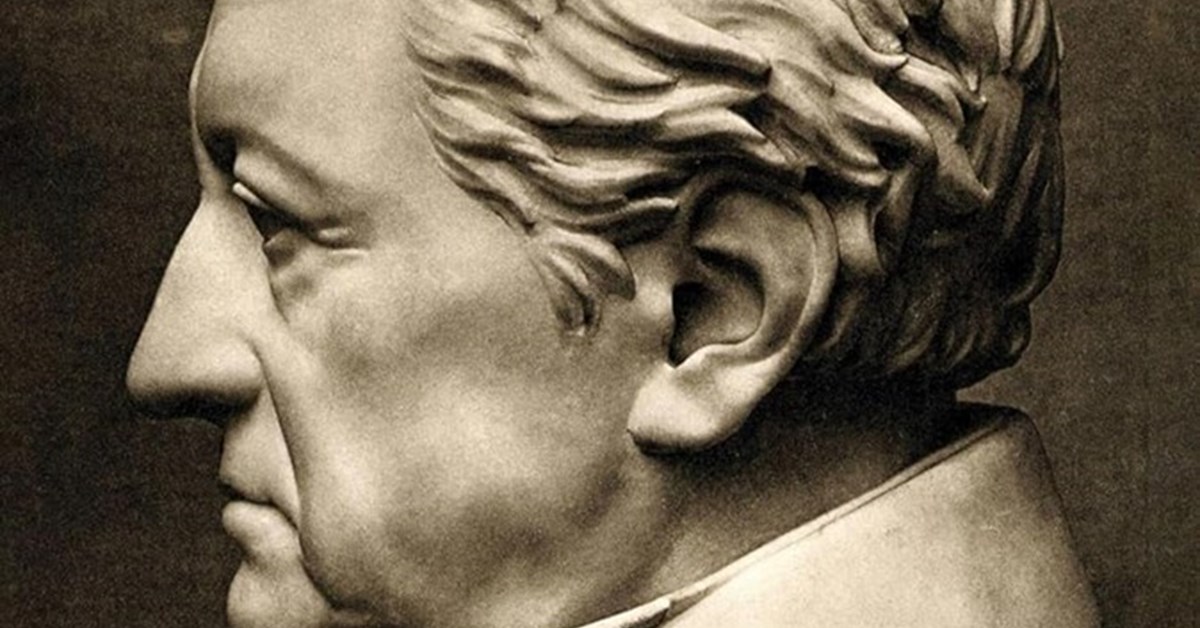
THE name of Johann Wolfgang von Goethe is perhaps the first that comes to mind when thinking about German literature, certainly before the 20th century. Some regard Goethe as Germany’s “national poet”, drawing parallels with England’s Shakespeare which are not entirely justified. Yet, to many in Germany and beyond, Goethe is best known and most widely read as the author of beautiful poetry, frequently quoted and, at times, reduced to aphorisms and apophthegmata that take on lives of their own, beyond not only their original context, but also their author.
Yet, Goethe’s literary “output” was phenomenal: the Weimar Edition, one of the two cited by Matthew Bell, runs to 150 volumes. Goethe was far more than a writer of poetry. There are plays, novels, essays, and scientific discourses, such as his famous theory of colours, or reports on his travels, from the Harz Mountains to Italy. In other words, here is a rich and complex intellect to engage with.
How to approach such a multifaceted individual and his writings, especially for an English-speaking or global audience with less access to or knowledge of Goethe’s legacy? There are, of course, biographies, beginning with Goethe’s friend Eckermann, who shaped the image of his subject for posterity, or more recently A. N. Wilson (Books, 29 November 2024), who presents Goethe as one of the greatest writers most people have never read and as the author of his best-known literary work, Faust.
Matthew Bell, Professor of German and Comparative Literature at King’s College, London, is certainly someone who has read Goethe’s works and thus is able to offer an intellectual biography that opens up to the reader Goethe’s writings and their author in their historical and biographical context, identifies them in the history and evolution of ideas, and discusses them with skilful literary criticism.
What emerges is far more than a complex and long introduction to Goethe’s better- and lesser-known works, but includes insights into the author’s own discipline, that of comparative literature. Goethe is frequently credited with inventing the term “world literature”, though Bell disputes this, as the term had already been used before him. But reading Goethe as Bell invites us to do means considering a much broader understanding of the term, not so much as the reading of other nations’ and languages’ writings, but as the exchange of ideas that are the common possession of humankind, a “cosmopolitan and civilized form of universalism”.
Bell points out that Goethe “disliked much of the response to his works in Germany in the 1820s, and he found a new reception outside Germany that was welcome and reinvigorating”. Maybe it is a book like this one that can enable such a reception in our time. Bell writes that Goethe enjoyed seeing his work translated “and was not at all worried what gets ‘lost in translation’”.
In writing this book and getting it published, Bell makes a significant contribution to the “creative process of transnational reception”. There are many well-chosen quotations and excerpts from Goethe’s writings, many translated by the author himself. A good insight into Goethe’s work as a poet can be gained through quotations in the original German.
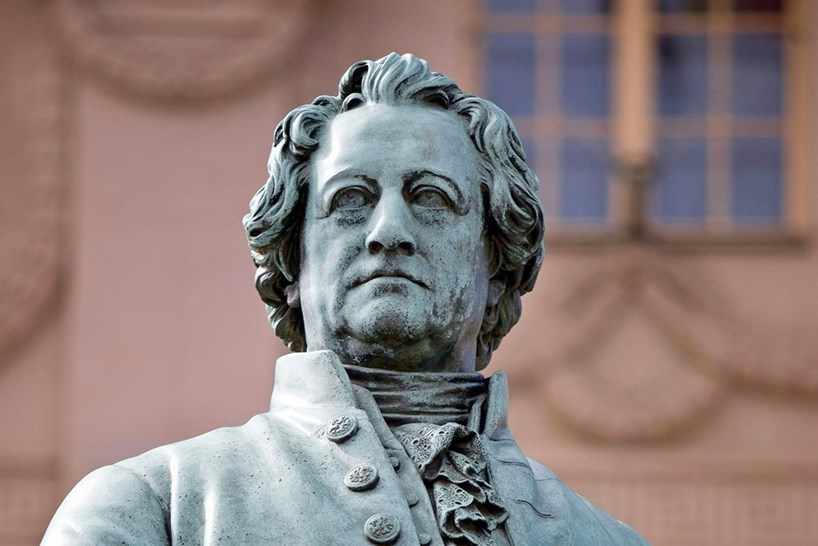 AlamyA detail of the figure of Goethe in the Goethe-Schiller Monument outside the Deutsches Nationaltheater, Weimar, in Germany
Underlying Bell’s reading of Goethe’s work is the question “how we might reconcile the consistent liberality of Goethe’s poetic and intellectual career with the overwhelmingly anti-liberal tenor of his ministerial activity and political thought”. He points to Goethe’s political vision, which is grounded in nature, where, after all, change, be it evolution or metamorphosis, is part of the course.
Goethe: A life in ideas is a long book reflecting on a long life and a significant body of writings, and yet it is beautifully focused on doing what it does well, backed by engagement with Goethe scholarship and the writings of those with whom Goethe engages. Readers are spared the repetition of worn-out anecdotes and the history of Goethe’s reception (which might offer some insight into the “national poet” question). Here is an appraisal of a man and his ideas which shows how the exchange of ideas across channels and borders is indeed fruitful for author and reader.
Dr Natalie K. Watson, a theologian and writer based in Peterborough, is an honorary lay canon of Peterborough Cathedral.
Goethe: A life in ideas
Matthew Bell
Princeton University Press £35
(978-0-691-15395-7)
Church Times Bookshop £31.50