“WHY are we going on safari in Scotland?” my youngest daughter asks, as we roll off the ferry on the seventh largest island in Scotland — and perhaps its biggest wildlife secret. I explain that Arran is the only island where you can see all of Scotland’s “Big Five”, and the mood in the car quickly changes.
We have a mission, an exciting one: striving to tick off the famous quintet in one wild week on the wildly beautiful Arran.
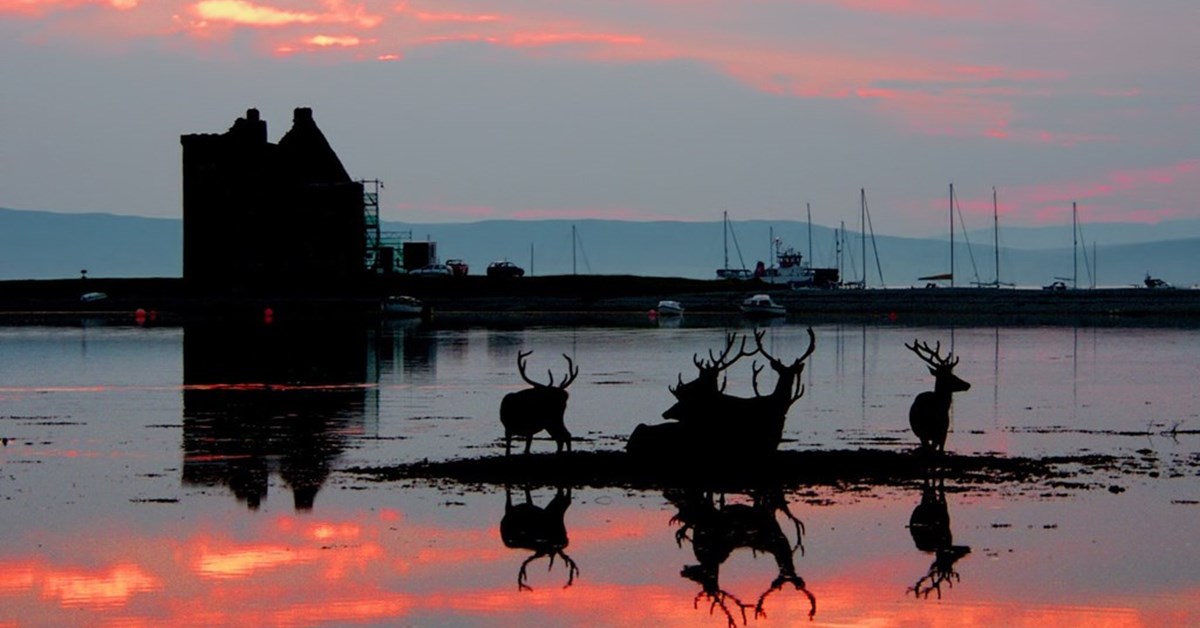
The wildlife famous five are: ultra-elusive otters, bushy-tailed red squirrels, majestic golden eagles, playful harbour seals, and hulking red deer — the latter the largest land mammal in the British Isles and a real sight in the wild with their jagged antlers silhouetted against brooding mountains (a shortbread-tin scene that would have Sir David Attenborough purring).
I’m cautiously optimistic, as this isn’t my first visit to Arran, which deserves its moniker of “Scotland in Miniature”. The Highland Boundary Fault savages right through Arran’s heart, gnarling the north into a rugged widescreen of soaring mountains, tumbling glens, and gushing burns. Heart-pumping elemental stuff. The south soothes with rolling hills, thick forests, and spirit-soaring stretches of sand. Scotland in microcosm: a geologist’s dream, a paradise for wildlife and for anyone looking for an alternative to Africa in search of that continent’s “Big Five”.
We don’t waste any time, easing off from the Brodick ferry terminal, on the east coast, and setting off on the road that circles the island’s stunning coastline. Our target is Brodick Castle, which has one of the few red-squirrel hides in Scotland.
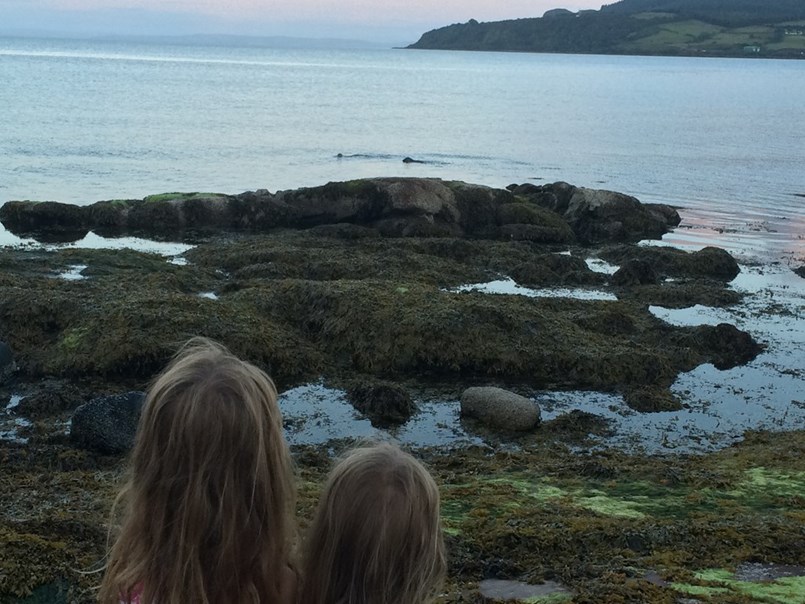 Robin McKelvie Seal spotting at Merklands Point
Arran is the only Scottish isle with a red-squirrel population, thanks to the absence of the invasive greys. We don’t even make it as far as the hide before one of these wee creatures charms his way across the road right in front of us. Then another. Minutes later, in the hide, I don’t need to tell the girls to be quiet. We’re rewarded as a trio of squirrels grab a snack right in front of us.
We try to push north, up the A841, but, around the next bay, we’re stopped by another of the Big Five — a big colony of seals. They have dragged themselves up on to the rocks by the road at Merklands Point, 3km from Brodick, to bask in the sun. A local cyclist pauses to ask why we’ve stopped. He just smiles and continues on when he realises it’s “only” seals. On Arran, daily wildlife interactions are the glorious norm, not the exception.
Easing north of the coastal village of Corrie, the land rises, and brutal hills unfurl like a cinema curtain pulling back. Pure, glorious technicolour nature. Craggy Alpine-sharp peaks and ridges tear across the skyline, but we’re drawn to something in the foreground. There he is: the monarch of the glen, standing stoic in a wisp of mist, antlers warning any rivals off his patch. There is no doubting that this is his glen.
Then comes a moment that would have us struggling to contain the excitement of Sir David, were he in the back seat. As we turn away from the stag, we catch sight of a golden eagle rising high into the thermals in the crags. This close, there is no mistaking this elegant giant for a buzzard, a “tourist eagle”, as the locals call them on Arran.
By the time we descend off the hills to the Highland village of Lochranza, we’ve only got one of the Big Five left. In the shadow of Lochranza Castle, there they are: a brace of otters, busying their way along the shore. We watch them flip in and out of the water — my girls reckon they’re playing rather than fishing, and it looks like it. So, Big Five “done” before sunset on our first day. Very Arran.
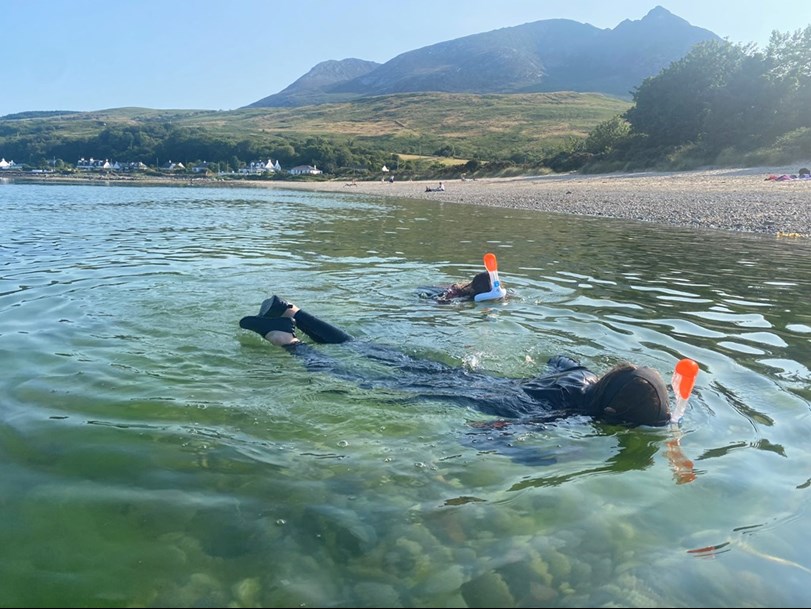 Robin McKelvie Snorkelling off Sannox beach
My daughters are thrilled at seeing all the Big Five so quickly. I am mildly disappointed, as now I have to think up more things to spot. But this is, of course, a joy on Arran. I’ve lost hours, in the past, to watching basking sharks patrol Lochranza’s bay, paddled with porpoises sea-kayaking in Lamlash, caught sight of a soaring sea eagle off Catacol, a few miles along the coastal road from Lochranza, on the north-west side of the island, and spotted a minke whale off Arran’s southern tip. I’ve even viewed porpoises and dolphins from the ferry. With Arran, it’s hard not to be on safari.
The next day, we follow advice from the local maritime body, Community of Arran Seabed Trust (COAST), and check out one of the half dozen snorkel trails they have helped set up, to augment their wildlife boat tours. The hills are swapped for billowing sea grass alive with tiny fish, scuttling crabs, and darting sand fish. Bright anemones remind me of the Great Barrier Reef, and, with wetsuits on, it’s no struggle snorkelling here. We’re in the water for more than an hour; it feels like five minutes, and I literally have to haul the girls out.
Three times over the week, we don our masks and head out to explore more sites below the surface of the water again. We also walk sections of the Arran Coastal Way, hike Glen Sannox and Glen Rosa, opt to go on a boat trip in Lamlash Bay with Lamlash Cruises, and enjoy the beaches in Blackwaterfoot and Kildonan.
All Arranachs are understandably passionate about protecting their bountiful natural riches. And the islanders were delighted in April last year when, after decades of battling, Arran was awarded Global Geopark status — recognising the island’s rich geological heritage, biodiversity, and commitment to sustainable development — one of only 225 Geoparks around the world. It further recognises the island’s uniqueness.
But anyone who has been on safari on glorious Arran knows how unique the island is already. Just ask my daughters.
Travel details
THE Caledonian Sleeper (sleeper.scot) is a lovely way to travel to Glasgow overnight; beds are available, as well as sleeper seats. Then take the train to Ardrossan for the CalMac ferry (calmac.co.uk) to Brodick, Arran (look out for dolphins, porpoises, even whales en route). Car hire can be arranged on the island (arran-motors.com). Alternatively, Arran is great for fit cyclists (arranbikehire.com), and the Arran Coastal Way (coastalway.co.uk) provides a 65-mile route that circles the island.
Auchrannie Resort (auchrannie.co.uk) offers resort-style accommodation with activities and choice of dining venues; the Corrie Hotel (corriehotel.co.uk) is a relaxed boutique bolthole. In Corrie, don’t miss seafood temple Mara, open March to October (mara-arran.co.uk)
snorkel.scottishwildlifetrust.org.uk/region/arran
TRAVEL AND RETREATS is edited by Christine Miles. Tours and holidays advertised are not guaranteed or underwritten by the Church Times or Hymns A&M. Readers should check for ATOL/ABTA guarantees and take out insurance. Details are correct at the time of publication. See also www.gov.uk/foreign-travel-advice