BY ANYONE’s lights, the Italian composer Carlo Gesualdo (1566-1613) had a colourful life. He was born into an aristocratic family, and his brother’s death moved him up the family line and prevented the planned church career; he was a great-nephew of Pope Pius IV, and another uncle was (St) Charles Borromeo.
Gesualdo married a beautiful cousin, but her adulterous affair with a rival duke led to their double murder when he caught them in bed in his Naples palace. Their corpses were put on public display, and Gesualdo was cleared of the “honour killing”, but the scandal was so much that he retreated to his family estate in Campania, and into his music.
His second marriage was wretched (he was abusive and unfaithful); he had servants beat him daily, two concubines apparently into witchcraft, ill health, and extreme religious practice. He was haunted by his own behaviour; his two sons predeceased him. It was all bleak, and the astringent St John of the Cross-style spirituality found voice in his taut, harrowing melodies, all angular intervals and chromatically adventurous harmonies. The sacred and the psychodrama were made real.
St Martin-in-the-Fields marks 300 years of its world-famous building this year and has commissioned Death of Gesualdo: A theatrical concert with New York’s National Centre for Early Music and Music Before 1800. Its world première was in the Trafalgar Square church on 16 January, by Concert Theatre Works and the Gesualdo Six, bringing polyphonic homage to the horror.
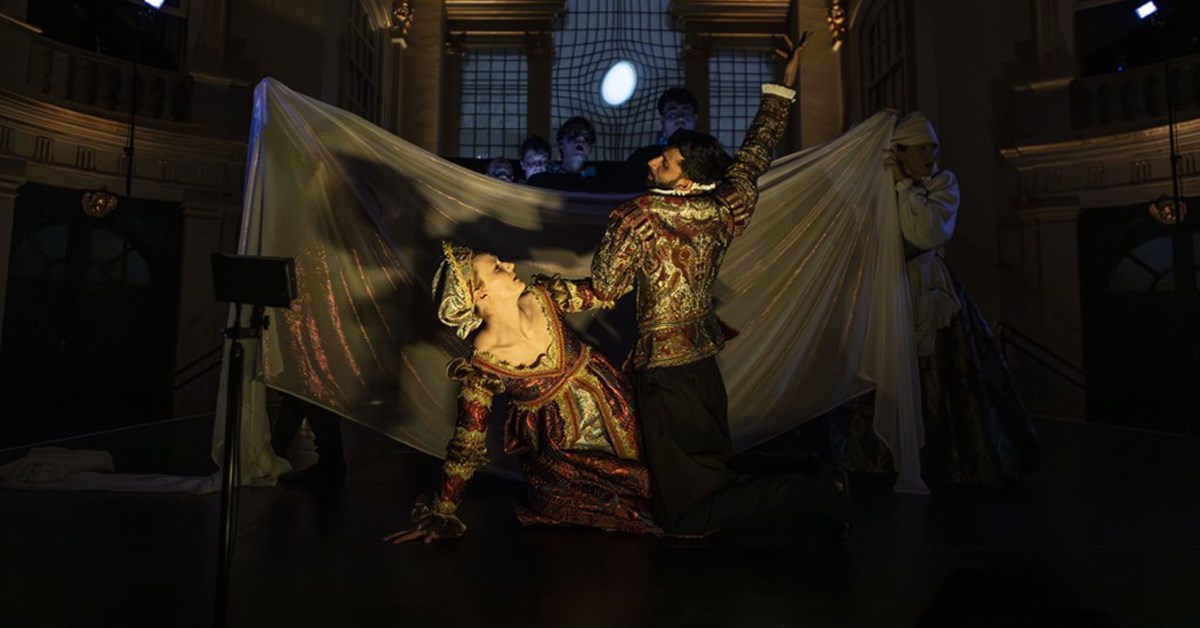
Created, directed, and lit by Bill Barclay (previously director of music at Shakespeare’s Globe), the show is a remarkable and arresting dramatic biography of this dark Renaissance prince. Barclay has cleverly selected from the Gesualdo catalogue to match key moments to the music, and uses the Tenebrae cycle as a framing device. Will Tuckett has choreographed the balletic movement.
The Gesualdo Six is an astonishing ensemble and did not tire once throughout the 75-minute performance of challenging music. Under the direction of Owain Park, their lines and volumes were spot-on, and special mention must go to Will Wright, who had stepped in to dep just that afternoon. Their presence hemmed the stage where six players and a puppet acted out the narrative in a series of tableaux vivants and masques, easily as beautiful as a painting by Caravaggio or Velázquez. Arthur Oliver, the US-based designer, sourced sumptuous fabrics from around Manhattan for the period costumes.
The two-night run in London was followed by further performances in York. This intense piece moves to the Cathedral Church of St John the Divine in New York next month (13 February), further dates to be announced.
For more information, visit: www.thegesualdosix.co.uk