ADVENT is the season of promise and hope. The two concepts seem at first contradictory. If something is promised, then it is reasonable to suppose that you don’t need to hope that the promise will be kept. Unfortunately, things do not always work out like that. You discover that the one making the promise was not to be trusted after all.
Advent celebrates the absolute confidence that Christians have in the fulfilment of God’s essential promise. He promises that we are not alone. We carry a primal fear of being alone deep in our subconscious. It begins as a child’s fear of abandonment: the kind of fear experienced when we became momentarily separated from a parent in a busy street or shop. It ends in a fear of aloneness and of abandonment in the moment of death.
GOD has promised himself to us as Immanuel, God with us. But it is hard, sometimes, to see how God can be with us in our primal fear of being alone. All we can do is to hope that he is. It is easy to write off hope as something that is too vague and nebulous to be taken seriously; so we tend to “hope for the best” and leave it at that.
But Christian hope is more than wishful thinking, because it takes us from simple belief into the realm of faith. It stands against that kind of lazy indifference. It is alive and active. It lays hold of us when we feel helpless, and voiceless, in regard to what we read in the news, to everyday betrayals of trust, and to the loss of integrity and honour among the powerful, who in no small measure control our lives. Hope surprises us when we least expect it.
As we grow out of childhood, we loosen our grip on certain beliefs, especially with regard to Christmas. If you ever believed in Father Christmas, you keep that belief — if you keep it at all — as a kind of private longing for times long past. You don’t expect Christmas to be what it once was. You know it to be a season of mixed blessings, especially if you have been recently bereaved, or experienced adversity over the past year, or are simply defeated by what is happening on the world stage.
You do not try to make Christmas something that it is not. So, if the season of Advent is one of hope, it must prepare us for Christmas by allowing us first to deepen in hope when faced with the harsh realities of today. We do this not by exercising a kind of forced and sentimental optimism about the Christmas season, but by allowing ourselves to grasp hold of hope from a place of certainty, and from within our own hearts.
CERTAINTY is not something that is easily associated with Christmas. Other Christmas myths have overlaid the idea of certainty, reducing hope to childish sentiment and to a general spirit of bonhomie. Those feelings are hard to sustain at the best of times — partly as a result of the sheer physical exhaustion involved in making a traditional Christmas happen as it has always happened, in any one family or context, compounded by anxieties relating to everything from money and relationships to whether we are going to be able to manage our own long-term depression during the few days of enforced festivities that lie ahead. Advent can be a time of great anxiety if we do not lay hold of Christian hope.
Hope does not banish anxieties, but it transcends them. For this to be possible, hope needs to be made real in such a way that a person is absolutely certain that what they are holding to is hope and not mere optimism. We lay hold of hope — and of the certainty that comes with it — by first being reminded of what it is that we both hope for and already have: Immanuel, God with us, in the “now” and in the “not yet”.
Advent is a season of “the now and the not yet”; of realised eschatology brought home to us through a kind of robust determination to face down the sentimental myths of Christmas with the realities of now, before we put up the cards or decorate the tree.
This facing down of outworn sentiment can require a mixture of empathy and courage. We need to know how to engender something like Christian joy when people around us are going through difficult times, or simply do not have the emotional or other resources needed to make the reality of Christmas true for themselves.
JOY is not the same as cheerfulness. We also need courage: a courage that comes with a knowing that takes us beyond belief. It is a courage that we carry within us. We should own it and lay hold of it with confidence. With courage, we can face down the unnameable fears that we carry within us regarding the state of the planet and the politics of the day. We name this courage and the knowing that it brings as hope.
This is the knowing that the prophet Job spoke of: “I know that my redeemer lives.” He did not simply believe. He knew. We do not pretend, either to ourselves or to anyone else, that we “know” this truth epistemologically (simply as a truth that is limited by finite knowledge or provability), but that the knowledge that we have is a different kind of knowing, and already lies within our hearts.
We know because, like the shepherds and the magi, we are drawn — even compelled — to love and worship what is holy about Christmas, even though Christmas has not officially begun, despite the street decorations that have been up since mid-October. We allow the holy to emerge from the tinsel and glitter, from the canned music in the shops, from the anxiety and stress of the coming season, from the “not yet”.
We call this “allowing” prayer.
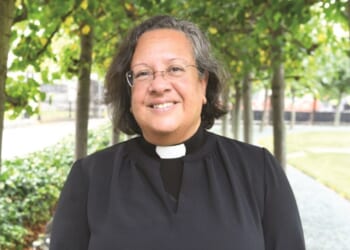
The Revd Dr Lorraine Cavanagh is an author, and a priest in the Church in Wales.