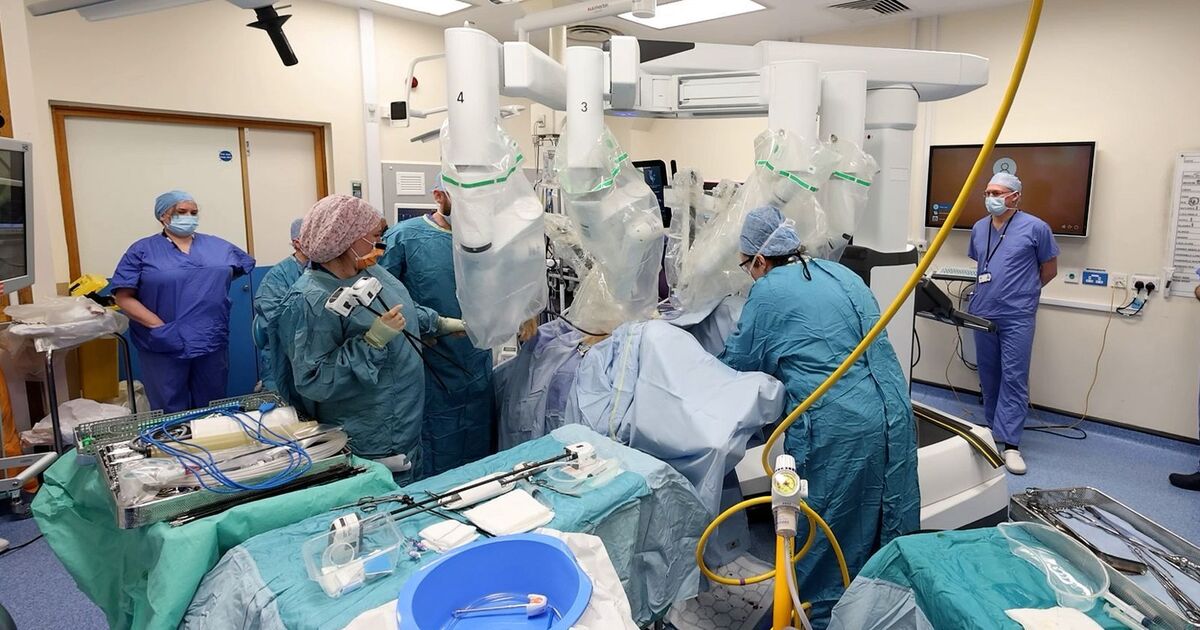
Revolutionary AI powered robotic surgery. (Image: Royal Stoke Hospital)
A new generation of ultra-precise, AI-powered surgical robots is set to transform how thousands of NHS patients are treated – slashing recovery times, reducing complications and easing pressure on overcrowded hospitals.
The new digital technology, used to perform complex cancer, and emergency operations, is now being rolled out across the UK in what surgeons describe as one of the biggest advances in modern medicine.
At the heart of the system is a powerful computer with built in artificial intelligence that processes vast amounts of data during an operation while remaining firmly under human control.
The technology, known as da Vinci 5, will allow thousands more patients each year to benefit from minimally invasive surgery – meaning smaller cuts, less pain and far quicker recoveries.
The robots are set to significantly reduce long hospital stays – a vital need for an NHS still struggling with bed shortages and record waiting lists.
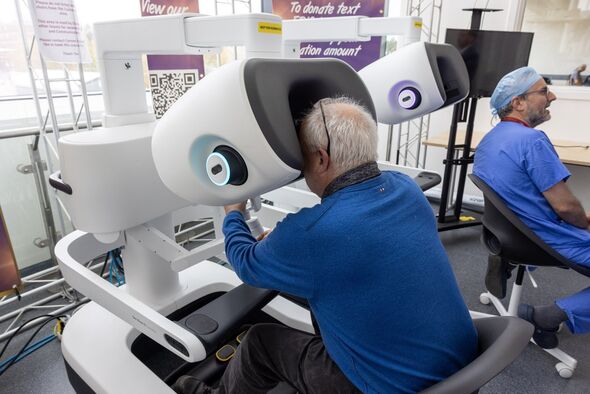
Ultra precise robots. (Image: Royal Stoke Hospital)
The robotic procedures will also mean the difference between spending a week or more in hospital and being home in under a day.
Doctors say the breakthrough could dramatically improve outcomes for patients undergoing treatment for bowel cancer, lung cancer, pancreatic cancer, and complex gynaecological conditions.
The AI-powered robots also allow surgeons to replace large, invasive incisions with tiny access points – meaning operations can now be carried out through incisions just a few centimetres wide or less, instead of large 8-10 cm cuts.
This improves control, reduces unnecessary pulling or pressure and makes surgery safer and more precise.
Doctors believe the technology could also reduce rare but devastating surgical complications, while also protecting delicate nerves, organs and surrounding tissue that can affect quality of life long after surgery.
Tiny incisions replace large cuts (Image: Royal Stoke Hospital)
One of the first hospitals in the UK to adopt the technology is Royal Stoke University Hospital, as part of a £12 million donation from the Denise Coates Foundation, which supports projects aimed at improving health and communities.
Consultant colorectal surgeon MR Philip Varghese said the system marked a fundamental shift in what surgeons can safely achieve.
He said: “This is cutting-edge technology. It pushes the barrier of what we can do to the next level of precision and it is genuinely game-changing.”
He added: “It is like comparing an iPhone 1 to an iPhone 17 – the computer power is quicker, faster and more accurate, with additional navigational aspects built in.
“The system has better vision and allows for remote collaboration with clinicians from different hospitals and produces data that allows surgeons to understand surgery like never before, allowing for quicker and gentler surgery. This allows far greater accuracy and reduces the risk of rare complications and deaths.”
The technology also allows surgeons to avoid major trauma in procedures that traditionally required large external incisions.
“We can remove the thyroid from inside the mouth using a small incision rather than cutting the neck,” he said.
“And for cardiac surgery we can operate through a small cut rather than splitting the breastbone.”
Beyond physical recovery, new AI-powered robotic surgery could also protect long-term quality of life.
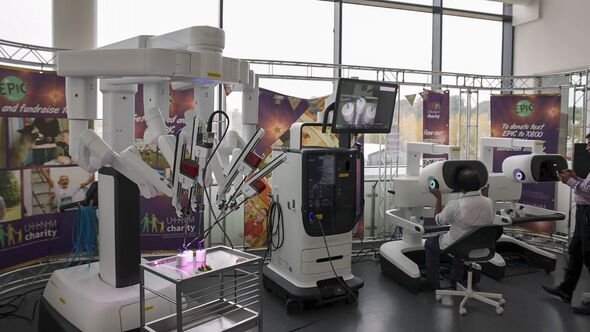
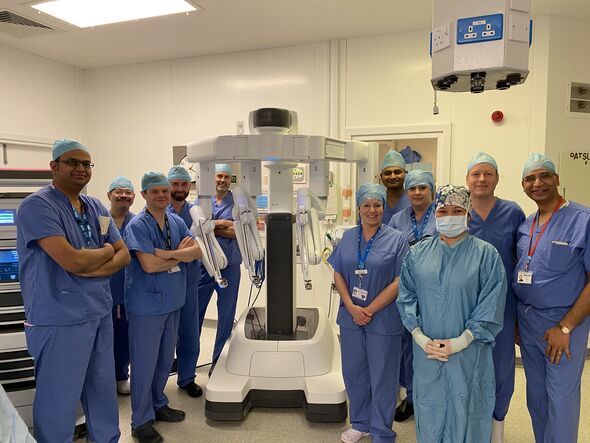
Doctors excited by breakthrough (Image: Royal Stoke Hospital)
“It gives you the opportunity to do nerve-preserving surgery and preserve sexual function in complex neurological and gynaecological surgery,” Mr Varghese said.
“This is surgery we simply were not able to do before at this level of precision.”
Robotic surgery has already been shown to increase productivity and shorten hospital stays, freeing up beds and allowing hospitals to treat more patients safely.
“People used to stay in hospital for five to ten days following an operation. With this technology, they can be home within 23 hours.
“It makes a massive difference to turnaround times and allows us to do three or four cases in a day rather than just one.”
Crucially, surgeons stress that the technology does not replace doctors.
“This is not dangerous,” he said.
“It is operated by a surgeon, with the system constantly monitored and highlighting errors in real time, so the surgeon can adjust immediately.”
Royal Stoke’s robotic capacity will rise to six da Vinci systems, making it one of the largest robotic surgery centres in the UK, though health leaders say the wider significance lies in what the technology could mean nationally.
Doctors believe technology could play a major role in the NHS’s future – helping hospitals treat more patients, more safely, in less time.
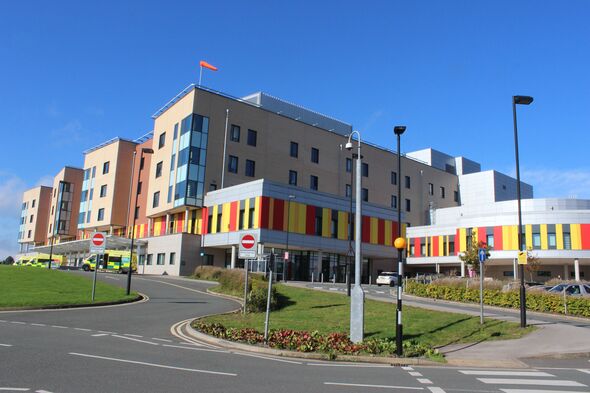
AI powered robots to revolutionise healthcare (Image: Royal Stoke Hospital)