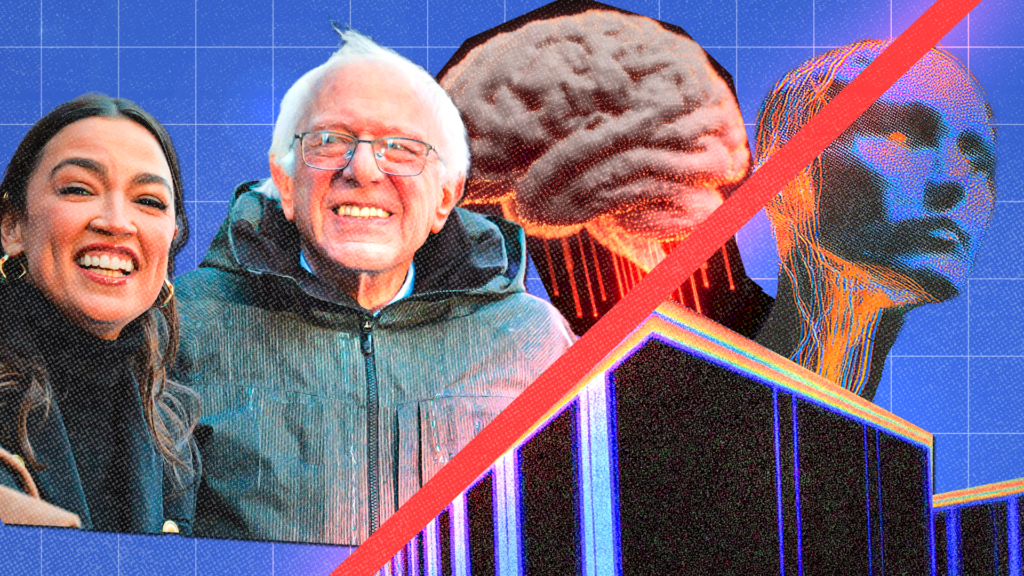
In December, Sen. Bernie Sanders (I–Vt.) took to Instagram, where he proposed freezing the construction of data centers. Now the progressive senator is hoping to turn his social media rant into a law.
On Wednesday, Sanders and Rep. Alexandria Ocasio-Cortez (D–N.Y.) announced the Artificial Intelligence Data Center Moratorium Act. The bill would prohibit “the construction or upgrading of all new AI data center projects until Congress passes comprehensive AI legislation that ensures the safety and prosperity of the American people.”
Should the bill pass, the moratorium could only be lifted if Congress passed legislation requiring AI products to be reviewed by the federal government before they are released; preventing AI job displacement; requiring union labor for data center construction; empowering Americans to approve or reject the construction or upgrading of AI data centers in their local communities; prohibiting increased electric bills for consumers and harm to the environment; instituting a litany of data reporting requirements; and mandating the wealth generated by AI companies to be shared with the American people.
Sanders said the “moratorium will give us the time to figure out how to ensure that AI is safe and effective.” Reason’s Christian Britschgi points out that Sanders’ opposition to data centers “tacitly accept[s]…that these facilities will be fabulously profitable investments that spur the development of the innovative, labor-saving technologies of the future.” But Sander assumes that, without government intervention, only Big Tech owners—five of whom he names in the bill’s summary—will benefit from these investments, not “ordinary Americans.”
But this is not the case: AI developers and the hardware companies powering their models make revenue by offering consumers a service worth more than its price. Unless they’re being subsidized by taxpayers—which Sanders’ bill would rightly outlaw—AI companies profit when we profit. But Americans don’t only benefit from AI abstractly; virtually every American with a retirement account makes capital gains through equity ownership of companies critical to the AI tech stack: Alphabet, Amazon, Meta, Microsoft, Nvidia, and Oracle.
While Sanders is anxious to avert costs he unjustifiably predicts will accompany AI innovation, he fails to consider the tremendous costs of the stagnation he proposes.
Adam Thierer, senior fellow at the R Street Institute, says “the Sanders-AOC bill represents an outright declaration of war on computation in America….It might as well be called the ‘Hand China the Lead on AI Act,’ because that would be the end result of this innovation-killing proposal.” Sen. John Fetterman (D–Pa.) agrees, describing such an AI moratorium as “China First.” And Sen. Mark Warner (D–Va.) called the moratorium “idiocy.”
Sanders also assumes that data centers impose costs on the communities in which they’re located. But Jennifer Huddleston, senior fellow in technology policy at the Cato Institute, tells Reason that data centers can positively contribute to local economies during and after construction. “For example, Loudon County noted that data centers’ tax revenue helped them decrease the car tax for residents.” In terms of electricity consumption, Britschgi highlights that, “where they’re allowed, data center owners are bankrolling the expansion of electrical generation capacity, which often benefits consumers through lower prices.”
Evidence of data centers’ relatively minor inconveniences notwithstanding, towns whose residents don’t want data centers moving in have the power to ensure just this. To declare a blanket moratorium on data center construction for the entire nation robs Americans of the right to choose what best suits their neighborhoods.
Kevin Frazier, senior fellow at the Abundance Institute, tells Reason that the bill would deprive “local communities and states of their longstanding role in determining what infrastructure is built within their borders” by their use of police powers over land use, zoning, and energy siting. Frazier explains that the moratorium would erode the division between “federal leadership on innovation and national priorities [and] state control over local infrastructure impacts….that has long underwritten American growth and characterizes our federal system.”
Not only can localities stop the construction of data centers, but many have also done just this. In September, Maryland’s Prince George’s County stopped issuing construction permits for data centers after a community member’s petition garnered over 20,000 signatures in opposition. Atlanta has required special permits for data centers since late 2024, and the adjacent Douglas and Clayton counties imposed restrictions on data center development in 2025, according to government relations firm MultiState. Ocasio-Cortez recognized as much during the announcement: “More than 100 local communities across 12 states have already enacted local moratoriums on data centers.”
The Artificial Intelligence Data Center Moratorium Act is unlikely to go anywhere. Save for Sens. Josh Hawley (R–Mo.) and Marsha Blackburn (R–Tenn.), there is very little Republican appetite for heavy-handed AI regulation. Even if such legislation magically won bipartisan support and passed both chambers, President Donald Trump would undoubtedly veto it, as it directly contradicts the National AI Policy Framework released last week by the White House.