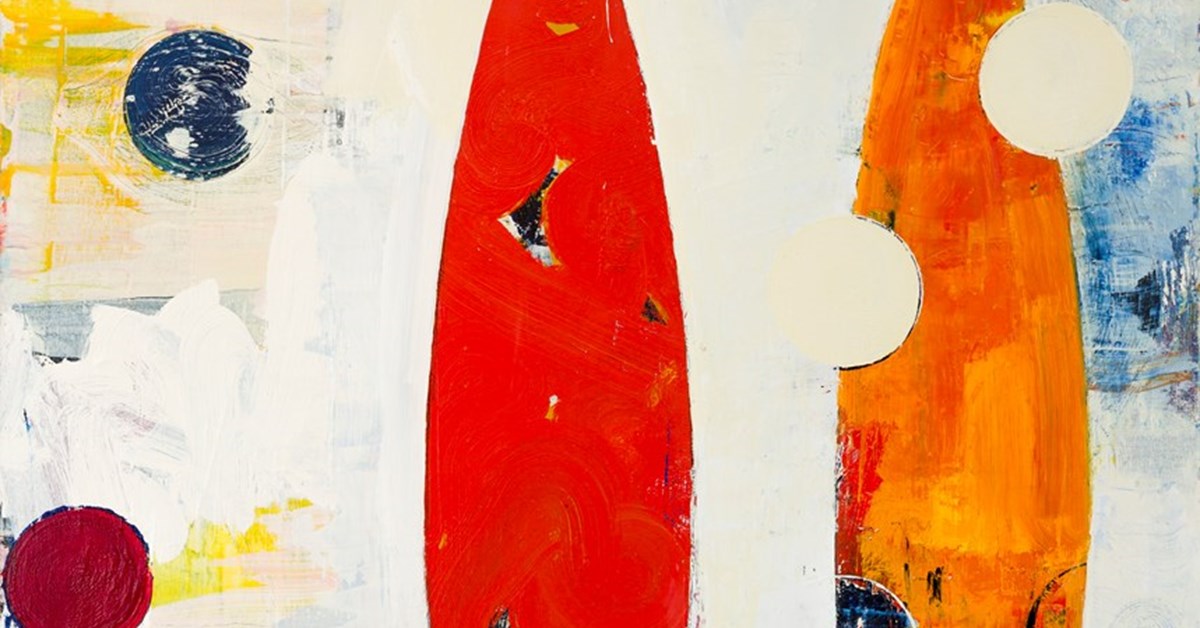
GEORGE BLACKLOCK is an innovator in the field of abstract art. He has written, with the eye of an artist, on the history of how colour was liberated from its subservient role to drawing in developing pictorial space, and how — once traditional roles were broken — abstraction was born, allowing a more vibrant use of colour. In his own work, however, he is seeking to utilise the freedoms won through the birth of abstraction to go beyond the sense of abstraction as either a technical exercise or a personalised expression of emotion. His works seek to explore a sense of narrative within, and also the metaphysics of, abstract art.
In this regard, Blacklock has spoken of his own cultural heritage, which is primarily that of Western Christendom (one of his parents was Roman Catholic, the other Protestant), and, within that, his love of the religious art of the Renaissance. His works seek to get close to the feelings engendered by the works of art from the past which he loves and with which he is in a creative dialogue. He seeks to do so by forming abstract equations for the relationships seen within images such as the Annunciation or Pietà. The relationships that he commonly explores within his works are those of interaction, mergers, and transcendence.
In “Alchemy”, he is reassessing the early influence of Fauvism on his work and responding to aspects of Pop Art, including the work and colouration of Jasper Johns, while also, as is always the case, being challenged by the great daring and metaphysical intent of the original Abstract Expressionists. In this series, he is trying to thin his paints further to achieve new effects, whilst also retaining the freedom with some images to blast the paint joyfully on to the canvas. A sense of the joy that is to be found in creation (both human and natural) is very much at the heart of these works.
Blacklock has a lexicon of gestural motifs, which he brings into play, one with the other, on the canvas. Ellipses equate to figures, one responding to another to introduce a sense of narrative into the dynamics of the image. In these images, which find their inspiration in alchemy and the work of alchemists and magicians, Blacklock’s circles equate to the fizzing and whirring of ideas in creative space as these set off mini-explosions in the minds of creatives. Where thinned paint drips from these circles, a sense of frustration or weeping is evoked. The colouration of these works also relates to times of day — morning, evening, sunset, night — to add to the sense of time passing and different relationships occurring within times and spaces.
Although there is nothing overt about particular religious narratives in his work, as he has an open attitude to where the painting comes from, he notes, nevertheless, that the “studio narrative” of his “Magician’s Garden” series “definitely has the Garden at Gethsemane within it”, and the “weeping shapes” definitely have Donatello’s Mary Magdalene within his obsession with them.
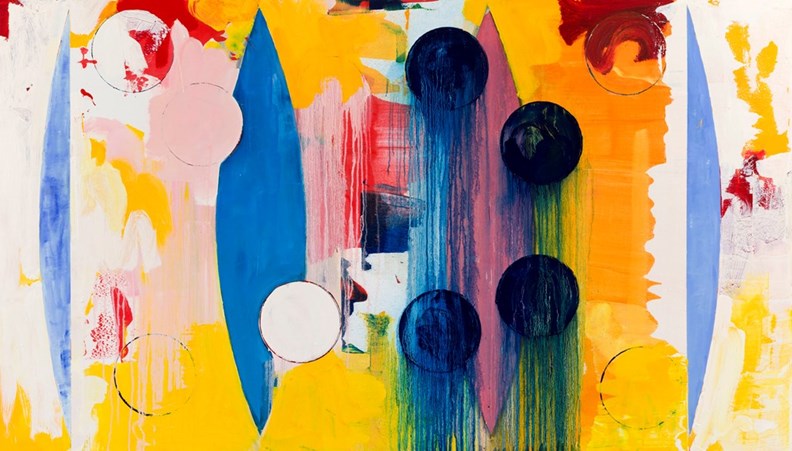 George Blacklock/Flowers GalleryGeorge Blacklock (b.1952), Magician’s Studio — Morning (2025), oil on canvas
He thinks, however, that his work is going ahead of him into the metaphysical dimension of abstract art, and that his ability to articulate what the works are saying lags behind. This aspect of his process relates to the “observer effect” from quantum mechanics, in that he often relinquishes control to encourage the painting to “lead the way forward”, allowing its internal logic to surface: “I find I uncover the core of the painting rather than consciously put it in. . . I am beginning to suspect the paintings are ahead of me.”
As an artist, writer, musician, and teacher, Blacklock has wide-ranging interests and experiences. Throughout his career, his practice — as an artist and academic — has engaged deeply with the languages of abstraction, gesture, musicality, and colour. In the studio, his works are continually in dialogue with the work of other earlier artists. The influence of those already mentioned is supplemented by that of three tutors from his student days: John Mitchell, Terry Frost, and John Walker.
The works in “Alchemy” utilise his interest in transformation, as referred to in the alchemical and magical titles of the works. In these works, his feeling for colour and mark-making act acts as an agent of change, guiding him toward moments of revelation. These moments are relationships within the paintings that create “a shift in another direction”, becoming “a gateway to another space”, one that “opens us up to thinking about how the painting feels”. In Blacklock’s work, revelation is both relational and transcendent, going further and deeper into the beyond.
“George Blacklock: Alchemy” is at Flowers Gallery, 21 Cork Street, London W1, until 7 February. Phone 020 7439 7766. flowersgallery.com