THE appointment of Archbishop Mullally may be the final straw for some whose relationship with the Church of England has been tested during the past few years.
Those unhappy with the appointment have expressed appreciation for her pastoral heart, her commitment to seeing parishes thrive, and her administrative skills. She is regarded, however, as pushing the LBTQ liberal line and being pro-choice. The cry “Enough is enough” is now heard, as some individuals and congregations prepare to pack their bags and move.
While groups such as the Church of England Evangelical Council call for structural changes that would enable them to remain within the Church, others go further, and see secession as the only solution, because they feel unable to live in what they see as an increasingly liberal denomination.
When secession happens, it tends to be the Evangelicals who move out, leaving all the assets and family jewels to the liberals. But history is not on the side of secession. It is exciting in the early stages, but, after a while, it loses its momentum; as the decades unfold, hardly anyone can remember what all the fuss was about.
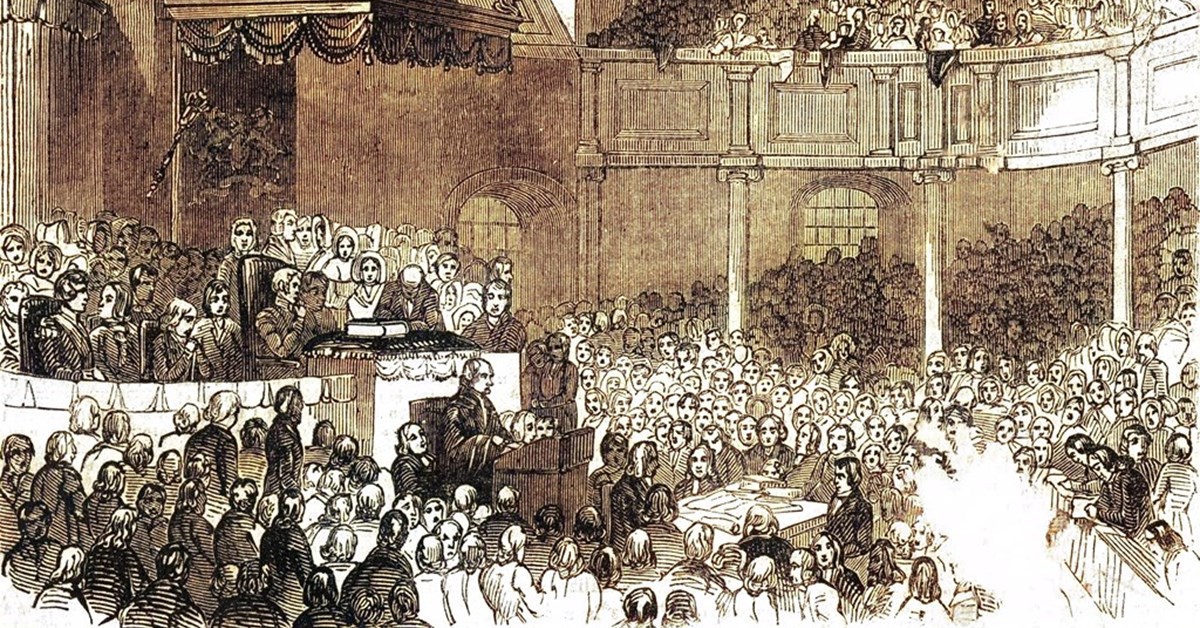
The year 1843 was a year of secession in Scotland, when the Evangelicals separated from the Church of Scotland to become the Free Church of Scotland. For the first few decades, the Free Church was riding high: larger congregations and new buildings going up everywhere. By 1900, however, the Free Church itself was settling down and uniting with similar denominations; by 1929, it had mostly rejoined the Church of Scotland.
There was a rump, however, mainly in the Highlands and Gaelic-speaking people in the Lowlands, who continued the Evangelical heritage of the 1843 Disruption. As the 20th century progressed, they became a rather strict Calvinistic sect, the Wee Frees, who are now a shadow of their former selves, even in the Highlands and Islands. There are, of course, pockets of renewal among them through former Church of Scotland parishes joining them and church-planting projects; but, so far, they have not regained much lost ground.
IN THE past few years, the Church of Scotland has pursued the liberal agenda with enthusiasm, to the extent that clergy are now allowed to be married to a same-sex partner, and same-sex weddings take place. The Evangelicals have haemorrhaged either to join the Free Church or to become independent, while the remaining conservative rump seem powerless to stop the tide.
The recent closure and sell-off of almost half their buildings, and the freefall in membership and attendance, is claimed by many to be the result of a progressive ethos that has not produced much progress. Of course, many of the buildings were sold as a result of the flurry of opening new buildings at the Disruption of 1843.
While the Disruption in the Kirk of 1843 is better known, many may be unaware that the Scottish Episcopal Church also had its own secession in that year. This was over Ritualism, and, at the time, was known as “the Drummond affair”. Most of the Evangelicals left the to form a new denomination, the English Episcopal Church. At its height, it would have had about 40 churches; 150 years later, its last handful of churches has reunited with the parent body. Only church historians could tell you what the split was about.
And what of the Free Church of England? Founded in 1844, the year after the Scottish Disruption, this denomination has declined considerably, and, today, it is fraught by splits and power struggles. One informed observer has described it as “a tiny Church which has only a few hundred members in the whole of Britain . . . and may shrink back into being yet another cluster of local congregations lacking direction or sense of purpose”.
The Church of England (Continuing) was founded in 1994 at a meeting chaired by the Revd David Samuel in St Mary’s, Castle Street, Reading, as a reaction against the use of contemporary-language liturgies and the recently approved ordination of women as priests. A handful of clergy left the Church of England to form this; but, rather than provide a vehicle for further secessions, it has shrunk to four churches with only two buildings; its website describes it as “a handful of small congregations”.
THE Church of today is made up of various denominations, all of which are man-made. Theologians have grappled with this inconsistency by teaching that there is the “Visible Church”: the institutional organisations, the many church buildings, and the multiplicity of denominations all put together as seen by people. But within that group is a body of people whose faith is known only to God. This is the “Invisible Church” — if you like, a Church within a Church. The challenge is for us to make sure that we belong to both.
The idea of these two Churches was taught by the 16th-century Protestant Reformers, but it was also taught in the Early Church by Fathers such as St Clement of Alexandria and St Augustine of Hippo.
Not all who are members of the Church are necessarily Christians in the sense of being “born again” and having the Holy Spirit in them; and not all who are Christians are living in the Spirit: some are living from their flesh — see Galatians 5.16-26, where the “works of the flesh” include “enmity, strife, quarrels, dissensions, factions”. Sound familiar? This has led to all sorts of errors and ungodly living.
This has also led some groups to separate themselves from mainline denominations, and even from other newly formed independent churches, to create churches made up of entirely “born-again” Christians.
The problem is, who can tell who is who? The best of churches can have within it those whose hearts were never truly converted, and it does not take long before the old problems of the old churches begin to surface.
My own view is the principle of Matthew 13.24-29, where the farm labourers are keen to pull up the weeds to separate them from the wheat, but the master told them to let them grow together until judgement day, when the separation will be made. Let God be the judge. That is why I am content to live in a “mixed” denomination such as the Church of England.
In the mean time, if I feel that a brother or sister is in theological error, or living an ungodly lifestyle, where the “works of the flesh” seem to outweigh “the fruit of the Spirit”, Galatians 6.1 points to the right attitude: not to jump ship, cause division, or even bury our heads in the sand, but to correct with gentleness and humility. But, then, I do not yet feel in a position to correct anyone, since there is much within me which still needs to be dealt with.
Canon Ian Meredith is the Vicar of St Mary’s, Portchester, in the diocese of Portsmouth.