WE ARE barely a month into 2026, and President Trump has already bombed Nigeria, kidnapped the President of Venezuela, and threatened to invade Greenland, while there have been mass protests in Minneapolis after the mass deportation efforts of ICE agents, which have led to the killing of two US citizens.
Elsewhere, the crisis in South Sudan is worsening; Russia is nearly four years into its invasion of Ukraine; and the conflict in Israel and Gaza seems far from ended, despite its entering into its second phase of Trump’s peace plan.
The world feels more unstable than it has in decades: geopolitical conflicts are increasing, markets are wobbling, and societies are fracturing and polarising. A poll by More in Common last summer found that the most prevalent words the British people surved used to describe the state of the world in 2025 were “chaotic”, “dangerous”, “unstable”, and, simply, “bad”.
One of the things that are, perhaps, leading many of us to an increased sense of anxiety is that the post-Second World War structures intended to enable humanity to work together for a more collaborative and peaceful world seem ineffective in the renewed age of strongman leadership.
As Pope Leo XIV put it in his address to the diplomatic community this month, multilateralism seems weak, and the post-war principles of peace are being undermined (News, 16 January). “A diplomacy that promotes dialogue and seeks consensus among all parties is being replaced by a diplomacy based on force, by either individuals or groups of allies,” he said. “War is back in vogue, and a zeal for war is spreading.”
As his predecessor Pope Francis famously noted, we are not simply living in an era of change, but a change of era. The rules-based order and the world that many of us had — perhaps naïvely — assumed would continue feel as if they are on their way out, creaking under the strain of isolationist policies and quests for power rather than the common good.
In an analysis of the situation at the World Economic Forum, in Davos, the Prime Minister of Canada, Mark Carney, described “the end of a nice story and the beginning of a brutal reality where geopolitics among the great powers is not subject to any constraints”. Quoting Thucydides, he spoke of the way in which, today, “the strong can do what they can, and the weak must suffer what they must.”
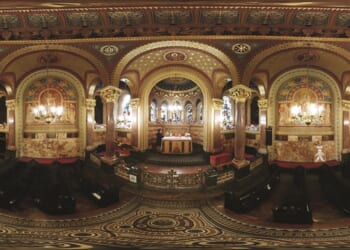
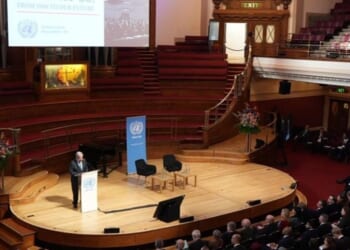
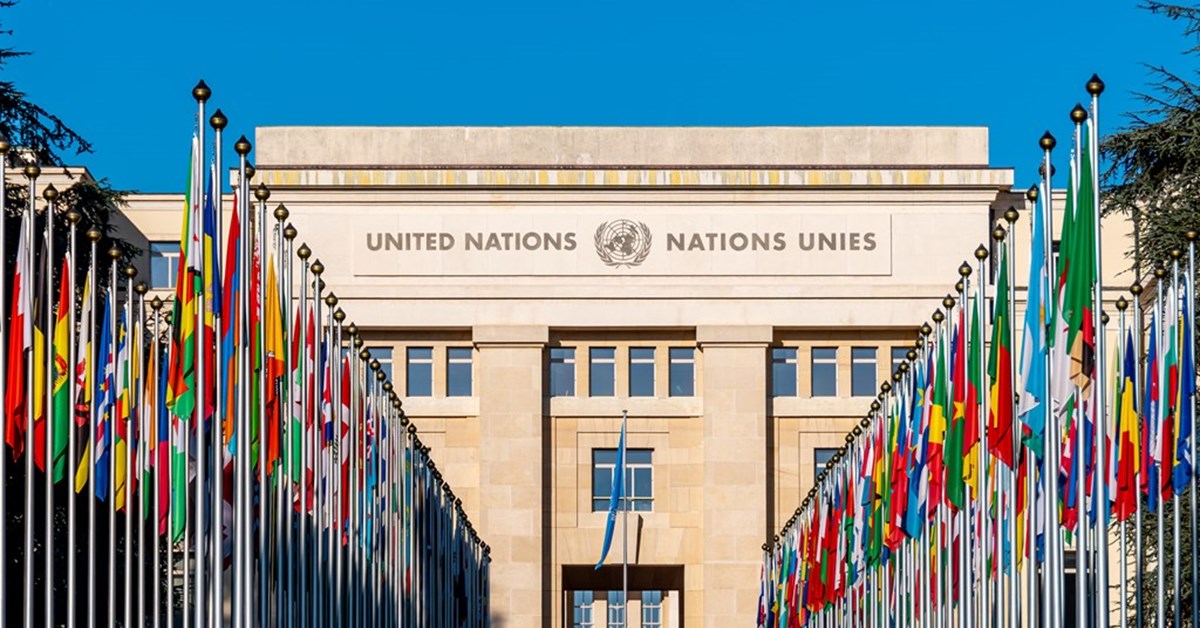
AMID all this geopolitical turmoil, I found it sobering and somewhat surreal to attend a thanksgiving service for the United Nations at the Methodist Central Hall, in Westminster, this month (News, 23 January). The service, attended by dignitaries including Secretary-General of the UN, António Gutteres, the Duchess of Edinburgh, and the Archbishop of Canterbury-elect, marked 80 years since the first meeting of the UN’s General Assembly in the iconic building’s Great Hall.
Since then, as Pope Leo notes, the UN has “Mediated conflicts, promoted development, and helped states protect human rights and fundamental freedoms.” Not without its faults — notably its unparalleled bureaucracy — the UN has become the most significant body promoting peace and solidarity around the world.
At its first meeting, just four months after the end of the Second World War, the trustees of the thriving congregation — whose building had been unscathed by war — had to be convinced by the Foreign Secretary, Ernest Bevin, to vacate the building for the purposes of the landmark meeting. “There could be no better place than a House of God, with the atmosphere of prayer already there,” Bevin said.
For much of the 80 years since the end of the war, the part played by religion on the Western stage has been receding. The religious — indeed, Christian — underpinnings of Western democracies have given way to rising tides of secularism, declines in religious affiliation, and an unwavering belief in progress.
But, as that belief in progress has wavered during the past decade, this is perhaps the moment for faith to step in again. Many of our modern institutions are, after all, built on the Christian tradition. As Professor Anna Rowlands, of Durham University, said at a recent event at the House of Lords, “Christian faith and democracy in the West are closely intertwined . . . the idea of limited government accountable to the people, of orderly government, of the restrained use of power, of the person before the law, equal, free, dignified, of some responsibility we bear for suffering neighbours — the solidaristic elements of democratic cultures.”
WHAT, then, of the national Church’s response to this moment, and to the fragile future of multilateralism? We have, of course, seen the Church of England’s presence at moments of global and diplomatic significance. Both Sarah Mullally and Justin Welby attended the UN thanksgiving service. But, beyond these symbolic moments, Anglican theological engagement with multilateralism, international institutions, and the moral architecture of the rules-based order has often felt comparatively muted.
There are, of course, notable exceptions: through its consultative status at the UN, the Anglican Communion engages global institutions on peacebuilding, climate justice, migration, and human rights, and has longstanding partnerships with churches and faith-based NGOs in conflict zones.
But, in a time when multilateral institutions are under sustained attack, the Church of England has rarely articulated a clear, confident theological defence of international co-operation. This relative reticence could reflect the Church’s complex relationship with national power, or a reluctance to be seen as intervening in contested political debates. It could be said that there is a theological vacuum at precisely the moment that it is most needed; perhaps that the C of E is too focused on internal affairs to provide global moral leadership.
GIVEN the size and reach of the Roman Catholic Church, many of the most robust and theologically grounded Christian responses that I have seen to our geopolitical moment have come from figures within it — including the Pope, bishops who have spoken out for refugees and asylum-seekers, theologians, and lay people in public life, such as Mr Carney. It would seem that the solidarity and quest for the common good which underpin Catholic social teaching are helpful in the discussions about multilateralism in these fractured times.
In his homily at the UN thanksgiving service, the Archbishop of Westminster, Cardinal Vincent Nichols, said that “the very idea of nations working with trust, purpose, accountability, and patience feels, at times, like a whisper against the clamour of nationalism and protective isolation.”
But he asked how the spirit of solidarity and mutual flourishing that was present in the UN’s formation could be recaptured. For him, here, the Christian faith “offers a timeless compass” — and a “great resource to be rediscovered” rather than just a problem to be solved. “The gospel we have heard reminds us that the work of peace begins in the heart of every person,” he said. “St Paul puts before us the behaviour that is needed: mutual respect and service, hospitality to the stranger, patience, empathy, freedom from revenge, the pursuit of the noble and the good.”
For people of faith, now is the time to dig in to the resources from within our tradition that spell out a compelling vision of human flourishing: one that is grounded in love of God and love of neighbour, which holds power lightly, and works for a world in which each of us is seen as made in the image of God, of equal dignity and worth. These messages are increasingly the ones that our fractured world is so desperately looking for.
Chine McDonald is the director of Theos.