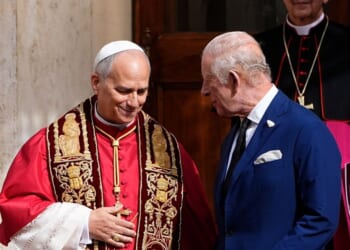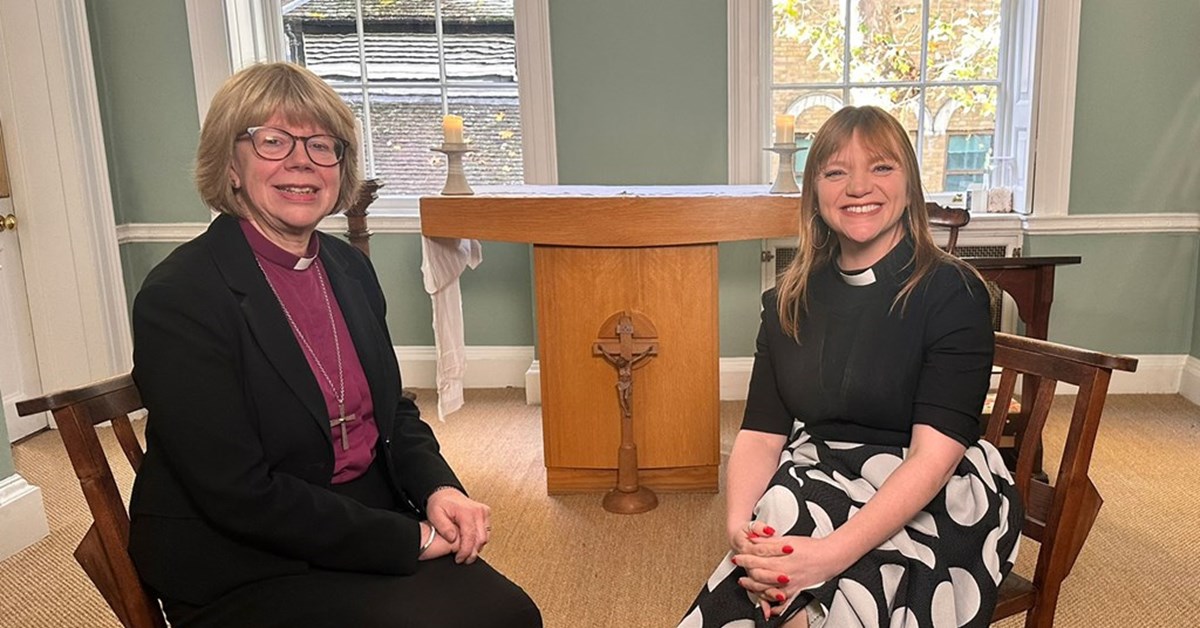
BEING nominated to be the next Archbishop of Canterbury was a “golden moment” of affirmation for her calling, Archbishop Mullally said in an interview to celebrate International Women’s Day, on Sunday.
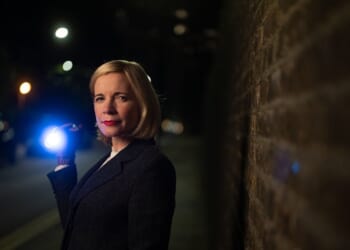
Speaking to the Revd Kate Bottley in a special episode of the BBC’s Songs of Praise to mark the day, Archbishop Mullally said that this moment had been followed by “Gosh, what do I do now?”
Looking back at the trajectory of events since 1994 — when women were first ordained to the priesthood in the Church of England — she reflected: “In a sense, my nomination is the result of all those men and women who faithfully campaigned for the ordination of women.
“That’s enormous. But also, when I go into schools, I see young women who may not want to be the next Archbishop of Canterbury, but this does say to them, it’s entirely possible for them to be what they want to be.”
Archbishop Mullally, who was chief nursing officer for England before her ordination, also spoke of her vocation to nursing and the image that had always remained with her: Jesus washing the disciples’ feet “and calling us to do the same. What nursing gave me was this sense of how you serve people.”
Asked about those in the wider Anglican Communion who remained opposed to the ordination of women, she said: “There are very few provinces now that don’t ordain women, interestingly; therefore, I’ve always tried to hold that space in which I offer generosity to those people. I say, ‘Fundamentally, I’m a shepherd. I want to enable your ministry to flourish.
“‘But I can’t underestimate that I’m a woman. Without us, you’re missing 50 per cent of the Body of Christ, and therefore, just [our] coming widens that possibility of having a whole variety of skills and people from different backgrounds and different experiences.’
“International Women’s Day is a real opportunity for us to celebrate women but also to remind ourselves that there are still parts of the world where women are still not equal, where women are still struggling, and so it is about reminding us of those places as well as celebrating the place of women.”
The Archbishop chose as her favourite hymn “I heard the voice of Jesus say”. Quoting lines from the last verse — “I looked to Jesus and I found/In Him my star, my sun/And in that light of life, I’ll walk/ Till travelling days are done”, she said: “I suppose that’s what I’ve sought to do. I have found my star and my sun in Jesus, and I hope that I’ll continue to live in that light.”
The programme also featured stories of inspirational women whose faith had left a lasting legacy, notably Josephine Butler, the 19th-century campaigner who built a prayer movement on behalf of those who were marginalised and excluded from the community, and who also exposed child trafficking across Europe.
Funke Ohan, a mentor, speaker, and writer who supports women experiencing infertility and baby loss, told the programme that she was “helping others all over the world by turning her own heartbreak into hope”.
In a debate about International Women’s Day in the House of Lords on Friday, the Bishop of Derby, the Rt Revd Libby Lane, said: “As the Church of England’s first female bishop, I know that opening a door is both a powerful and a humbling act, particularly as we rejoice in the appointment and forthcoming installation of my noble friend, the Most Revd Primate, our first female Archbishop of Canterbury.
“My faith has inspired and enabled me to open doors for others, and it is a profoundly positive influence in my life, but I recognise that many women who give of themselves to support other women do so in profoundly painful circumstances.”
She thanked the Minister for drawing attention to the legacy of the late Jill Saward (Obituary, 13 January 2017), who was the daughter of a parish priest in Ealing. Forty years ago this year, in 1986, three men entered the vicarage, attacked her father and her boyfriend, and two of the intruders raped her. The attack was headline news on TV, radio, and in the national press.
Bishop Lane said: “Jill was the first woman to waive her right to anonymity, and she testified in court. Because of her, the national debate that the subsequent trial sparked has paved the way for a monumental shift in the following four decades towards the survivors of sexual violence, and influenced changes in the law which continue to be worked on today.”
She concluded: “Just over half the world’s population is currently observing either Ramadan or Lent, so it seems appropriate in this holy season of repentance and prayer to recognise how much further we have to go. Women have always been involved in struggle and embroiled in geopolitical events; at the centre of transformation domestically, locally, nationally and internationally, whether on the front line or in leading efforts in reconciliation and healing.”