ALICE CARTER’s road to displaying her seven-work series “Ashes to Fire” in Chichester Cathedral, offering a meditation on key moments in Easter, began on the tarmac of Fulham Broadway in 2011, when she had a cycling accident.
Although conscious, a terrible headache indicated possible brain damage, and scans revealed a potentially life-altering brain bleed.
After more than five hours of surgery, Mrs Carter, a digital marketing director, returned to her family’s estate in Ayrshire to recover. A devout Roman Catholic, she decided to walk the Via Francigena pilgrimage route from Canterbury to Rome, as both a goal to focus her recuperation, and an act of grateful acknowledgement for still being alive.
On the c.1200-mile route, recounted in her book An Accidental Jubilee, Mrs Carter realised that she wanted to go art school. She already had a degree in art history, having been a contemporary of the Princess of Wales at the University of St Andrews.
Explaining her choice to study at the very traditional Royal Drawing School in order to begin her career as an artist, Mrs Carter says: “What I found was discipline, stillness, working hard at something. Being challenged, you have got to strip it all back. You have to learn to draw — then you can break the rules. If you look at Leonardo, Raphael, Michelangelo, or Picasso and Van Gogh, they could draw beautifully, and then they went off and did their things.”
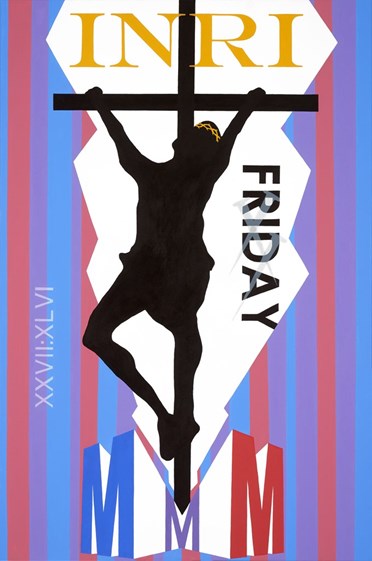 Good Friday by Alice Carter
Mrs Carter describes the funded postgraduate course as a “wonderful opportunity”.
Reflecting on her time at the Shoreditch school, she continues: “I wanted to start at the bottom. For example, one of the favourite classes I did was for nine weeks, once a week, when you drew the same painting in the National Gallery. And that taught you discipline.
“I did Botticelli’s Venus and Mars because I love it as a painting, but also because there was a bench where you could sit, in front of the painting. I don’t really like being interrupted when I’m focusing, and people like to talk to you, saying things like, ‘Oh, are you drawing?’ So, if I could find a bench where you might look like you’re sitting anyway, you were a tiny bit more discreet.”
Mrs Carter’s immersion in the classical art canon of Europe and America shines through her work. Fittingly, given that it is the 60th anniversary of John Piper’s celebrated seven-panel high-altar tapestry in Chichester, this artist, inextricably associated with the Sussex landscape, is the first artistic influence that she cites.
“I am influenced by Piper, and he used colour and symbolism, and he was controversial. People liked it [the tapestry] or absolutely hated it. There’s no denying my ‘Ashes to Fire’ series is influenced by Piper, and they work well with it.”
The British artist Paul Nash is another inspiration. “I love Paul Nash. He paints from life, but he takes it a step further, where you feel there’s a story in his painting, or the earth in the painting is moving with the ancient history of it.
“I have a broad cross section of artists who were an influence, beginning with Piero della Francesca. I like his colours. I like the simplicity of his pictures, which become an assortment of geometric shapes and colours.”
In Piero’s fresco The Resurrection, painted for a Tuscan meeting hall, c.1460, the figure of Christ holds a banner with a red cross, similar to the one included in Mrs Carter’s Easter Sunday.
THE exhibition covers Ash Wednesday, Palm Sunday, Maundy Thursday, Good Friday, Easter Day, Ascension Day, and Pentecost.
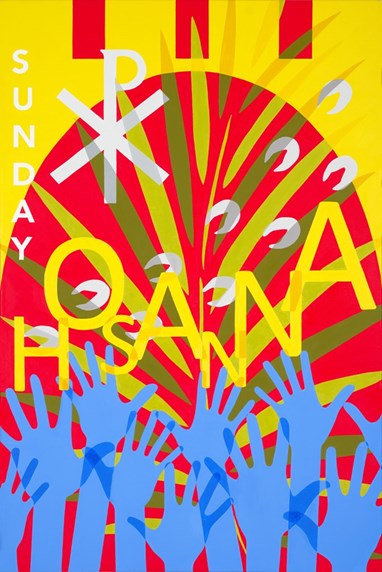 Palm Sunday by Alice Carter
Bridging the divide between the secular Easter of fluffy bunnies and chocolate with the agony of the Passion, the artist says: “We’re dealing with a really gory subject. But the thing is, we’re jolly lucky because we’ve lived after Christ; so we know the story. And we know it was gory; so we don’t need to make it too explicit. And so I wanted to try and make it beautiful, even though it has been depicted by lots of artists. I’ve painted a rather beautiful scene with Christ off the cross.
“Easter Sunday is joy, celebration, rebirth, early morning, He rose again on the third day, the Paschal candle, all in gold and white, as these are the liturgical colour worn. The resurrection flag, which has confused a lot of people, because, they’re used to it with the lamb holding the resurrection flag, but I love Piero’s resurrection, where it’s Christ with the resurrection flags.”
Ash Wednesday has a briefer artistic lineage than Easter Day. “Find me a picture that somebody’s painted of Ash Wednesday. It’s a bit rarer,” the artist says. She represents Ash Wednesday with a barren desert scene, with yellow light symbolising God’s love.
When the artist turns to 20th-century American artists, her homage to them in “Ashes to Fire” is very clear.
“I moved on to the Americans, the ’30s and ’40s artists Charles Demuth and Georgia O’Keefe. Demuth, in particular, painted portraits of people that weren’t portraits of somebody you’d recognise. They were attributes of that person, things to do with them. He painted his friend, William Carlos Williams, the poet. I saw this picture in the Met, and I was like ‘Wow, I can read so much into this.’
“Also, it’s full of movement, even though it’s a flat surface. I wondered if I could tell stories in a similar manner: invite people in to look at something before they necessarily realise it is deeply personal and based on my faith.”
Admirers of Deluth will be struck by the echoes of his I Saw the Figure 5 in Gold (1928), in Mrs Carter’s Ascension Thursday. In both works yellow gold numerals are centre-stage, against a graphically patterned sunray background.
“My work is conveying forty days after Easter, with the text ‘DISCIPLES’ weaving in and out of the fish-net, and the olives at the base.”
For Pentecost Sunday: “There’s tongue of fire, 12 of them, for the twelve apostles, speaking in different languages. The green background is because from here on in, we’re in ordinary time until the next festival, the period when green is worn.”
Summing up the fusion of figuration, text and non-figurative pattern making in her work the artist says: “Nothing is there by accident. I’m obsessive about these tiny little details that people might say, ‘Why did you bother doing that?’ But all the way through life, you have to be as true as you can. And if I knew I’d cut corners, I’m not doing the best I can. And one never feels one’s ever going to make something that’s brilliant, but you can give it a really good try.”
LIVING north of Brighton, the artist is deeply attached to the local Downs landscape. “I love to walk, and I love to pray, and that’s where I focus my attention.”
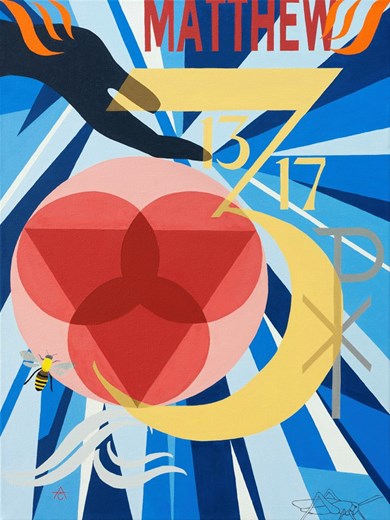 Jesus’s Baptism by Alice Carter
Expanding on her faith, she says: “I am a Catholic, born a Catholic, brought up a Catholic. And there’s the most wonderful Augustinian convent near Burgess Hill, St George’s, but it’s clubbed together with a big community associated with schools; so that’s where I go.
“Or I have a great friend who runs St Patrick’s, in Soho Square. He feeds thousands of homeless people, and he’s a wonderful man. So I go there quite a bit, too. But we just love going to church. We love religious art. We love travelling and going to church.”
The artist’s road accident and lengthy subsequent recovery brought a new dimension to her faith. “I will never forget waking up, thinking: ‘Oh, my goodness, I’m alive. I am so lucky to be alive.’ I cannot believe I didn’t realise before that life is a gift. And I now need to live each day as if I’m very lucky to have been given this day.
“So, from that moment on, my faith was a lot stronger. I felt I needed the discipline of going to church, where you feel you’re doing a tiny bit of something rather than just taking. And I set off on a walk, which then became a pilgrimage, which then became a foundation for how to lead life from thereon in.
“People would say ‘Are you really religious? Do you believe in God?’ And I would say: ‘There is no way I would have walked for three months if I hadn’t believed someone else was going get me there.’”
“Ashes to Fire” runs in Chichester Cathedral until 24 May