(LifeSiteNews) — In an interview with Diane Montagna on January 20, 2026, Bishop Athanasius Schneider draws attention to some historical facts about the liturgical reform after the Second Vatican Council, which most bishops and cardinals ignore or are no longer aware of:
The liturgical constitution Sacrosanctum concilium was adopted on December 4, 1963, and provided guidelines for the reform of the Mass and other liturgical rites. It contained theological and pastoral principles. The actual implementation was entrusted to the Pontifical Commission (Consilium ad exsequendam Constitutionem de Sacra Liturgia). On January 27, 1965, a revised form of the order of Mass was published under the direction of the Consilium: Ordo Missae. Ritus servandus in celebratione missae … Editio typica 1965. This Ordo Missae legally replaced parts of the Missale Romanum of 1962 and introduced the first changes.
In October 1967, an experimental new Mass (“Missa normativa“) was celebrated in Rome, which had been decided upon by the commission. It was another draft that no longer only slightly modified the 1962 rite. This version was presented by Annibale Bugnini, the secretary of the commission, to the first post-conciliar synod of bishops, but met with divided opinions:
- About 71 bishops voted in favor (“placet”)
- 43 were against (“non placet”)
- 62 saw it only as a basis for discussion
In other words, this draft was not accepted as binding. It can be said that the majority of the synod fathers rejected the “Missa normativa” in this form and did not give a clear mandate to adopt or pursue this version (several were against it or wanted changes). Nevertheless, the process was not stopped; work on the new missal continued despite the divided response. Over several years, the texts and structure were revised, with the participation of Pope Paul VI himself. On April 3, 1969, the new missal was promulgated by the apostolic constitution Missale Romanum and was bindingly introduced on the first Sunday of Advent (November 30, 1969). This 1969 missal is the so-called Mass according to Paul VI (in ecclesiastical parlance, the “Novus Ordo Missae”). It differs considerably from the editio typica of 1965, which was already celebrated by the Council Fathers and met with no opposition among them. The change in the direction of celebration [ad orientem vs. versus populum] and the people’s altar were not envisaged by the Council.
To summarize:
- 1965: A revised Ordo Missae was published – a transitional version of the old Mass based on the initial impulses of the Council.
- 1967: There was an experimental draft (“Missa normativa“), which was not confirmed.
- 1969: The new missal (Missale Romanum) was promulgated, known today as the Mass according to Paul VI (often called “Novus Ordo Missae”). It implements changes that were rejected by a majority of the Synod of Bishops in 1967.
As then-Fr. Josef Ratzinger soberly noted in the mid-1970s, the Novus Ordo Missae of 1969 contains breaks with tradition rather than organic development. Bishop Athanasius Schneider quotes from his letter (1976) to Prof. Wolfgang Waldstein:
The problem with the new Missal, on the other hand, is that it breaks with this continuous history that had always continued before and after Pius V and creates a completely new book, the appearance of which is accompanied by a type of prohibition of the previous one that is completely foreign to ecclesiastical legal and liturgical history. From my knowledge of the Council debates and from rereading the speeches given by the Council Fathers at that time, I can say with certainty that this was not the intention.
In contrast, we read in SC 23: “No innovations are to be introduced unless a real and certain benefit to the Church requires it. Care must be taken to ensure that the new forms grow organically out of the existing ones” (Sacrosanctum Concilium, No. 23).
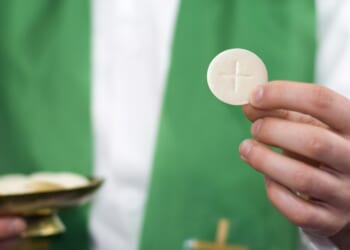
The next consistory of cardinals, expected in June of this year, should address these historical details with honesty and appropriate knowledge and reflect on the liturgical reform. The loss of the sacredness and verticality of the liturgy in many churches, the lack of centrality of God and the dominance of the congregation, a certain trivialization of the sacred, of the liturgical space and of the liturgical vestments (or the absence of such, e.g., during the distribution of Holy Communion), the marginalization of the tabernacle, the one-sided emphasis on the meal character and the congregation as the subject of the liturgy: all this needs to be reconsidered! The author Martin Mosebach spoke eloquently of a “heresy of formlessness” in the Novus Ordo – and that is what it is in many places. The behaviors that can be observed everywhere reflect this.
Every bishop has sufficient insight into this matter in his own diocese (cf. thematic patchwork liturgies, the focus of which is ourselves rather than God or Christ). The path to healing lies in correct diagnosis and recognition of the illness.
Pope Leo XIV would be well advised to first bring the cardinals up to the necessary level of historical knowledge before the upcoming consistory, which will address the liturgical question, before they discuss matters whose origins they know too little about in detail. These details, however, are extremely revealing: This includes the role of Bugnini and the Protestant influence in the redesign of the Novus Ordo with a view to ecumenical harmonization (cf. the sanctuary in the parish of Heilig Geist, Zurich-Höngg, where the so-called table of the word stands next to the so-called table of bread on the altar island, but no longer an altar).
Bishop Athanasius also points out that SC 4 advocated the equality of the rites established in the Catholic Church: “Faithful to tradition, the Holy Council finally declares that Holy Mother Church recognizes all legally recognized rites as having equal rights and equal honor. It is her will that these rites be preserved and promoted in every way in the future.”
Let us hope for insight from the Pope and the cardinals. In Rome, they have been listening for years and are also trimming the universal Church to this. But what exactly they are hearing remains unclear. In burning questions, it is still not known which direction things are going.