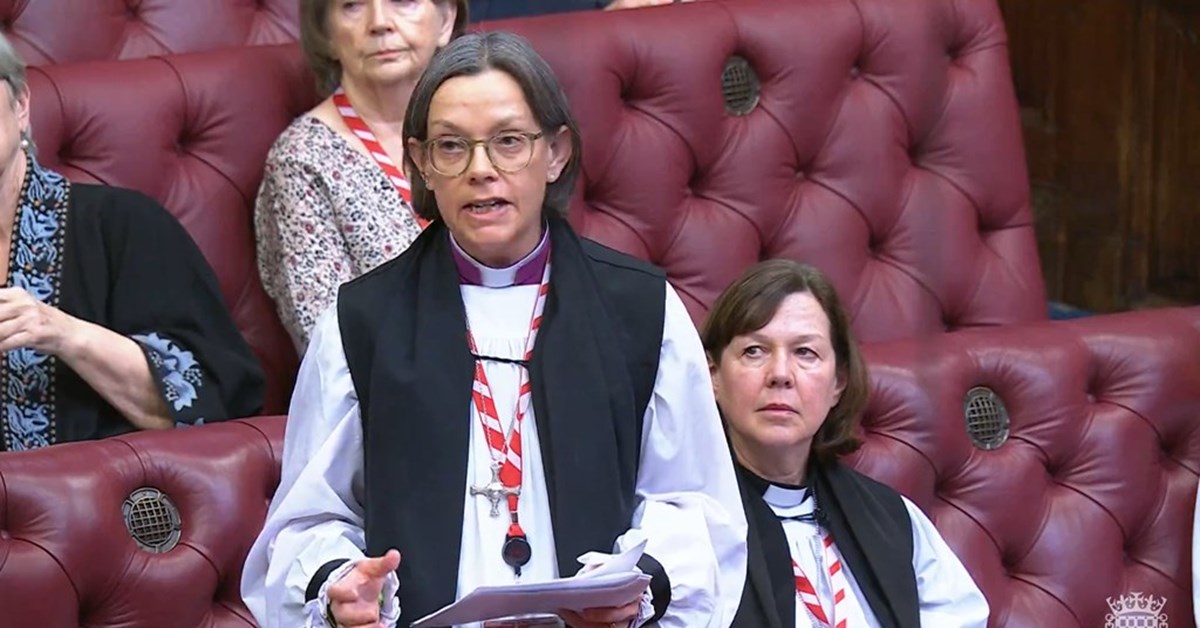
THE Bishop of Newcastle, Dr Helen-Ann Hartley, expressed concern on Friday for those with “additional vulnerability to coercion” when it comes to assisted dying — “especially due to cultural and religious factors”.
Addressing peers as they continued to debate the Terminally Ill Adults (End of Life) Bill in the House of Lords, Dr Hartley said: “It is often those who are subject to health inequalities who hold the most distrust towards the health service, and understandably so since we are still in the shadow, even now, of the pandemic.”
Dr Hartley, and the Bishop of Southwark, the Rt Revd Christopher Chessun, were speaking in favour of a series of amendments aimed at providing assistance to people with disabilities, and those, especially women, who may face coercion.
Bishop Chessun said: “My experience of more than 40 years of ordained ministry is that there are those who purport to represent a religious or cultural identity, and do so for less than an individual’s best interests.” He continued: “Should the Bill become law, it will make the vulnerable more vulnerable as it currently stands.”
Dr Hartley thanked Bishop Chessun for preparing the way for some of the comments she wished to make. She continued: “Amendments 171A and 174A in the name of . . . [Baroness] Nicholson [Liberal Democrat] would require the provision of an advocate for women who might have additional vulnerability to coercion, especially due to cultural and religious factors.
“It is a very interesting and significant idea, which highlights the complex factors at play in considering certain groups of people.”
Baroness Grey-Thompson (Crossbench), a former Paralympic wheelchair racer, spoke out for those with “intellectual disabilities or autism spectrum disorders”.
The peer, one of those, including Baroness Nicholson, whose amendments were being debated, said: “People with learning disabilities have internalised the message that they are not as important as others, and are likely to hear the raising of the question as a suggestion that this might be the right thing to do. It becomes normalised, and it becomes ‘when’, not ‘if’.
“We know that health is not a level playing-field for people with learning disabilities. Disabled people frequently have to fight to get the same treatment for health issues as non-disabled people, so there are real worries in this.”
Lord Falconer (Labour), who is sponsoring the Bill in the House of Lords, rejected the amendments as unnecessary.
He said: “First, in her Amendment 168. . . [Baroness] Grey-Thompson, states that everybody should have an independent advocate right from the start. No, I do not think that that is right. An independent advocate should be restricted to those who are qualifying persons, because that is what the role is trying to deal with.
“Amendment 300 says there should be an advocate for disabled people. . . Again, I say no. The purpose of the independent advocate is to help somebody who has an understanding difficulty or a mental health problem. We have therefore restricted entitlement to an independent advocate to the specific group of people who have an understanding difficulty.”
The debate took place on the same day as more than a dozen terminally ill and bereaved people protested outside Parliament in favour of assisted dying. They were joined by Kim Leadbeater, the Labour MP who sponsored the Bill in the House of Commons, where it was passed last June. She said on Friday: “The irony of the Lords signing its own death warrant on this really important issue is not lost on me and isn’t lost on the public, many of whom are extremely angry because there is huge public support for this change in law.”
Lord Falconer said that he was “deeply disappointed” over the way a minority of peers had used what he called “procedural shenanigans” in an attempt to block the Bill. “The issues should be debated and then we should vote on them, but that’s not what’s happened. It’s absolutely appalling.”