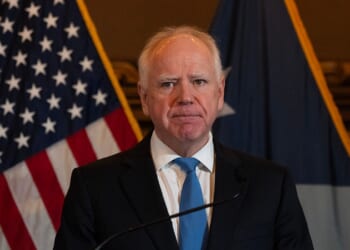
In January, Minnesota governor and recent Democratic vice presidential nominee Tim Walz announced that he would not be seeking reelection. Walz’s surprise announcement came in the wake of escalating attention on health care fraud in the state, much of it tied to Somali immigrants. The Trump administration had targeted Walz rhetorically and threatened to cut off health care funding for the state. “I don’t think any governor in history has had to fight a war against the federal government every single day,” Walz said.
Perhaps Walz should have spent more time fighting the war on fraud and misuse of federal funds. The prior month, Assistant U.S. Attorney Joe Thompson revealed in an indictment that since 2018, at least half of the roughly $18 billion in federal funds meant to support a collection of state-run programs had been used fraudulently. “The magnitude cannot be overstated,” Thompson said in December. “What we see in Minnesota is not a handful of bad actors committing crimes. It’s staggering, industrial-scale fraud.” And it happened on Walz’s watch.
Yet Walz’s negligence was hardly remarkable. Health care fraud is an all-too-common feature of the U.S. health care system—not only in Minnesota, and not only through Medicaid. Neither Democrats nor Republicans appear intent on fixing it.
Much of the coverage of the Minnesota fraud focused on the ethnic background of the perpetrators. The alleged fraudsters were disproportionately of Somali background and part of Minnesota’s distinctive Somali immigrant community. A White House release on the issue noted that 78 of the 86 individuals so far charged in the scheme were Somali.
The statement then declared that President Donald Trump was “taking action” by “terminating Temporary Protected Status for Somalis, indefinitely halting migration from third-world countries, reexamining green cards for every alien from every country of concern, pausing all asylum decisions, and more.” The Trump administration wanted to treat the fraud primarily as an immigration problem.
It’s not. Fraud and abuse are persistent throughout the U.S. health care system.
Shortly before the scandal began to make national headlines, the Government Accountability Office (GAO) released a report on fraud in the Affordable Care Act, otherwise known as Obamacare. The report focused on the program’s “premium tax credit,” essentially a federal subsidy for buying heavily regulated health insurance through government-run online marketplaces. For 2024 and 2025, GAO investigators created fictitious accounts and used them to apply for the tax credit. Of the 24 fake accounts created, 22 were approved for and received subsidies, costing the government more than $10,000 a month.
That figure is just a fraction of the true scale of the likely fraud the GAO report estimates in the program: The report found $21 billion in “unreconciled” premium tax credits. Not all of that amount is certain to be fraudulent, but given the ease of fraud, much of it likely is.
Notably, the subsidies were the subject of 2025’s most heated health care debate—a government shutdown in which Democrats demanded that a temporary expansion of the subsidies put in place during the pandemic be made permanent. As House Budget Committee Chairman Jodey Arrington (R–Texas) remarked, the report “exposed the rampant fraud plaguing Democrats’ expanded Obamacare subsidies, which have effectively no eligibility checks, anti-fraud controls, or other basic program integrity measures in place, resulting in billions of wasted tax dollars and increased health care costs.”
These problems are not new. The GAO report found that “fraud risks have persisted since we first reported on this.” That was more than a decade ago, in 2014. And that’s just Obamacare. Even before that, in 2011, the GAO estimated that Medicare—the federal program for seniors—annually made $48 billion in “improper payments,” which was almost certainly an undercount since it overlooked many erroneous payments in the drug program.
A separate GAO report, from 2008, detailed how watchdogs fraudulently billed Medicare after creating fake names and bank accounts and completing a cursory application process. The GAO agents even used a phone number inside the GAO office building for their application. They were approved anyway.
None of this was a result of lax immigration policy. Rather, it was a product of loose, bordering on nonexistent, spending controls on federal health care programs, in which the fundamental goal is to pay quickly and—maybe—ask verification questions later. Industrial-scale fraud is a feature of poorly designed, poorly run, bloated government health care programs. Walz was just the latest in a long line of politicians who allowed rampant misspending to persist.
This article originally appeared in print under the headline “Minnesota’s Fraud Scandal Isn’t About Immigration.”